
What the July 2026 WMO Dust Bulletin Shows
As of July 2026, the WMO Airborne Dust Bulletin No. 10, published on July 10, reports that global average annual mean dust surface concentrations in 2025 were broadly similar to 2024, with substantial regional variation. North Africa and the Middle East experienced major intrusions, China recorded its worst dust intrusion in a decade, and the U.S.–Mexico border region experienced exceptionally frequent, intense and prolonged events.
Sand and dust can reduce visibility and disrupt transport, aviation, economic activity and energy systems. WMO continues to emphasize monitoring, forecasting and international early-warning cooperation. Global averages do not describe every region, and severity varies by location, event and time. This report provides product-planning context, not a product endorsement or a prediction for a specific market. Official warnings, workplace procedures and local visibility restrictions take priority. Portable lighting does not make travel or work during a dangerous dust event safe.
How should buyers select a portable light for dust and low visibility?
A dust resistant portable light should be selected by verifying its solid-ingress rating, beam pattern, usable output levels, port protection and maintenance requirements—not by maximum lumens alone. Buyers should read both IP digits because the first addresses solid objects and the second addresses liquids. Particle-related glare can change the usefulness of narrow and broad beams, so low and medium modes should be evaluated in representative conditions. Lens and charging-port cleaning requirements, final-product seals and model-specific test evidence also matter. Official visibility warnings remain controlling, and no portable light guarantees safe movement or work during a hazardous event.
Why More Lumens May Create More Glare
Suspended dust, fog droplets and fine particles can scatter light back toward the user. This near-field reflection may reduce contrast, making nearby particles appear brighter without producing the same improvement at the intended target.
Usable visibility depends on output, beam intensity, beam width, distance, particle density, particle size, moisture, observer position and surrounding surfaces. Under some conditions, increasing output could increase perceived glare. Maximum-lumen data alone cannot describe low-visibility performance.
Three Portable-Lighting Tasks in Low Visibility
01. Directional Observation
A controlled beam can support defined-object checks, equipment identification and signage observation from an authorized position. Buyers should compare hotspot intensity, spill, useful distance, lower modes and lens cleanliness.
A strong hotspot may help some tasks but can also make nearby particles visually prominent. Directional beams do not guarantee safe travel.
02. Close-Range Task Lighting
Maintenance, labels, controls and sheltered work areas may need uniform output with limited glare. Mode spacing, beam angle, mounting stability and reflected light from metal surfaces should be reviewed.
A hands-free headlamp range may support close work, but near-eye particle reflection can be more noticeable.
03. Area Illumination
Broad diffuse output supports tables, sheltered work zones, indoor staging and equipment sorting. Buyers should verify diffuser quality, lower modes, stable placement, ingress protection and charging-port design.
Area lighting supports local tasks. It does not create long-range visibility through a dust storm.
Read Both Digits of an IP Rating
The IEC ingress-protection rating guide explains the enclosure classifications defined through IEC 60529. The first digit addresses access and solid foreign objects, while the second addresses water ingress under specified test conditions. The letter X means a protection level is not stated for that category.
IPX does not mean that a product has zero dust resistance, but it also does not prove dust resistance. IP ratings do not automatically cover smoke, corrosive dust, conductive dust, combustible dust, chemicals or hazardous locations. Port covers, seals, assembly, wear and final-product condition remain relevant.
F5 Case Study: IP64 Area Light and Enclosure Verification
Area-Light Function
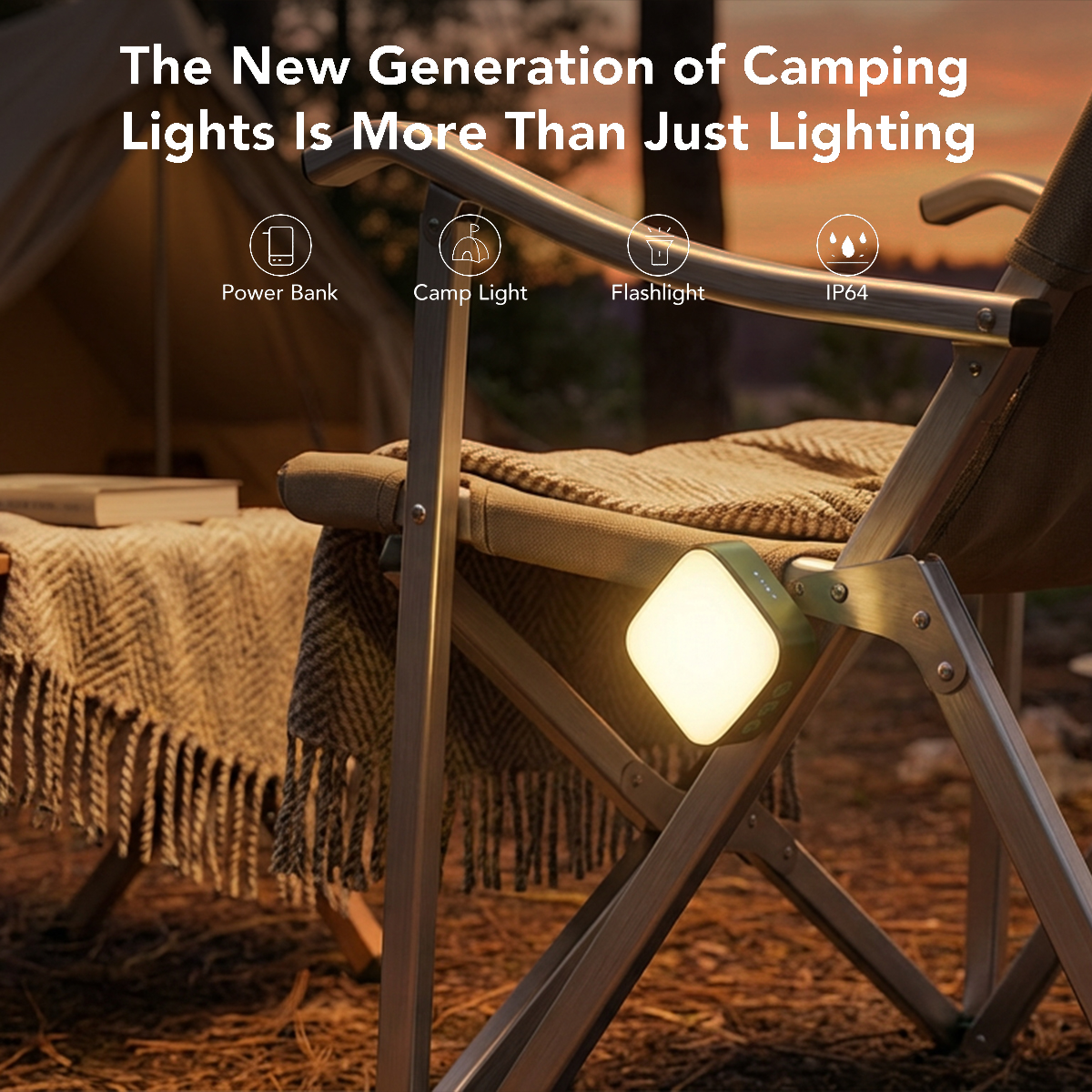
The F5 IP64 rechargeable area lantern is an ABS and PC area light, not a long-range dust-penetrating beam.
It offers 3000K, 4500K and 6000K settings, with three brightness levels under each. The 9–10LM low modes and 120–140LM medium modes provide useful options for evaluating local glare and task-zone illumination.
No color-temperature setting should be described as universally superior in dust or fog. Representative scene testing remains necessary.
Enclosure and Placement
The product specification lists IP64 and 1-meter impact resistance. A magnetic base and integrated hanging hook allow different placements, which can change the angle between the light, airborne particles and the user’s eyes.
Its Type-C input makes port-cover fit, closure consistency, contamination control and cleaning instructions important buyer-verification items.
The current source set does not include the complete IP64 laboratory report. Buyers should request model-specific ingress evidence for the final configuration.
Where Dust Enters a Portable Light
Does Warmer Light Always Work Better in Dust or Fog?
No. Color temperature alone does not determine visibility in dust or fog. CCT describes the visual appearance of white light, while usable visibility also depends on intensity, beam width, particle characteristics, moisture, distance and background contrast.
Warmer light may feel less harsh in some situations, while cooler light may create a different visual impression. Neither outcome should be generalized without controlled comparison. F5 provides 3000K, 4500K and 6000K options, giving buyers a platform for comparative user evaluation.
Portable Light Beam Selection in Low Visibility
| Lighting Format | Beam Character | Appropriate Task | Potential Low-Visibility Issue | Buyer Verification Point | Product Example |
|---|---|---|---|---|---|
| Directional Handheld | Concentrated beam with controlled spill | Defined-object observation | Nearby particles may become prominent | Hotspot, spill and output levels | Review the directional handheld flashlight range |
| Headlamp | Beam close to the line of sight | Hands-free close work | Near-eye reflection may be noticeable | Beam angle, low modes and position | Format-specific evaluation |
| Area Lantern | Broad diffuse output | Local task-zone illumination | Not intended for long-range visibility | Diffuser, modes, placement and IP | F5 |
The table describes lighting roles, not safety approval for travel or work during a dust storm. Detailed reflector and lens definitions are covered separately in the flashlight optical engineering guide.
Maintenance Is Part of Dust Resistance
Dust should be removed according to product instructions, with the light powered off for routine external cleaning. Charging ports should be clean and dry before connection, and lens surfaces should be maintained using non-abrasive, manufacturer-approved methods.
Inspect seals and port covers for visible wear, keep storage cases clean and do not open the product beyond user-serviceable instructions. A damaged seal or cover may compromise the intended protection level. Industrial, conductive, combustible or contaminated dust requires workplace-specific procedures and appropriately certified equipment.
What Buyers Should Test Before Approving a Dust-Exposed Light
B2B Dust-Exposure Lighting Checklist
B2B buyers should not approve a dust resistant portable light based only on maximum lumens, a vague “weatherproof” label or an IP rating with an unspecified solid-ingress digit.
How SHENGQI LIGHTING Supports Dust-Exposure Product Development
For dust-exposure portable-light projects, custom portable-light development can coordinate beam distribution, enclosure design, charging-port protection, switch structure, seals, output spacing, maintenance instructions and model-specific verification.
Relevant capabilities include Optical Engineering Design, Electronic Design, Lumen Testing, Water Resistance Testing, Button Testing and production quality control. Buyers can review SHENGQI’s portable-light testing and quality control approach.
Manufacturing resources include 75 CNC machines and eleven dust-free assembly lines. SHENGQI LIGHTING operates under an ISO9001 quality management system. These capabilities support development and repeatability but do not prove that every model has completed solid-ingress testing.
Frequently Asked Questions
1. What makes a portable light dust resistant?
Dust resistance depends on the enclosure, seals, ports, switches and other interfaces, supported by a complete IP marking or separate evidence. Buyers should verify that the test documentation matches the model and final configuration rather than relying on general housing descriptions.
2. Does a higher-lumen flashlight work better in dust or fog?
No. Higher output may illuminate nearby particles and increase glare. Usable visibility depends on beam pattern, intensity, particle conditions, distance and background contrast. Buyers should compare several output levels instead of judging performance by peak lumens alone.
3. What does the first digit in an IP rating mean?
The first digit describes protection against access and solid foreign objects under applicable IEC 60529 test conditions. A rating of 6 identifies the highest listed solid-ingress classification, but real-world suitability still depends on final configuration, condition and maintenance.
4. Is an IPX5 or IPX6 flashlight proven to be dust resistant?
No dust classification can be inferred from the X alone. IPX5 and IPX6 state liquid-ingress performance but do not declare a solid-ingress level. Separate model-specific evidence is necessary before describing the product as dust-tight.
5. Does warmer light always improve visibility in dust?
No. CCT alone does not determine low-visibility performance. Beam intensity, width, moisture, particle size, distance and contrast also affect the result. Product teams should compare intended beam and color-temperature combinations under controlled, representative conditions.
6. What should B2B buyers verify before sourcing lights for dusty environments?
Verify the exact IP code, applicable report, final SKU, beam pattern, output spacing, port-cover design, seal durability, cleaning instructions, hazardous-dust limitations and production consistency. Generic weatherproof language is not a substitute for model-specific evidence.
Develop Portable Lighting Around Beam and Enclosure Evidence
Industrial tool brands, outdoor companies, maintenance-equipment suppliers, hardware retailers, facility-safety teams and sourcing managers can discuss beam-pattern planning, area-light diffusion, enclosure structures, ports, switches, seals, output modes and ingress-test preparation.
Contact SHENGQI LIGHTING for an OEM/ODM technical evaluation at sales@shengqilight.com.
Portable lighting does not make travel, driving or work during a hazardous dust or low-visibility event safe. Follow official warnings and workplace procedures.