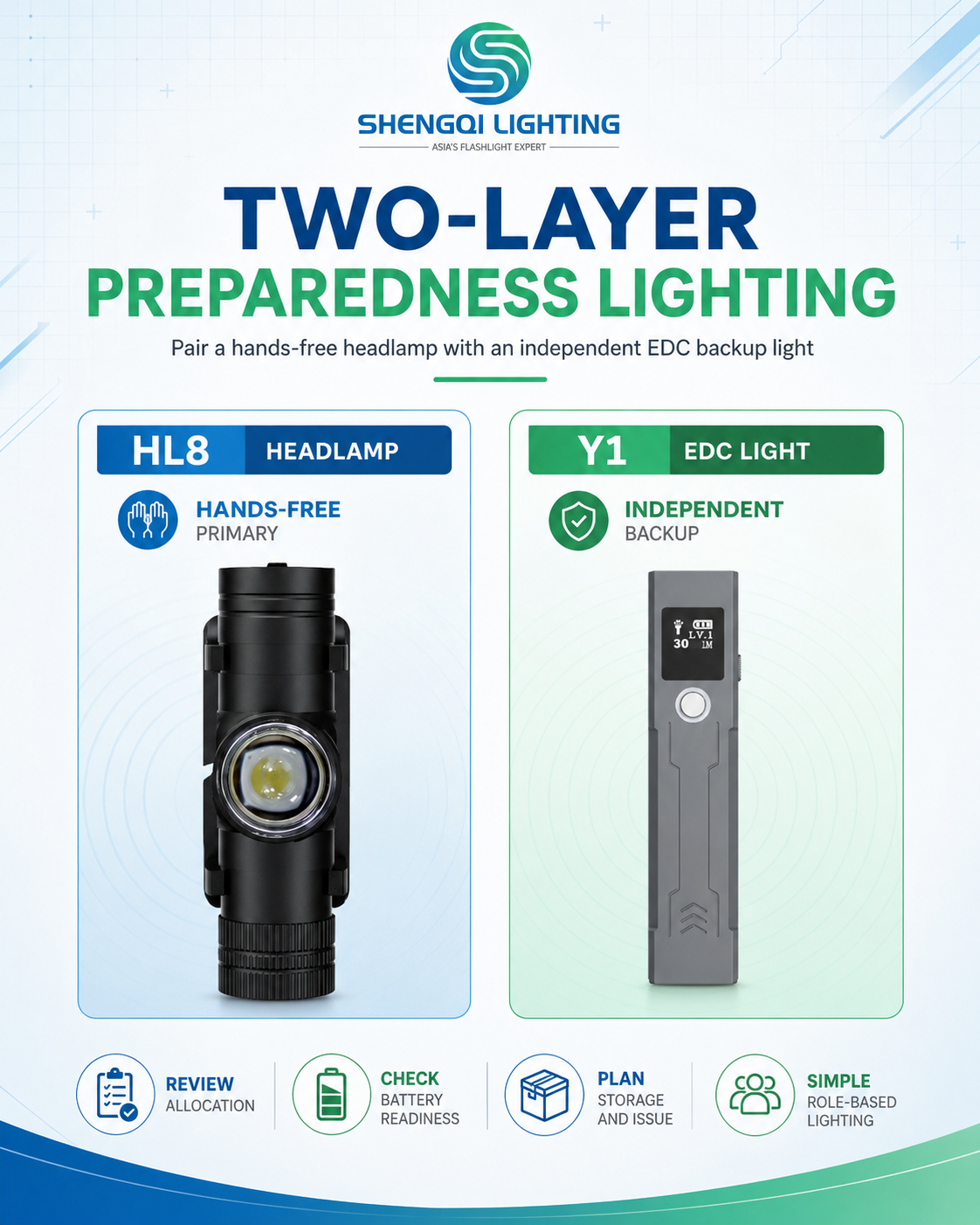

Preparedness Month Is a Useful Procurement Review Point
September provides a practical review window for organizations to examine stored emergency supplies, portable-light availability, battery condition, equipment ownership, allocation and instructions. It should be treated as a procurement and operations checkpoint—not as a requirement to purchase a particular flashlight format.
Six Questions for a September Lighting Audit
- How many portable lights are actually available?
- Where are they stored?
- Who is responsible for them?
- Are batteries charged or serviceable?
- Can occasional users understand the controls?
- Does each product have a defined operational role?
Use a Two-Layer Portable Lighting Model
Redundancy can come from different physical form, separate storage, independent battery, independent user assignment or different operational role. It does not mean every characteristic must be different. Two identical products in the same cabinet using the same unavailable charger may provide less independence than the inventory count suggests.
The procurement decision is a balance between standardization and independence. Standardization can simplify training and spares; independence can reduce shared points of failure.
What Should the Headlamp Layer Do?
The headlamp layer primarily solves hands-free work: movement through a facility, handling supplies, equipment setup, inspection, maintenance and temporary tasks where both hands need to remain available. Institutional buyers comparing headlamp product platforms should look beyond maximum lumens to fit, headband architecture, weight, beam direction, controls, battery workflow, charging, angle adjustment and sensors where relevant.
HF08 is one lightweight architecture reference: a 5W LED, maximum output of 240LM, 1200mAh polymer battery, 32g weight including battery, 180° angle adjustment, Type-C charging and inductive operation. HL10 illustrates a different architecture with 1250LM / 500LM / 350LM steady main modes, a 16340 650mAh Li-ion battery, detachable headlamp/handheld structure and magnetic tail. These are platform examples, not emergency approvals.
Why the Backup Light Should Be Independent
An EDC backup can support pocket carry, quick inspection, lending to another user and continued availability while the headlamp is charging, being inspected or temporarily unavailable. Different format means different workflow; the handheld backup is not assumed to replace the headlamp's hands-free role.
G8 represents a compact architecture with 6061-T6 aluminum, OSRAM P8, 400LM Turbo, 180LM High, 50LM Medium, 20LM Low and 2LM Moon modes, a 290mAh lithium battery, φ30 × 64mm dimensions, 32g weight and a listed maximum range of 40m. Y1 represents a larger multifunction platform with a flat 6063 aluminum body, white light, UV, side light, magnetic tail, built-in 1000mAh battery and 700 / 400 / 200 / 30 / 10LM main-light levels.
Simple Compact Backup vs Multi-Function EDC Backup
| Decision | Simple Compact Backup | Multi-Function EDC Backup |
|---|---|---|
| Size | Can prioritize compact carry | May require more body volume |
| UI | Potentially simpler | More functions may add control steps |
| Functions | Primary handheld lighting role | Can support additional inspection roles |
| Training | Potentially lower instruction burden | Functions must be explained |
| Issue Complexity | Role can remain narrow | Role should justify additional features |
The better architecture depends on organizational role. Buyers can compare broader EDC flashlight platforms before defining the backup role.
Allocate Lights by Role, Not by Headcount Alone
One light per person is not automatically the right allocation model. Organizations may use individually issued equipment, shared emergency kits, department kits, vehicle kits, maintenance kits or facility cabinets. Start with Role → Quantity → Location → Owner.
| Role | Primary Light | Backup Light | Storage | Issue Method |
|---|---|---|---|---|
| Facility Maintenance | Hands-free task light | Handheld inspection backup | Maintenance area | Individual or team issue |
| Warehouse Team | Hands-free movement / handling | Quick handheld inspection | Department storage | Role-based issue |
| Field Service | Hands-free work layer | Independent pocket backup | Vehicle / field kit | Assigned asset |
| Shared Emergency Kit | Task-defined headlamp | Separate handheld backup | Defined cabinet / kit | Controlled checkout |
This is an example allocation framework, not an official staffing standard.
Numbering and Issue Control Are Part of the Procurement Plan
A bulk program may need an asset number, kit number, department label, color code or packaging code. If private-label branding and asset identification must share the product surface, reserve that space during design rather than after production.
Printing, laser marking, labels and packaging codes can each work depending on surface, wear, readability, replacement process and quantity. Laser marking is not universally best. The identification method should support both physical durability and the organization's replacement workflow.
Battery Strategy Must Cover Storage, Charging and Replacement
Battery planning should answer more than capacity. Is the battery integrated or removable? Who charges the unit? Where are chargers or cables stored? Are spares required? How is charge state checked? What happens after long storage? Are there transport requirements?
There is no universal best strategy. Larger mAh also does not automatically mean a better preparedness light; operating mode, battery condition, storage, charging, driver behavior and product role all affect usefulness.
A Stored Flashlight Is Still an Asset That Needs Rotation
Stored equipment can become unavailable through battery depletion, missing cables, relocation, visible damage, missing accessories or unknown inspection history. Rotation should therefore be part of the asset-management process rather than waiting for an incident to reveal the problem.
| Asset ID | Storage Location | Last Check | Battery / Charge Status | Visible Damage | Accessories | Next Review |
|---|---|---|---|---|---|---|
| Example | Defined by organization | Recorded date | Recorded status | Check result | Complete / missing | Organization-defined |
Simple Instructions Matter More When Equipment Is Stored for Months
A regular EDC user may remember double-click, long-press, lockout and mode memory. A person opening a shared kit after months of non-use may not. Institutional instructions should prioritize: Turn On, Normal Working Mode, Charge or Replace Battery, Lockout if applicable, Indicator Meaning and Return to Storage.
Design the Deployment Workflow Before the Kit Is Packed
STORE → CHECK → ISSUE → USE → RECOVER → RESTORE
Store
Place equipment in a defined location with a responsible owner.
Check
Confirm battery or charge status, function and completeness.
Issue
Define who receives the headlamp, backup light or shared kit.
Use
Deploy each light according to its operational role.
Recover
Collect issued equipment and record loss or damage.
Restore
Recharge or replace batteries, replace missing accessories, update records and return equipment to storage.
Four Existing Platforms Show Why One Specification Cannot Cover Every Role
| Platform | Architecture | Verified Reference | Possible Procurement Role | Question to Validate |
|---|---|---|---|---|
| HF08 | Lightweight rechargeable headlamp | 240LM max, 1200mAh, 32g, 180° adjustment | Hands-free lightweight layer | Does fit, UI and battery workflow suit the team? |
| HL10 | Detachable headlamp / handheld | 1250 / 500 / 350LM, 16340 650mAh, magnetic tail | Convertible hands-free layer | Does detachability support the real workflow? |
| G8 | Compact handheld backup | 400LM Turbo, 290mAh, 32g | Compact independent backup | Is the UI simple enough for occasional users? |
| Y1 | Flat multifunction EDC | White / UV / side light, 1000mAh battery | Backup plus inspection functions | Does the organization actually need the extra functions? |
These are architecture references, not emergency certifications. Buyers can review the broader portable lighting product range when mapping roles.
Institutional Preparedness Lighting Procurement Matrix
| Decision Area | Headlamp Question | EDC Backup Question | Bulk Program Requirement |
|---|---|---|---|
| 1. Primary Role | Which hands-free tasks? | Which independent backup tasks? | Document role ownership |
| 2. User | Who wears it? | Who carries or receives it? | Define issue population |
| 3. Beam | Useful work illumination? | Useful inspection beam? | Validate by task |
| 4. Carry | Fit and stability? | Pocket or kit access? | Define storage state |
| 5. Controls | Usable while worn? | Fast access? | Instruction standard |
| 6. Battery | Integrated or removable? | Independent or standardized? | Battery policy |
| 7. Charging | Where and by whom? | Same or separate workflow? | Accessory control |
| 8. Identification | Asset marking space? | Asset marking space? | ID method and records |
| 9. Storage | Where stored? | Stored separately? | Location ownership |
| 10. Instructions | Essential UI? | Essential UI? | Simple instruction card |
| 11. Maintenance | Fit, battery, function? | Battery, function, location? | Organization-defined review |
| 12. Validation | Does it perform the primary role? | Does it remain an independent backup? | System-level approval |
Validate the Pair as a System Before Bulk Approval
Headlamp: validate fit, beam, angle adjustment, controls and power workflow.
EDC: validate carry, controls, beam, battery and quick access.
System: validate issue workflow, redundancy, charging, labeling, instructions and storage. Two lights that both turn on do not prove that the kit works operationally.
System Failure Review
- What happens if the primary headlamp is discharged?
- What happens if the charging cable is unavailable?
- What happens if one employee takes the wrong unit?
- What happens if the backup light has been moved?
- What happens if the operator does not remember the UI?
The purpose is to identify single points of failure before bulk deployment.
For OEM/ODM Programs, Specify the System Before Styling the Package
For institutional programs requiring private-label configuration or differentiated headlamp and EDC roles, SHENGQI can support platform review and OEM/ODM product development around the buyer's application, labeling, packaging and verification requirements. The brief should begin with system requirements rather than asking only for the brightest available flashlight.
What to Include in an Institutional Lighting RFQ
- Organization / Channel
- Target Market
- Headlamp Role
- EDC Backup Role
- Estimated Quantity
- Power / Charging Preference
- Branding
- Asset Identification
- Packaging / Instructions
- Target Timeline
What Should the Supplier Return After Reviewing the RFQ?
The response should clarify Platform Options, Technical Questions, Configuration Differences, Open Risks, Sample Plan, Verification Direction, Packaging Questions and Commercial Assumptions. A useful supplier response should clarify the system, not merely send a catalog.
Where a program proceeds into development, Industrial Design, Optical Engineering, Electronic Design, PCB Layout, Packaging Design, Manufacturing, Testing and Quality Control may all become relevant. SHENGQI's approximately 130,000 sq ft facility, 75 CNC machines and automated SMT capability support manufacturing capacity, but those resources do not constitute emergency certification. Buyers can review relevant flashlight manufacturing capabilities separately from product-specific evidence.
For a buyer comparing an emergency kit headlamp supplier, the stronger sourcing question is whether the supplier can help define and reproduce the intended lighting system—not simply whether a catalog contains a headlamp and a flashlight.
Portable Lighting Has Clear Boundaries
A headlamp plus an EDC backup can improve portable-light availability, but the pair does not replace fixed emergency lighting, legally required building systems, professional rescue lighting, PPE, communication equipment, emergency procedures or medical equipment.
National Preparedness Month does not create a flashlight procurement requirement, product certification or government approval system. Institutional buyers remain responsible for identifying the formal requirements that apply to their facility, industry, jurisdiction and intended use.
Frequently Asked Questions About Institutional Preparedness Lighting
1. Why should an organization issue both a headlamp and an EDC backup light?
Because the formats solve different operational problems. A headlamp provides hands-free illumination for movement, handling and temporary work. An EDC backup provides a separate handheld source that can support inspection, reassignment or primary-light downtime. The objective is functional redundancy, not simply owning two devices. Allocation, battery strategy, storage and issue control should determine how independent the two layers need to be.
2. Is a high-lumen headlamp automatically better for an emergency kit?
No. Maximum lumens describe only one performance dimension. Institutional buyers should also consider fit, weight, beam direction, controls, battery workflow, charging, angle adjustment, useful lower modes and the actual task. A higher-output model can be appropriate for one role while a lighter or simpler architecture may be more suitable for another. The requirement should come from the operational role rather than a single headline specification.
3. Should the headlamp and backup flashlight use the same battery?
No universal best answer exists. Standardizing batteries can simplify spares, charging and training. Using different architectures can provide more independence or allow each product to be optimized for its role, but it can increase inventory complexity. Buyers should compare shared-failure risk, charging logistics, replacement availability and maintenance capability rather than assuming identical batteries always provide the best preparedness strategy.
4. How should bulk emergency lights be identified?
Programs can use asset numbers, department identifiers, kit numbers, color coding, product marking or packaging codes depending on the organization's issue and replacement process. The marking method should be selected around surface, wear, readability and quantity. Where private-label branding and asset IDs share the product body, space for both should be defined before production rather than added after the housing and graphics are already frozen.
5. How often should stored lights be checked?
There is no universal inspection interval that fits every organization and battery architecture. The review frequency should be defined according to the product, battery system, storage environment, supplier guidance and internal asset-management procedures. Each review should confirm location, function, battery or charge status, visible condition and required accessories, with the result recorded so future users can see when the equipment was last verified.
6. Can an EDC light replace a headlamp?
Not automatically. Different format means different workflow. A handheld EDC light can support inspection, temporary backup and reassignment, while a headlamp keeps both hands available. Some convertible products may bridge the two roles, but the organization should test the actual task rather than assume one form factor replaces the other. The goal is to assign the correct operational role to each product.
7. What should B2B buyers test before approving a lighting kit?
Buyers should validate headlamp fit, beam direction, adjustment, controls and power workflow; EDC carry, beam, controls, battery and access; and the combined system's labeling, storage, charging, issue, recovery and instructions. They should also review what happens when a battery is discharged, a unit is moved or an accessory is unavailable. Approval should demonstrate operational usability, not simply that both lights switch on.
8. Can headlamp and EDC platforms be customized for institutional programs?
Yes. An OEM/ODM program can define separate roles, battery strategy, controls, branding, asset identification, packaging and instructions around the institution's intended workflow. Customization should begin with the organization, target market, operational roles, quantity assumptions and deployment process rather than cosmetic changes alone. Product-specific performance, testing and compliance requirements then need to be verified for the final configuration.
Buy Lighting Roles, Not Just Flashlights
The headlamp is the hands-free layer. The EDC light is the independent backup layer. Their preparedness value comes from allocation, storage, battery management, instructions, testing, issue, recovery and restoration—not from the maximum lumen number printed on either specification sheet. Institutional procurement becomes stronger when portable lights are treated as assets inside a managed deployment system rather than as isolated products stored in a cabinet.
Coming Soon: Shengqi Lighting is preparing to introduce a new Compact EDC Flashlight. Full specifications and official product information will be released soon.
Planning a Preparedness Lighting Program?
For the first technical review, prepare your Target Market, Organization / Channel, Headlamp Role, Backup-Light Role, Estimated Quantity, Battery / Charging Preference, Labeling Requirement and Target Timeline.
Review SHENGQI LIGHTING's custom flashlight development capabilities for institutional and private-label programs.
Contact SHENGQI LIGHTING for an OEM/ODM technical evaluation at sales@shengqilight.com.
Contact SHENGQI LIGHTING