
Why Wildfire Evacuation Lighting Matters in 2026
As of July 22, 2026, the latest national update from the National Interagency Fire Center, dated July 21, reported 72 large fires being actively suppressed across the United States. Evacuations, road closures and infrastructure threats were present around multiple incidents.
Emergency-kit guidance from Ready.gov includes a flashlight and extra batteries among basic preparedness supplies. Lighting is especially relevant when evacuation, temporary power loss and nighttime movement occur together.
Current incidents are only a timely reminder. The product-selection principles in this guide are intended to remain useful beyond a specific fire or season. Wildfire conditions and evacuation orders can change rapidly, so readers should follow current instructions from local authorities and official emergency agencies.
What type of flashlight belongs in a wildfire evacuation kit?
A wildfire evacuation kit should include a dependable primary flashlight and may also benefit from a compact personal backup light that is easy to access, offers practical low-output modes and uses an independently maintained power source. The compact light does not replace the primary flashlight or headlamp. Personal lighting access can help household members complete close-range tasks, while rechargeable batteries require regular readiness checks. Runtime, charging instructions and durability claims should be verified, and official evacuation instructions must always take priority over collecting or using lighting equipment.
Why a Primary Flashlight Is Not Enough
A single handheld flashlight can provide useful directional light, but it may be packed inside a bag, used by another person, discharged or unavailable when a short personal task appears.
A practical evacuation kit may include a primary handheld light, a headlamp and a compact personal backup. These products perform separate roles rather than duplicating the same function.
Lighting redundancy should be based on separate roles, not several identical products performing the same task. A compact backup light is most valuable when it is stored where the user can reach it without unpacking the entire evacuation kit.
What Should a Compact Personal Backup Light Do?
A compact personal backup light should prioritize accessibility, simple operation and useful task lighting. Its purpose is not to outperform the primary flashlight in every category.
It may be attached to keys, stored in an exterior bag compartment or carried with personal equipment. The storage position should be secure, consistent and easy to reach.
Useful medium, low and moon modes can support reading labels, checking a backpack, finding keys, reviewing documents and moving through dark indoor spaces. A higher mode can provide brief directional visibility when more light is needed.
Buyers should also evaluate charging instructions, battery condition, carry or attachment testing, water-resistance evidence, impact evidence and packaging language. A compact size or emergency-themed package does not automatically prove that a product is ready for outdoor evacuation use.
Follow evacuation orders immediately. Do not delay evacuation to collect lighting products, enter smoke-filled or restricted areas with a flashlight, or return to an evacuated area before authorities say it is safe. Lighting products are preparedness tools, not fire-protection equipment.
G8 Case Study: A Compact Five-Level Backup-Light Platform
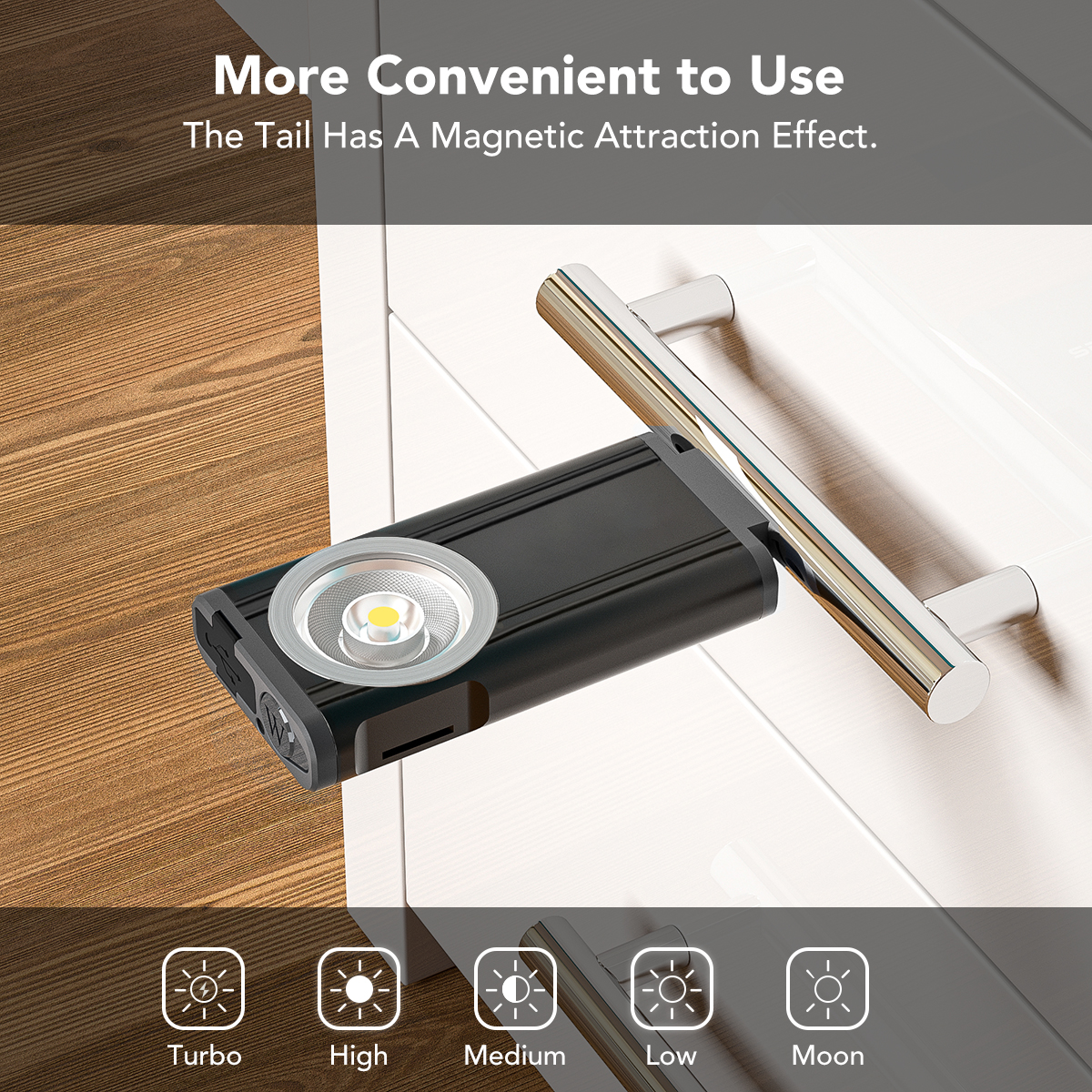
The G8 compact backup flashlight is a mini EDC lighting platform built around an OSRAM P8 LED and five output levels.
Its 400LM Turbo mode provides brief stronger visibility, while 180LM High supports repeated short tasks. The 50LM Medium, 20LM Low and 2LM Moon modes create lower-output options for close work, indoor orientation and document or bag inspection.
The maximum beam distance is 40 meters. This supports a compact personal-lighting role rather than positioning the product as a long-range primary evacuation flashlight.
G8 uses an integrated 3.7V 290mAh lithium battery. A 290mAh capacity figure does not by itself prove runtime. Actual operating time depends on output mode, driver behavior, battery condition, temperature and formal testing.
The body uses 6061 T6 aluminum alloy with a hard-anodized black finish and a 6000K–7000K color temperature. At 64mm in total length and 32g with the battery, the design supports pocket, bag and keychain-oriented personal carry.
No verified IP rating or impact-resistance specification is included in the confirmed information used for this guide. B2B buyers should verify model-specific water-resistance, impact and attachment-test evidence before positioning a compact light for outdoor emergency use.
Why Five Output Levels Matter for Short Emergency Tasks
Useful mode spacing can be more important to a personal backup light than maximum output alone. Each level should correspond to a realistic task.
400LM Turbo
Useful for brief stronger visibility, short directional checks and locating nearby objects. It should not be described as a sustained-output or long-runtime mode.
180LM High
Supports repeated short tasks, checking bags or equipment and general close-to-mid-range personal lighting.
50LM Medium
Fits organizing supplies, reading labels and indoor orientation where maximum output would be unnecessary.
20LM Low
Supports close-range tasks, checking personal items and reducing excessive glare inside a vehicle, room or evacuation bag.
2LM Moon
Can assist with map or document reading, finding objects inside a bag and low-light orientation while preserving night adaptation.
How to Keep a Rechargeable Backup Light Ready
An integrated rechargeable light must be maintained before an evacuation warning occurs. Readiness planning can include checking whether the light turns on, inspecting the body for physical damage, reviewing battery condition and recharging according to approved instructions.
The light should be stored where it can be reached quickly without opening every compartment in the kit. Commercial emergency-kit programs may also record charging and inspection dates to support repeatable maintenance.
Follow the battery and product manufacturer’s approved charging and storage instructions. A fixed inspection interval should not be assumed for every battery, product, organization or region.
A backup charging plan should also be considered because an integrated battery cannot provide unlimited availability during a prolonged outage. The charging interface, charging time, battery-cycle life and standby consumption should be verified before claims are approved.
Primary Flashlight vs Headlamp vs Compact Backup Light
These products perform different roles and should not be judged only by maximum lumens.
| Lighting Role | Primary Strength | Typical Preparedness Task | Main Limitation | Buyer Verification Point |
|---|---|---|---|---|
| Primary Handheld Flashlight | General directional lighting and larger-area checks. | Main kit lighting and route-document review from a safe location. | Occupies one hand and may be shared between users. | Verify output modes, runtime, battery platform and durability evidence. |
| Headlamp | Hands-free illumination. | Carrying supplies, organizing equipment and assisting others. | Battery and beam role may differ from a handheld light. | Verify fit, runtime, water resistance and mode usability. |
| Compact Personal Backup Light | Immediate personal access and independent redundancy. | Keys, bags, labels, documents and short indoor tasks. | Small battery capacity and limited primary-light role. | Verify runtime, charging, attachment, water resistance and impact evidence. |
Buyers can compare primary handheld flashlight options, hands-free emergency lighting and personal backup-light options as separate product roles.
What Should B2B Buyers Verify Before Sourcing a Wildfire Evacuation Light?
B2B buyers should not approve a wildfire evacuation light based only on maximum lumens, compact size or emergency-themed marketing.
What role will the compact light perform in the evacuation kit?
Define whether it is a personal backup, document light or short-task light. It should not be presented as the only evacuation light.
Can users access it without unpacking the entire kit?
Review the carry position and attachment structure. Accessibility is part of the product’s backup-light function.
Are the low and medium modes useful for close-range tasks?
Mode spacing should support bags, labels, documents and indoor orientation rather than focusing only on the maximum output number.
Has runtime been tested for every output mode?
Battery capacity does not prove operating time. Request mode-specific runtime curves and any relevant output-step data.
How is the integrated battery charged and inspected?
Confirm charging interface, charging instructions, battery-condition checks and readiness documentation before approving packaging.
What waterproof, impact and attachment tests support the product claims?
Request model-specific evidence. Do not infer outdoor durability from aluminum construction or compact dimensions alone.
Do instructions explain that the light is backup equipment?
Packaging should distinguish personal lighting from fire-protection, rescue or respiratory equipment and state the product’s limitations clearly.
How SHENGQI LIGHTING Supports Compact Emergency-Lighting Development
For compact emergency-light projects, OEM/ODM portable-lighting support can include Industrial Design, Optical Engineering Design and Electronic Design.
Product development should coordinate body size, output-mode spacing, battery capacity, charging instructions, attachment structure, packaging language and repeatable production testing.
SHENGQI LIGHTING also maintains battery and luminous performance testing capabilities. These company-level resources can support product evaluation without implying that G8 has completed every available test or holds unverified certifications.
Compact aluminum-body manufacturing supports dimensional control and repeatable assembly for pocket and keychain-oriented designs. SHENGQI LIGHTING operates under an ISO9001 quality management system, while final product claims should remain specific to the approved model data and test evidence.
Frequently Asked Questions
1. What type of flashlight belongs in a wildfire evacuation kit?
A kit should include a dependable primary handheld light and may benefit from a headlamp and compact personal backup. Each product should have a defined role, verified runtime and maintained battery plan. Official evacuation instructions always take priority.
2. Why should an evacuation kit include a compact backup light?
A compact light provides personal access when the main flashlight is packed away, discharged or being used by someone else. It can support labels, keys, documents, bags and short indoor tasks without replacing the primary light.
3. Is a 400-lumen keychain flashlight enough for evacuation?
A 400-lumen compact light can support short personal-lighting tasks, but it should not automatically be treated as the only or primary evacuation light. Battery capacity, runtime, durability and the broader lighting system also matter.
4. How often should a rechargeable emergency light be checked?
Inspection frequency should follow the product, battery, organization and local preparedness requirements. Checks may include operation, physical condition, battery readiness and charging records without relying on one universal schedule.
5. What should B2B buyers verify before sourcing a wildfire evacuation flashlight?
Buyers should verify runtime evidence, charging instructions, battery condition requirements, attachment or carry testing, waterproof and impact evidence, output-mode usefulness and packaging language. Emergency claims should remain within the product’s documented role.
Build Evacuation Lighting Around Separate Roles
A wildfire evacuation flashlight plan should not rely on one high-output device. A primary handheld light, hands-free headlamp and compact personal backup provide different forms of access and redundancy.
G8 demonstrates how a 64mm, 32g five-level light can support short personal tasks. Its compact integrated-battery format also shows why charging, inspection, runtime evidence and claim boundaries must be included in product planning.
Lighting can support preparedness, but it does not make smoke, damaged buildings, restricted areas or evacuation routes safe. Follow official instructions and never delay evacuation to retrieve equipment.
Develop Personal Backup Lights Around Verified Evacuation-Kit Requirements
Emergency preparedness brands, evacuation-kit companies, automotive emergency brands, outdoor companies, EDC brands, hardware retailers, distributors, importers, product managers and OEM/ODM sourcing teams can discuss compact backup-light development, keychain flashlight projects, mode-spacing design, battery-capacity planning, aluminum-body design, attachment structure, packaging instructions and testing.
Contact SHENGQI LIGHTING for an OEM/ODM technical evaluation at sales@shengqilight.com.