
What should buyers look for in a lightweight mini headlamp?
Buyers should evaluate a lightweight mini headlamp by its complete worn weight, headband stability, beam-angle adjustment, control logic, white and red light roles, charging workflow and sample-to-production consistency—not peak lumens alone. HF08 lists a 32g product weight, 240LM maximum listed output, 180° vertical adjustment, motion control, white and red light sources and rechargeable architecture. Buyers should still verify runtime, sensor false activation, headband stability and movement performance on the sample. Charging details and long-term adjustment behavior also need project-level review. HF08's currently verified specifications do not establish runtime, beam distance or an IP rating for this article. Batch consistency should therefore be checked against the approved configuration.
Is a 240LM lightweight headlamp suitable for running?
A 240LM lightweight headlamp can be evaluated for general nighttime running and hands-free movement, but suitability depends on sustained output, beam pattern, terrain, speed, runtime, fit and the lighting requirements of the route. Peak lumens alone are insufficient. HF08 beam distance is not confirmed for this article, so road or race compliance should not be assumed. Sample testing should reflect actual movement, terrain and the intended running pace before approval.
Why Headlamp Weight Matters Before Maximum Output
The HF08 lists a 32g product weight. Lower physical mass may reduce front-loaded feel, support compact carry and make movement on the head easier to manage during active tasks.
That does not guarantee comfort. Stability also depends on headband design, fit, head size, movement intensity, sweat, accessory weight and adjustment. A lighter lamp can still slip if the wearing system is poorly matched to the user.
Low product weight is an advantage to evaluate, not a guarantee of comfort.
Running and Field Tasks Create Different Lighting Requirements
Prioritize low weight, stable headband fit, useful beam direction, simple controls, sensor behavior, visibility for the intended terrain and charging readiness.
Prioritize hands-free operation, downward beam adjustment, repeated switching, white/red task separation, battery readiness and mechanical stability.
One configuration may not be equally suitable for every running speed, terrain or professional field task.
Why Beam Direction Can Matter More Than More Lumens
HF08 provides 180-degree vertical angle adjustment. That architecture lets the wearer redirect the light when looking ahead, checking the ground, handling gear or working at close range.
For buyers, the important question is not simply whether the lamp rotates. Samples should be checked for hinge resistance, repeated adjustment, position retention after movement and consistency between units.
Current evidence does not establish hinge-cycle life, so long-term retention should be treated as a sample-verification requirement.
Motion Control Is Useful Only When the Activation Logic Fits the Task
Motion or induction control can be useful when hands are occupied, gear is being handled or repeated button contact is inconvenient. However, a sensor should be evaluated for both intended activation and unintended activation.
Arm movement, nearby objects, another person passing, equipment handling or adjusting the headlamp may create false triggers depending on the final sensor logic.
B2B buyers should therefore test activation distance, activation angle, response consistency, accidental triggering, manual-control behavior and sensor on/off logic on the actual sample rather than assuming a motion sensor is automatically better.
White and Red Light Solve Different Tasks
HF08 includes white and red light sources. White light may support normal movement, gear organization, close field work and general hands-free illumination.
The auxiliary red source can be evaluated for lower-disturbance local lighting or identification-oriented tasks, depending on the final mode and output.
Red-light usefulness depends on actual output, beam pattern and user environment; color alone does not define the application. It should not be treated as a certified road-warning function or as a guarantee of dark-adaptation preservation.
Rechargeable Architecture Needs a Workflow Check
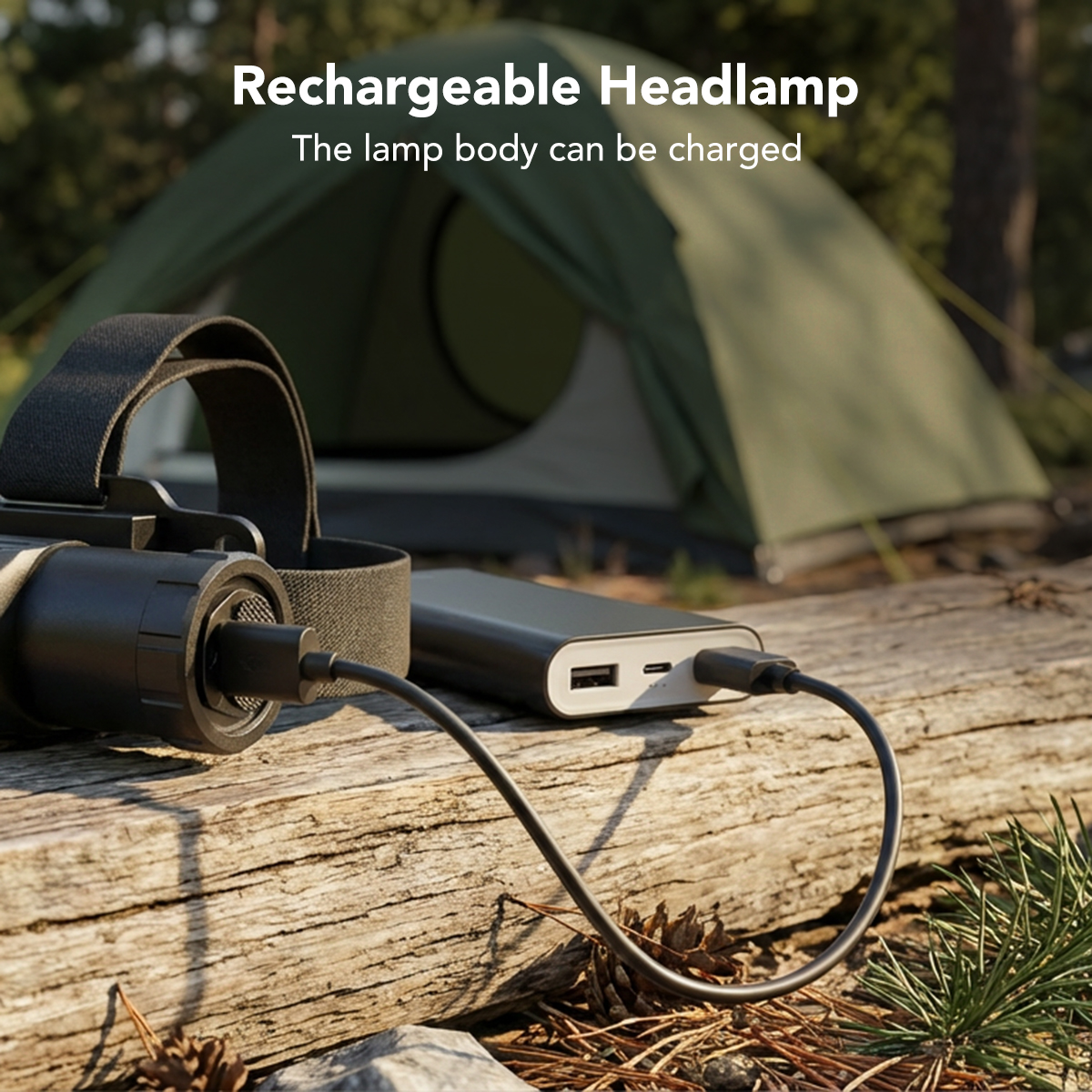
HF08 uses a rechargeable architecture, but “rechargeable” describes the power architecture rather than the complete charging experience.
Buyers should verify the final charging interface, whether a cable is supplied, charging-status indication, charging time, low-battery indication, charging-temperature limits, serviceability and applicable transport documentation.
These items should be confirmed for the final SKU instead of inferred from the rechargeable description alone.
Three Use Cases for a Lightweight Mini Headlamp
Evaluate low weight, headband stability, forward and downward positioning and simple operation during realistic movement.
Hands-free structure, adjustable angle, white/red source roles and rechargeable workflow may support tent setup and equipment organization.
Downward beam positioning and motion-control evaluation may support repeated close work while both hands remain available.
HF08 is used here as a product-architecture example. This article does not certify it for every running, industrial or safety-critical application.
HF08 Case Study: Lightweight Hands-Free Product Architecture
The HF08 lightweight mini headlamp represents a design direction where reduced physical mass, beam-position adjustment, multiple light sources and sensor control are combined in a head-mounted platform.
Verified facts for this article include 240LM maximum listed output, 32g listed weight, 180-degree vertical adjustment, motion or induction control, white and red light sources and rechargeable architecture.
Those features do not establish runtime, beam range, environmental protection, road-safety performance, long-term hinge durability or sensor false-trigger rate. Buyers looking for supplier-oriented information can review the separate HF08 supplier and product overview.
240 Lumens Is a Starting Specification, Not the Whole Headlamp
A 240LM maximum listed output helps define the product category, but it does not show sustained output, runtime, beam distance, beam width, thermal behavior or performance as the battery discharges.
Sample approval should therefore consider mode definition, output measurement, output-over-time behavior, beam pattern and task-specific evaluation.
Lightweight Design Creates Engineering Trade-Offs
Reducing weight can affect battery volume, thermal mass, enclosure space, controls, optics, runtime and mechanical structure. The design objective is not minimum weight at any cost; it is the lowest practical weight that still supports the intended task and verified performance requirements.
HF08 Task-Fit Evaluation Framework
| Task | Useful Verified Feature | Why It May Matter | Unverified Variable | Buyer Test |
|---|---|---|---|---|
| Light Running | 32g + head-mounted format | May support lower front-loaded feel | Headband stability | Movement test |
| Campsite Setup | White/red light + hands-free format | May support different local tasks | Actual mode output | Task-use test |
| Gear Organization | 180° adjustment | Allows directional repositioning | Hinge retention | Repeated adjustment |
| Close Field Task | Motion control + adjustable direction | May reduce repeated button contact | False activation | Sensor test |
| General Backup Carry | Compact lightweight architecture | May support portable storage | Runtime / charging readiness | Workflow review |
Lightweight Headlamp Buyer Verification Matrix
| Buyer Requirement | HF08 Verified Evidence | What It May Support | What Still Needs Verification | Approval Question |
|---|---|---|---|---|
| Maximum output | 240LM listed maximum | General illumination evaluation | Sustained output / beam | Does output fit the task? |
| Weight | 32g listed weight | Lightweight wearing architecture | Complete worn stability | Is the final configuration stable? |
| Beam positioning | 180° vertical adjustment | Directional task positioning | Hinge durability | Does the angle remain set? |
| Control | Motion / induction control | Hands-free activation evaluation | Sensor range / false triggers | Does sensor logic fit the task? |
| Light sources | White and red light | Task-role separation | Actual outputs / modes | Are the modes useful? |
| Power architecture | Rechargeable | Recharge workflow | Interface / time / serviceability | Is charging practical? |
| Runtime | Not currently confirmed | Requires testing | Output over time | Does it meet the target duration? |
| Environmental protection | Not currently confirmed | Project-specific | Applicable evidence | What environment is approved? |
| Sensor range | Not currently confirmed | Requires sample test | Distance / angle | Is activation repeatable? |
| Headband durability | Not currently confirmed | Requires movement testing | Stretch / retention | Does fit remain stable? |
Ten Tests Buyers Should Perform on a Lightweight Headlamp Sample
Measure the approved production configuration rather than relying only on a marketing figure.
Use walking and light-running movement to observe slipping or position changes.
Check whether useful positions can be selected for forward, ground and close tasks.
Observe whether repeated movement changes position retention or mechanical feel.
Verify that intended gestures activate the control consistently.
Simulate normal arm movement, equipment handling and nearby objects.
Confirm switching sequence and possible accidental activation.
Confirm the real interface, status indication and supplied charging instructions.
Evaluate movement or field use rather than judging maximum brightness on a wall.
Compare weight, controls, adjustment and lighting behavior across representative units.
Acceptance criteria should be project-specific and agreed according to the target application, market and final product specification.
Eight Questions to Ask Before Sourcing a Lightweight Mini Headlamp
B2B buyers should not approve a lightweight headlamp from weight and peak lumens alone.
Confirm the approved configuration rather than only the lamp body's nominal figure.
Test the actual movement expected from the target user.
Repeated adjustment should be included in sample evaluation.
Review intended activation and false-trigger behavior together.
Ask for verified mode behavior and output relevant to the application.
Confirm the interface, charging time, indication and battery-service strategy.
Review runtime, beam and environmental evidence before approving specific use claims.
Connect product revision, controls, weight, modes, sensor behavior and packaging.
A 32g Sample Is Not Enough—Verify the Production Revision
LED, optics, PCB, sensor, switch, battery, hinge, headband, plastic housing, charging components and packaging can all influence the final user experience.
Buyers should connect the approved sample with the product model, BOM revision, control logic, weight, light modes, sensor behavior, mechanical adjustment and packaging revision.
Mass-production consistency requires controlled specifications and inspection.
Motion-Sensor Headlamp OEM Projects Need UI Definition
Sensor-enabled projects should define startup behavior, sensor activation method, manual override, activation zone, unintended-activation tolerance, mode sequence and interaction between light sources. These are project-specific design decisions rather than assumptions about the existing HF08 configuration.
Multi-Light-Source Design Needs a Clear User Workflow
Brands should decide which task uses white light, which uses red light, whether either source starts independently and how users move between modes. The useful question is not “How many modes can we add?” but “Which modes solve the buyer's actual workflow?”
How SHENGQI LIGHTING Supports Lightweight Headlamp Development
A lightweight headlamp project requires more than reducing physical mass. Product teams may need to balance head-mounted stability, optics, light-source architecture, sensor logic, battery and charging architecture, hinge behavior, headband design and production consistency.
SHENGQI supports relevant work through Industrial Design, Optical Engineering, Electronic Design, manufacturing, testing, quality control and custom headlamp development. Buyers can also review the company's rechargeable headlamp range, portable-light testing and quality control and sample-to-production process.
SHENGQI LIGHTING has manufacturing roots dating back to 1981, while the current company was formally established in 2008. Final performance and application claims should still be verified against the approved sample and target project.
Frequently Asked Questions
1. What is a lightweight mini headlamp useful for?
A lightweight mini headlamp can support general running, campsite movement, gear organization and close field tasks where hands-free illumination is useful. Its suitability should still be verified for the specific task, movement level and environment. Weight, headband stability, beam direction, controls and lighting modes should be evaluated together rather than assuming every compact headlamp fits every user.
2. Is 240 lumens enough for running?
It depends. Peak output alone does not determine suitability. Beam pattern, sustained output, terrain, running speed, runtime and fit all influence whether a headlamp works for a particular route. A 240LM maximum listed output can be a useful starting specification, but buyers should test the actual sample under representative movement and terrain before defining a running claim.
3. Why does headlamp weight matter?
Lower weight may reduce movement and front-loaded feel, but lighter is not automatically better. The complete configuration includes the lamp body, headband and other attached parts. Headband fit, adjustment, user head size, movement intensity and stability all matter. Buyers should evaluate total worn behavior rather than approve a headlamp from a low weight figure alone.
4. What is the benefit of a 180-degree adjustable headlamp?
Angle adjustment lets the wearer redirect illumination ahead, toward the ground or onto a close task without changing head position as much. For B2B approval, the mechanism should also be checked for position retention and repeated use. A wide adjustment range alone does not establish hinge durability, so the final sample should be evaluated under realistic movement.
5. Are motion-sensor headlamps better for hands-free work?
Not automatically. Motion control may reduce repeated button contact when hands are occupied, but accidental triggering and control logic must be tested. Nearby objects, arm movement and equipment handling may affect sensor behavior depending on the design. Buyers should evaluate both intended activation and unwanted activation before deciding whether the sensor improves the actual workflow.
6. Why do some lightweight headlamps include both white and red light?
White light can support general illumination, movement and close tasks, while red light may support lower-disturbance local use or identification-oriented tasks. The two sources should serve defined roles rather than simply increase mode count. Actual output and beam behavior still need verification, and red light should not be assumed to guarantee night-vision preservation or road visibility.
7. What should B2B buyers test before approving a lightweight headlamp?
Check weight, headband stability, angle-hinge behavior, sensor activation, accidental triggering, white/red mode logic and charging workflow. Buyers should also request verified runtime, environmental evidence and task-relevant output data where required. Finally, compare representative samples and connect the approved configuration with production batch controls so that later units can be evaluated against the same specification.
Conclusion: Evaluate the Wearing System, Not Just the Lumen Number
A lightweight mini headlamp should be approved around the actual task. Weight, headband stability, beam direction, control logic, white/red light roles, charging workflow and production consistency all shape the final result. For running and field-task briefs, sample testing should recreate the user's movement and working conditions before product claims are frozen.
Coming Soon: Shengqi Lighting is preparing to introduce a new portable lighting product. Official product information will be released soon.
Define Weight, Fit, Controls and Lighting Roles Before Approval
Headlamp brands, running-accessory companies, outdoor businesses, hardware distributors and private-label buyers can discuss weight targets, headband structure, optical direction, white/red source definition, sensor logic, charging architecture, sample validation and batch consistency.
Contact SHENGQI LIGHTING for an OEM/ODM technical evaluation at sales@shengqilight.com.