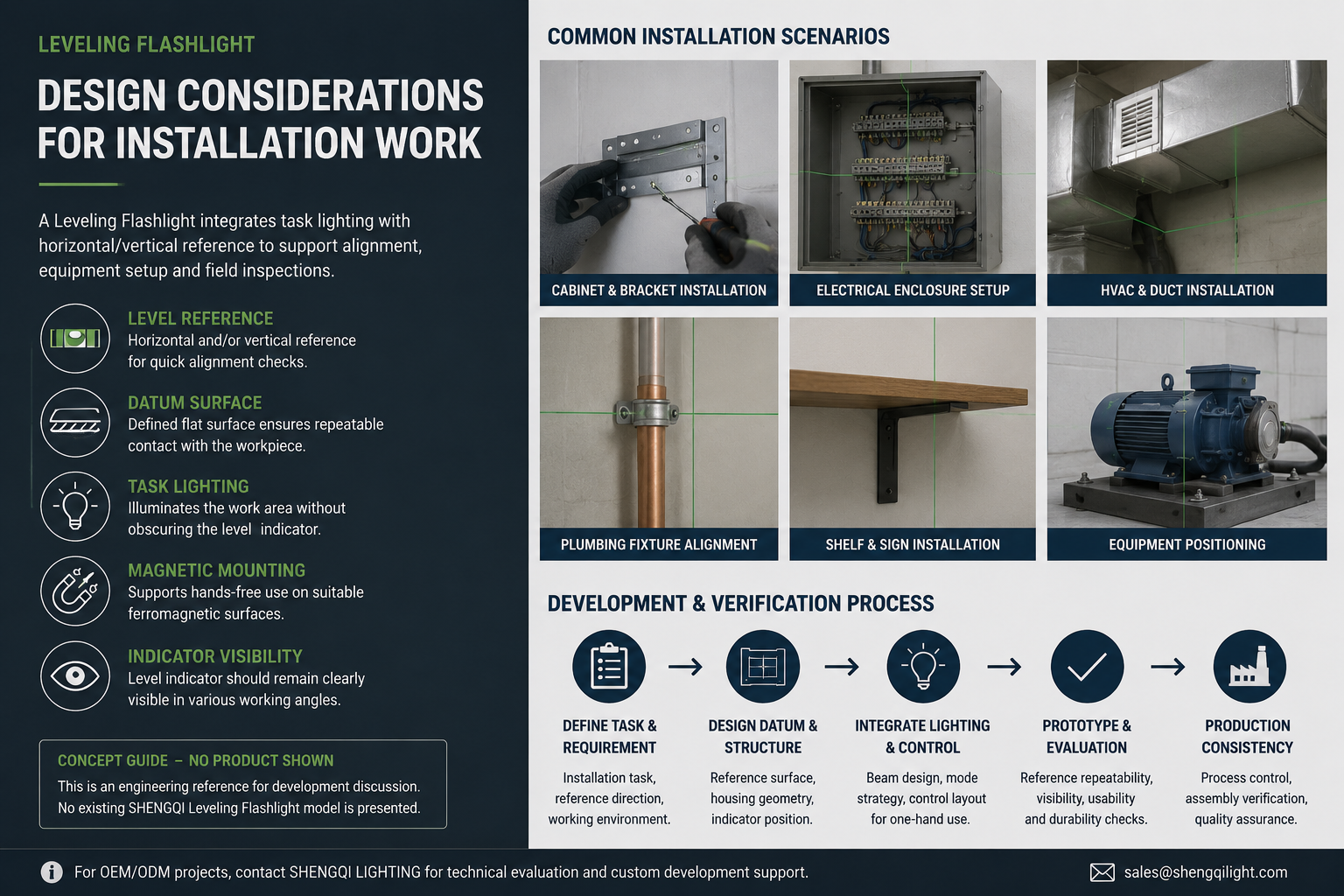

What Is a Leveling Flashlight?
A Leveling Flashlight is a portable task-light concept that combines illumination with a built-in reference for checking horizontal or vertical alignment. Depending on the product brief, the reference could conceptually use a bubble or vial level, a mechanical reference, an electronic orientation indicator or another project-specific mechanism.
The point is not to add one more feature to a flashlight. A useful product should let the user place the tool against a workpiece, illuminate the installation area and check orientation without constantly switching between separate devices.
Applications may include cabinet installation, shelving, equipment positioning, wall-mounted equipment, facility maintenance, HVAC setup, plumbing fixtures, signs, electrical enclosures and general property maintenance. Existing portable tooling light platforms can provide useful references for task-lighting architecture, but they should not be described as existing leveling products.
Start With the Installation Task, Not the Leveling Component
Product planning should begin with practical questions: What is being installed? What surface acts as the reference? Does the user need horizontal, vertical or both? Is the light handheld, placed directly against equipment or temporarily mounted? Will the user work overhead? Is magnetic positioning useful? What lighting conditions apply?
The most important distinction is whether the leveling feature is a quick installation reference or a formal measurement requirement. The mechanism should follow the task, not determine the task after the housing has already been designed.
Define What “Level” Actually Means for the Product
A brand may need a horizontal reference, a vertical reference or both. That decision sounds simple, but it immediately raises another question: which physical surface on the product represents that reference?
Orientation should be defined before the mechanism is selected. A product meant to rest on a shelf edge may require a different contact geometry from one intended to sit against the side of an electrical enclosure.
The Reference Surface Matters as Much as the Level Indicator
Even a correctly installed level indicator becomes less useful if the product does not contact the workpiece consistently. A curved surface, protruding fastener, uneven base, external clip or interrupted housing face can change how the tool sits against the object being checked.
Engineers often describe the intended reference face as a datum surface. In practical terms, it is the repeatable physical surface that ties the product's internal reference to the real workpiece.
The leveling function is only useful when the internal reference is tied to a repeatable physical surface on the product.
Body Geometry Determines How the Tool Contacts the Workpiece
A flat or rectangular enclosure can naturally provide defined contact faces for horizontal or vertical positioning. A traditional tubular flashlight remains comfortable to grip and carry, but a leveling function may require an engineered flat, bracket, base, magnetic contact surface or another dedicated datum.
That does not mean flat geometry is automatically more accurate. Accuracy and repeatability still depend on the relationship between the indicator, datum, housing tolerances and assembly.
Brands comparing possible structures can review existing portable lighting platforms for general enclosure ideas without treating those products as leveling tools.
The Light Should Help the User See the Work, Not Wash Out the Reference
Installation work is often close-range. The useful lighting questions are therefore not limited to maximum output. Low and medium modes, beam spread, working distance, shadows, reflections and glare can all affect whether the user can see both the workpiece and the leveling indicator.
The beam should support both the workpiece and the leveling reference. A very bright hotspot aimed at a reflective mounting plate may make the indicator harder to read rather than easier.
The Level Indicator Must Stay Readable in Real Working Conditions
If a project uses a bubble or vial reference, marking contrast, window location, viewing angle, reflection and surrounding light should be considered. If an electronic orientation indicator is selected, display brightness and viewing angle may become part of the brief.
The user should not have to cover the reference with a hand, rotate the tool away from the workpiece or shine the beam directly into the indicator just to read it. Hand position, sight line, light direction and body geometry should be reviewed together.
Magnetic Mounting Can Hold the Tool—But It Does Not Define Level
A magnet may help with temporary positioning on a suitable ferromagnetic surface, particularly when the user needs one hand free for installation work. But the magnet's job is holding. The datum geometry determines the reference.
Buyers should test the actual surface material, magnetic holding force, orientation, sliding, vibration and contact geometry. Magnetic attachment should never be assumed to work on every metal or every stainless-steel surface.
A Pocket Clip Can Interfere With the Reference Surface
A clip is useful for carry, but a protruding clip can prevent a housing face from sitting fully against the workpiece. That can make the physical reference inconsistent even when the internal leveling component is unchanged.
Product teams should ask whether the clip is removable, recessed, positioned outside the datum area or located on the opposite face. Carry function and alignment function need to be designed together rather than resolved after the enclosure is finished.
Controls Should Not Move the Tool During an Alignment Check
A hard-to-press button, a control positioned against the reference face or a switch that requires substantial side pressure can move the product during use. Even rotating the light to change modes may break contact with the workpiece.
Prototype testing should therefore review button location, actuation workflow, one-hand use, accidental movement and whether the user can change illumination without repositioning the reference surface.
Is It an Installation Reference or a Precision Measuring Instrument?
An installation reference can support quick alignment, horizontal or vertical checks, setup assistance and field positioning. A precision measuring instrument may require documented accuracy, calibration, traceability, defined test methods and repeated verification under controlled conditions.
For this product concept, the default role is installation assistance unless the project explicitly defines and verifies a more demanding measurement requirement. A compact leveling reference may support installation work, but it does not automatically replace a calibrated professional spirit level or project-specific measuring instrument.
Buyers should define the acceptable tolerance, datum, zero-check method, assembly verification, recalibration requirements and post-impact checks according to the actual project.
Power and Mechanical Durability Need to Support the Same Workflow
If the product includes only an LED and passive reference, its power architecture may be relatively simple. An electronic indicator, illuminated reference or display could add additional electrical loads. Integrated or replaceable batteries, charging and required operating duration should therefore follow the final product brief.
Durability creates a second issue: a product can survive an impact electrically while its leveling reference changes mechanically. The LED may still turn on even though a vial, bracket, sensor or reference relationship has shifted.
Post-impact verification matters when the leveling function is part of the product claim.
Environmental Requirements Are Project-Specific
Indoor or outdoor use, dust, rain, temperature and impact requirements should be defined for the final configuration. Environmental targets should be specified and tested rather than copied from an unrelated flashlight model.
Leveling Flashlight Product Specification Matrix
| Design Area | Buyer Question | Engineering Decision | Prototype Verification | Main Risk |
|---|---|---|---|---|
| Leveling Function | Reference or precision role? | Mechanism follows use case | Task-based review | Feature exceeds evidence |
| Horizontal / Vertical Reference | Which orientations are required? | Reference configuration | Orientation checks | Wrong reference direction |
| Datum Surface | What contacts the workpiece? | Repeatable reference face | Surface-contact check | Inconsistent contact |
| Body Geometry | How does the body sit on the work? | Flat, base or bracket concept | Placement test | Housing shifts reference |
| Lighting Beam | Can the user see work and reference? | Beam and mode strategy | Close-range lighting test | Glare or shadows |
| Indicator Visibility | Is the reference readable? | Window and sight-line design | Working-position review | Indicator blocked |
| Control Position | Can the light change without movement? | Switch location and logic | Control-without-movement test | Reference disturbed |
| Magnetic / Carry Structure | Does mounting affect the datum? | Magnet and clip integration | Holding and contact tests | Carry feature changes reference |
| Battery & Durability | Does the architecture survive real use? | Power and structural design | Workflow and post-impact check | Reference shifts after impact |
| Environmental Requirement | Where will it be used? | Project-defined protection targets | Applicable testing | Specification does not match environment |
Ten Tests Buyers Should Run on a Leveling Flashlight Prototype
These checks can be aligned with available product verification capabilities, but exact methods and acceptance criteria must be defined for the project.
Confirm repeatable contact between the intended datum and representative workpieces.
Repeat the intended horizontal check without inventing a universal tolerance.
Verify repeatable vertical-reference behavior where required by the brief.
Review the indicator from realistic working positions and viewing angles.
Check whether task lighting creates glare, shadows or blocked visibility.
Evaluate holding, sliding and contact geometry on representative surfaces.
Operate lighting controls while monitoring whether the tool shifts on the workpiece.
Evaluate charging or replacement behavior according to the final architecture.
Recheck the reference after the project's applicable durability evaluation.
Compare datum contact, indicator position and usability across representative builds.
Acceptance criteria are project-specific.
Ten Questions Before Developing a Leveling Flashlight
- What installation task is the product intended to support?
- Does the user need a horizontal reference, vertical reference or both?
- Which physical surface acts as the datum?
- Is the leveling feature a quick reference or a precision measurement requirement?
- How should the beam illuminate the work without obscuring the indicator?
- Does the product need magnetic positioning?
- Does a clip or other carry feature interfere with the datum surface?
- Can users operate the light without moving it away from the workpiece?
- How will the leveling reference be checked after assembly and durability testing?
- How will the approved prototype be matched to mass production?
Manufacturing Consistency Is Part of the Reference System
The final reference can be affected by machining, molding, brackets, adhesive, vial placement, sensor placement, magnets, clips, tolerance stack and assembly. A prototype that works well does not automatically prove that every later unit will reproduce the same geometry.
A project should connect Requirement → Drawing → Datum → Prototype → Verification → Production Revision.
This is where sample-to-production manufacturing matters: not because manufacturing capability itself proves leveling performance, but because the approved reference geometry has to be carried into production consistently.
How an OEM/ODM Project Should Approach a Leveling Flashlight
A custom product may require Industrial Design, Optical Engineering, Electronic Design, Mechanical Engineering, datum-surface design, leveling-mechanism integration, battery architecture, prototype verification, manufacturing, Quality Control and Packaging Design.
The leveling method, datum surfaces and lighting workflow should be defined before the housing geometry is frozen. This is especially important if the product also uses magnetic positioning, a pocket clip, multiple light modes or an electronic reference.
SHENGQI LIGHTING can support the portable-lighting and product-development side through its custom flashlight development capabilities. No existing SHENGQI Leveling Flashlight model, accuracy specification or calibration result is being claimed in this article.
Frequently Asked Questions About Leveling Flashlights
1. What is a leveling flashlight?
A leveling flashlight is a portable task-light concept that combines illumination with a built-in reference for checking horizontal or vertical alignment. The reference could use a bubble or vial, mechanical feature, electronic indicator or another project-specific mechanism. The important design issue is not simply having both functions in one housing. The leveling reference, contact surface, lighting beam and controls need to work together during the installation task.
2. What is a leveling flashlight used for?
The concept can support quick alignment during cabinet, shelving, equipment, HVAC, plumbing-fixture, sign or electrical-enclosure installation. It may also assist facility-maintenance and general property-work tasks where a user needs light and a basic orientation reference at the same location. The exact use depends on the product brief. It should not automatically be described as a surveying instrument or precision construction-measurement tool.
3. Does a leveling flashlight replace a professional spirit level?
Not automatically. Without documented accuracy, calibration, traceability and a defined test method, a compact built-in level should be treated as an installation reference or alignment aid. A professional level or project-specific measuring instrument may still be required when the installation has formal measurement tolerances. Buyers should define the required performance before deciding whether the integrated reference is intended for quick positioning or more demanding measurement work.
4. Why does a leveling flashlight need a defined reference surface?
The internal indicator only becomes useful when it is tied to a repeatable physical surface on the product. If the housing touches the workpiece differently from one use to another, the reference can become inconsistent even when the indicator itself has not changed. Clips, screws, curved surfaces, magnets and housing tolerances can all affect contact. The datum surface therefore needs to be designed and verified as part of the leveling system.
5. Can magnetic mounting improve leveling accuracy?
A magnet can help hold the tool against a suitable ferromagnetic surface, but it does not define the leveling reference. The magnet holds the tool; the datum geometry determines the reference. Buyers still need to verify surface material, sliding, orientation, vibration, holding force and contact geometry. Magnetic attachment can improve convenience in some installations, but it should not be used as evidence of accuracy by itself.
6. What should B2B buyers test on a leveling flashlight prototype?
Buyers should test the reference surface, horizontal and vertical repeatability, indicator readability, beam interaction, control operation and magnetic positioning where applicable. Battery workflow and post-impact reference checks may also be important depending on the product brief. Production-representative samples should then be compared to the approved prototype. Exact tolerances, sample quantities, cycle counts and acceptance criteria should be defined for the individual project rather than assumed.
7. Can a leveling flashlight be customized for OEM/ODM projects?
Yes. A custom project can define the lighting architecture, horizontal or vertical reference, datum surfaces, body geometry, indicator position, magnetic or clip features, controls, battery and environmental requirements as one product system. Industrial design and mechanical development should begin with the installation workflow rather than adding the leveling feature after the enclosure is finished. The final mechanism and performance targets still require project-specific prototype verification and production control.
Design the Reference and the Light as One Installation Tool
A useful Leveling Flashlight should connect the installation task, horizontal or vertical reference, datum surface, lighting beam, indicator, controls and body geometry before production decisions are frozen. A built-in level becomes meaningful only when the product can contact the workpiece consistently and the reference remains readable and repeatable after assembly and real-world handling.
Define the Datum, Lighting Workflow and Verification Before Production
Tool brands, hardware companies, installation-equipment businesses and private-label buyers can develop product briefs around task lighting, reference surfaces, magnetic positioning, control layout, durability and production consistency.
Contact SHENGQI LIGHTING for an OEM/ODM technical evaluation at sales@shengqilight.com.
Contact SHENGQI LIGHTING