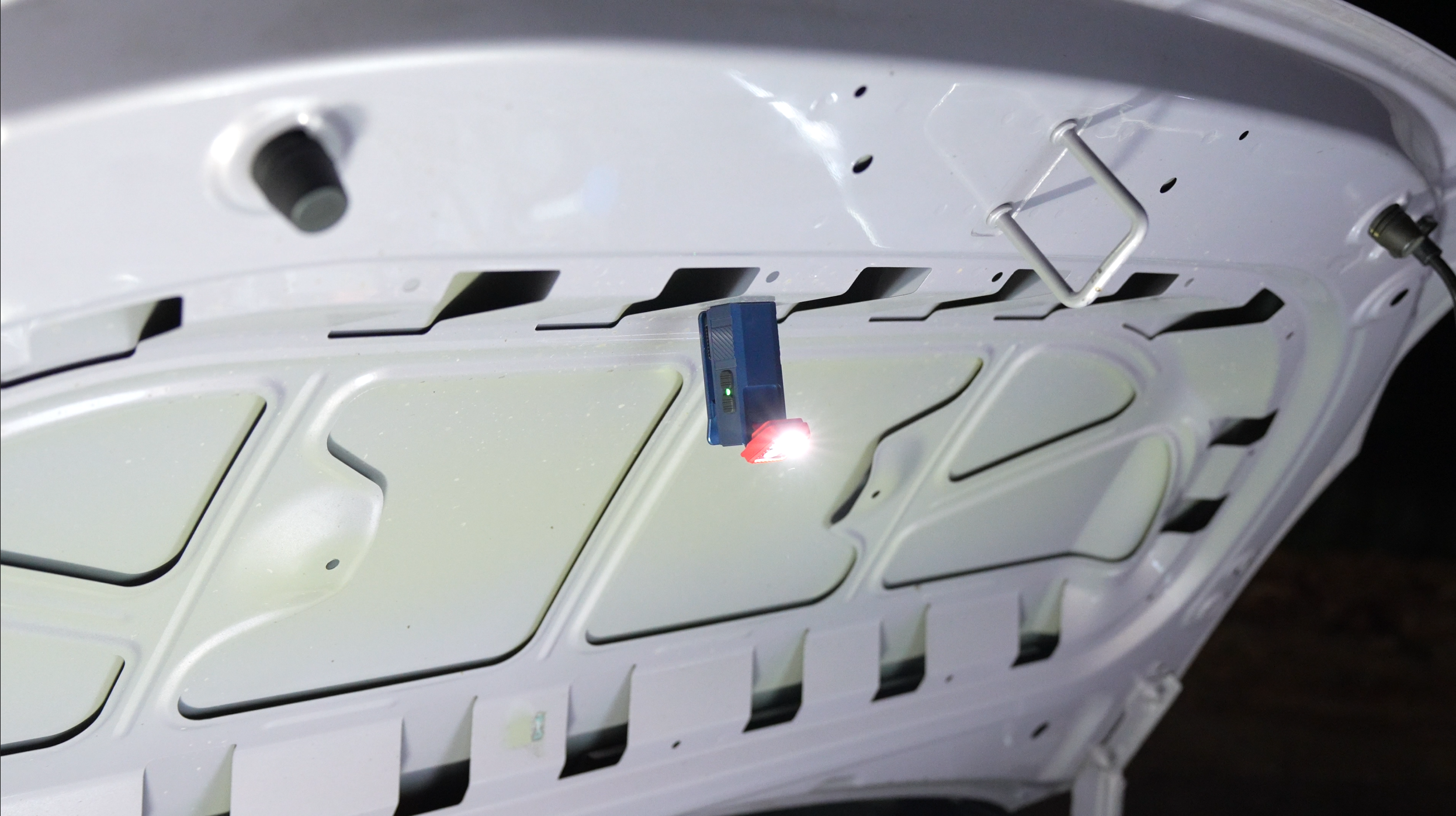
Imagine a work light that holds securely on a thick steel plate on a bench. The same sample is then placed on a coated, vertical, thinner steel surface. Its base may gradually slide down. Or the base may remain in place while an adjusted lamp head sends the beam away from the intended work area. This is a hypothetical evaluation scenario, not a SHENGQI LIGHTING customer case.
A magnetic work light mounting test should record the surface, mounting direction and lamp-head position, then observe the base and the beam separately. This method helps a buyer distinguish slide, rotation, edge lift and beam drift instead of treating every positioning problem as a single “magnet strength” issue.
1. Define the Sample and Target Mounting Condition
Before mounting the light, identify what is actually being evaluated. Record the sample or version reference, mounting location, surface material, mounting direction, head position and intended illuminated area. If the steel thickness, coating type or surface material is unknown, record it as unknown rather than filling the gap with an assumption.
A flat, clean steel plate can be useful as a baseline because it gives the team one repeatable reference surface. It should not be treated as proof that the same light will behave the same way on the work surface that matters to the buyer. The representative surface may be thinner, painted, curved, vertical, coated, uneven or partly separated from the magnetic contact area.
Baseline surface
A controlled flat steel plate gives a consistent starting point for comparing samples or repeated checks.
Representative surface
A surface that reflects the intended installation is the meaningful check for the proposed application.
Also record the contact-face shape and any protective pad, coating or gap between the magnetic base and the steel. These are part of the tested setup. A result without this context is difficult to compare later and should not be generalised to other installation positions.
2. Separate Pull-Off, Slip, Edge Lift and Beam Drift
A pull-off check concerns separation away from the surface. A slip observation concerns movement along the surface, such as a light slowly moving downward on a vertical steel panel. These are different conditions. A pull-force figure from a defined test configuration should not be converted directly into a safe working load for another orientation, surface or lamp position.
When a magnetic work light is mounted vertically, the base may not detach but can still move because friction, contact quality, surface condition and the loaded geometry all matter. A contact gap, reduced contact area, a curved panel or a changed centre of mass after the head is adjusted may alter the result. The test record should describe what happened rather than trying to explain the cause before the evidence is available.
Record these as separate outcomes:
- Base movement: the base slid, rotated or changed its reference position.
- Edge lift: part of the mounting face lifted or no longer sat fully against the surface.
- Head movement: the lamp head changed position after adjustment or during observation.
- Beam drift: the beam moved away from a marked target area, whether or not the base moved.
Use a visible reference at the base edge, another reference for the lamp-head position and a fixed target point for the beam. If the light spot moves while the base reference stays unchanged, the magnet may not be the source of the positioning issue. If both move, the record should show that too.
3. Why Base Stability and Beam Direction Should Be Checked Separately
A light with a magnetic mounting point and an adjustable head can provide useful placement flexibility in confined work areas. For example, the official P3 product page lists a magnetic tail and a 90-degree rotating head. Those features illustrate why a tester can observe where the base stays and where the beam points as two separate questions.
The product listing is not evidence that the P3 has passed a vertical thin-steel, coated-surface, overhead, vibration, heat or long-duration mounting test. It is a structural example only. Actual suitability depends on the sample, installation surface, orientation and the required beam position.
This is the practical design value of a movable light system: the mounting base and the beam can be positioned separately. A useful sample test checks whether that flexibility remains controlled in the intended setup rather than assuming that adjustability automatically creates stable task lighting.
4. Run a Repeatable Bench Check
Conduct sample checks on a stable, low-height bench arrangement that can safely contain an accidental fall. Use a static environment with no operating machinery. This is a controlled observation method, not a safety certification and not proof for conditions that were not evaluated.
- Set a fixed target. Mark or define the intended illuminated area and keep the observation distance consistent for the comparison.
- Start with the baseline surface. Mount the light, note the initial base and beam references, then observe the condition through the agreed observation period.
- Change one condition at a time. Move to the representative work surface, alter the mounting direction or adjust the lamp head one variable at a time.
- Operate as instructed. Follow the product instructions for head adjustment and controls, then separately note movement at the time of adjustment and movement during the stationary observation period.
- Document what was not tested. Do not infer vibration, oily-surface, elevated-temperature or overhead behaviour from a static bench result unless those conditions were separately evaluated.
The buyer and supplier should agree on the observation period, permitted movement, target beam area and retest conditions for the intended application. A universal number would create false precision because the relevant product, surface, direction and task can differ substantially.
5. Copy This Magnetic Work Light Mounting Acceptance Record
Use one row for each tested setup. “Accepted for Tested Setup” means only that the stated sample met the agreed observation criteria under the recorded condition. It does not certify another surface, installation direction or configuration.
| Sample | Surface & Orientation | Head Position | Observation Time | Base Movement | Beam Position | Result & Retest |
|---|---|---|---|---|---|---|
| ________________ | Material / thickness if known / finish / contact condition / orientation | ________________ | ________________ | None / slide / rotate / edge lift / notes | Within target / drift / notes | Accepted for Tested Setup / Retest Needed / Not Evaluated |
| Illustrative Example Sample A |
Vertical coated steel panel; thickness unknown; flat contact area | Head adjusted toward target mark | Buyer-defined period | No visible base movement recorded | Beam moved away from target after head adjustment | Retest Needed: check head position and repeat on stated setup |
The illustrative example is not a SHENGQI product result. It only shows how a record can separate a stable base from a changed beam position.
Frequently Asked Questions
Why can a light hold on a flat steel plate but slide on a vertical panel?
The two setups may differ in surface condition, coating, panel thickness, contact quality, orientation and the light’s centre of mass. A baseline result on thick, flat steel is useful information, but it does not automatically predict performance on a different representative work surface.
Why can the beam drift when the magnetic base has not moved?
The lamp head, pivot or other adjustable element may have changed position while the base remained fixed. A beam target reference and a separate head-position observation help distinguish this result from base slip.
Does one successful sample check represent every surface and mounting direction?
No. It represents the stated sample in the stated setup. Any surface, orientation, head position or operating condition that differs materially should be treated as a separate condition for evaluation.
What should I provide when asking a supplier about magnetic mounting?
Provide photos or a clear description of the target work surface, material where known, installation direction, intended lamp-head position, target illuminated area and the acceptance conditions you want the sample discussion to address.
Discuss Your Work Light Mounting Requirements
If you are evaluating a magnetic work-light sample, share the target work-surface photo or material description, mounting direction, head position, target illumination area and the conditions you want to evaluate. This gives both sides a clearer basis for discussing the sample setup and open questions.
Explore the wider tooling and work light range, or use the existing contact page to begin a project discussion.
Discuss Your Work Light Mounting RequirementsYou may also email sales@shengqilight.com.