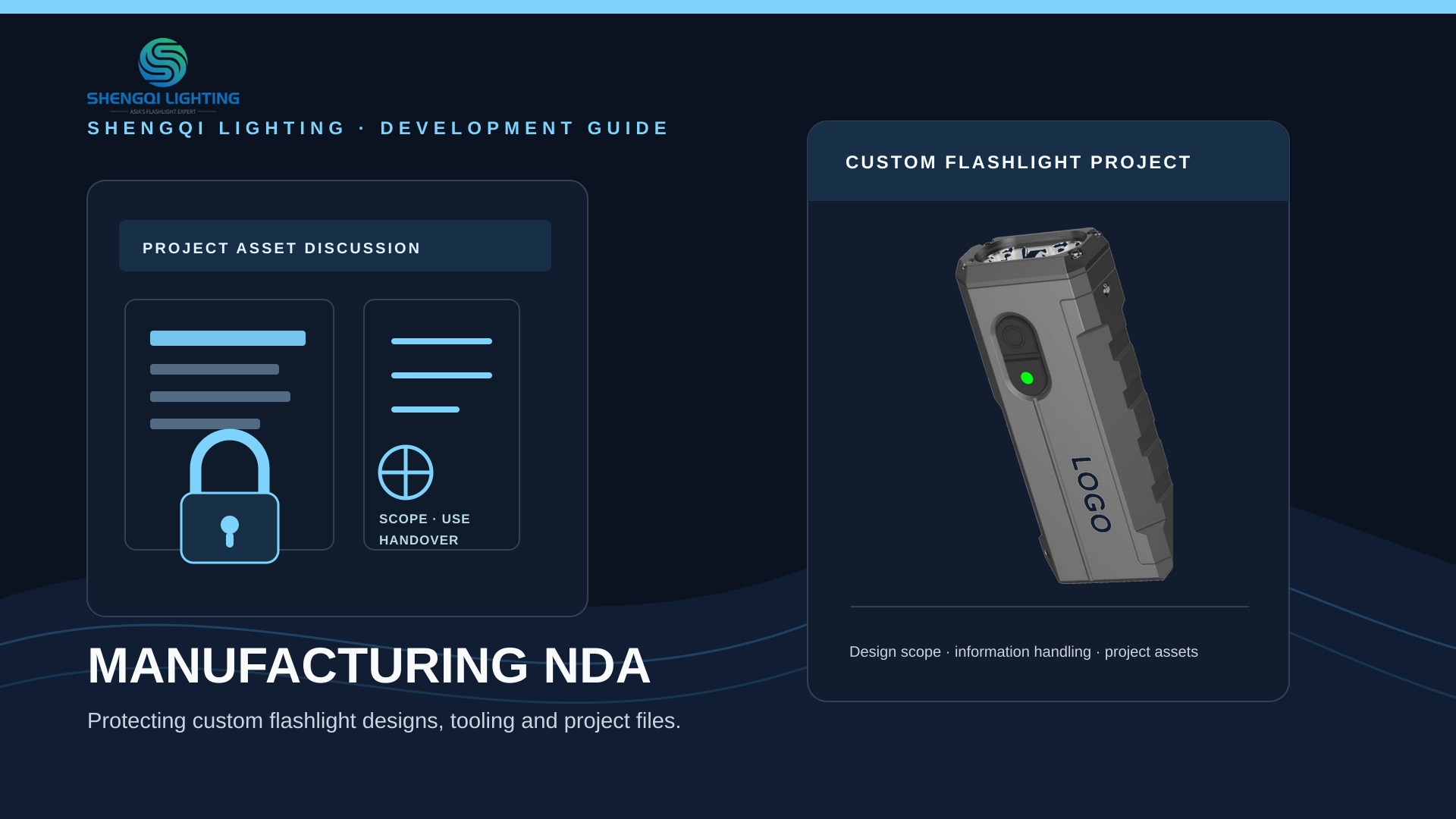
What to clarify before sharing a custom flashlight concept
Before sending non-public flashlight drawings or project files to a manufacturing partner, define what information is confidential, how it may be used, who may access it, and which design or tooling rights need to be discussed. A manufacturing NDA is an important part of that conversation, but an NDA alone does not decide ownership of a design, a mold, firmware, source files, or an exclusive sales territory. Share the information needed at each development stage, then document the relevant handover arrangements before they become urgent.
This article explains practical discussion points for custom flashlight development. It is not a contract template or legal advice; the appropriate terms should be confirmed by the parties for the applicable project and legal context.
Identify what needs protection before calling everything “confidential”
A custom flashlight project can combine commercial information, design work and manufacturing assets. Some projects may involve only a logo and packaging treatment on an existing platform. Others may include a new housing, a revised optical layout, electronics, control behavior or project-specific tooling. Naming the information clearly helps both sides decide what should be shared, recorded and handled under the agreed arrangement.
- Unreleased product appearance, structure drawings, CAD files and critical dimensions.
- Lighting layout, optical design files, electronic design materials, PCB files, and applicable firmware or user-interface logic.
- Molds, fixtures, jigs and identifying records connected to a specific project.
- Unannounced packaging, trademark application, market-launch plans, customer identity and channel information.
Not every item automatically receives the same protection in every jurisdiction or agreement. WIPO’s trade-secret guidance explains that confidentiality agreements work alongside reasonable information-management measures. In practical terms, a project team should identify sensitive material, limit access to the people who need it, and avoid treating a general product conversation as a substitute for a defined disclosure process.
Project assets that need separate questions
Confidentiality, ownership, a permission to use an asset, and market exclusivity answer different questions. The following discussion tool helps a buyer turn a broad concern about flashlight design protection into specific points that can be written down and reviewed.
| Project asset | What to clarify | Useful record | What should not be assumed |
|---|---|---|---|
| Customer CAD and design brief | Allowed purpose, receiving scope, project identity and version handling. | A file list, version record and agreed recipient scope. | That the material may be used for another customer project or displayed publicly. |
| Existing platform and pre-existing technology | Which elements already exist and what use is contemplated for this project. | Platform scope and the relevant license or supply arrangement. | That branding or a configuration change transfers all rights in the underlying platform. |
| New appearance, structure or electronic design | New deliverables, ownership terms and permitted use after development. | A development scope, deliverable list and written rights arrangement. | That the word “custom” or a development charge alone transfers every related right. |
| Molds and project-specific tooling | Physical ownership, storage location, use permission, maintenance and transfer conditions. | A tooling list, identification record and written project terms. | That paying a tooling charge automatically covers software, design files or global sales exclusivity. |
| Firmware and UI materials, where applicable | Executable files, source materials, modification permissions and third-party or existing technology. | A defined software-delivery scope and version record. | That a finished product includes all source code or unrestricted modification rights. |
| Sample photos, packaging and public references | Who may show what, through which channel, at what time and with which approval. | A display or reference permission tied to the proposed content and audience. | That an on-market product permits disclosure of the cooperation or its internal development materials. |
A well-defined arrangement can distinguish material supplied by the customer, technology that existed before the project, and work created within the agreed scope. WIPO’s overview of IP agreements with suppliers similarly emphasizes defining rights and obligations in supplier relationships instead of leaving key assumptions unstated.
Use staged disclosure to keep the first conversation useful
A brand does not need to send every proprietary file in its first inquiry. It can first establish whether the manufacturing partner understands the category, application and expected development scope. As the discussion becomes more specific, the information shared can become more specific as well.
1. Initial discussion
Start with the target user, application, product type, core function direction and intended market. This is often enough to decide whether an existing platform adjustment or a new-development discussion is appropriate. It does not require a complete CAD package, bill of materials, source code, customer list or unreleased commercial plan.
2. Confidentiality and scope
Before proprietary materials are exchanged, discuss the agreement parties, protected information, permitted use, people or organizations that may need access, and any expected handling by outside collaborators. A staged approach should still provide engineers with the information needed to assess feasibility honestly.
3. Development and handover
When detailed development or tooling begins, share the files required by the agreed work scope and retain version and delivery records. Discuss in advance what happens if the project pauses, ends or moves: which files, samples and tooling are to be handed over, and under what agreed conditions.
If external tooling, component, testing or other specialist support is relevant, the practical question is not whether outside participation is inherently good or bad. It is which party needs access to which information, for what purpose, and under what corresponding confidentiality arrangements.
A custom-lighting brief can create several different assets
Consider a hypothetical brief for a flat EDC light with forward illumination, a side-light function and a tailored switch interface. The exterior and mechanical layout may create design files. The division of work between the main beam and side light may require optical, electronic and space-allocation decisions. The interaction design may involve button behavior and, where applicable, firmware. Manufacturing may also require project-specific tooling.
The useful question is not whether the entire project can be described with one ownership label. Each category can require its own agreed treatment: what is delivered, who may use it, what remains pre-existing technology, and what can be transferred or displayed. This is where the technical character of a custom light becomes visible: light sources, control behavior, body space and manufacturing methods work together, while the rights discussion should remain just as specific.
How to evaluate a manufacturer without asking it to reveal customer projects
Customer brand names are not the only way to assess development and manufacturing capability. A manufacturer can provide credible, appropriate evidence through its company identity, manufacturing background, public or authorized product examples, relevant process explanations, and materials that have been reviewed for sharing. A redacted document is not automatically safe to publish: a combination of details may still identify a customer or project, so authorization and review remain important.
SHENGQI LIGHTING has manufacturing roots dating back to 1981, as described in Shengqi Lighting’s manufacturing history. Its publicly described development support includes industrial design, optical engineering, electronic design, PCB layout and custom-mold discussions within the scope of a project. Readers can review the available flashlight design and development capabilities and related manufacturing processes when deciding what information to request next.
IP Protection and NDA Arrangements at Shengqi Lighting
Shengqi Lighting’s policy is to treat non-public customer identities and project materials as confidential. Public references and project displays require appropriate authorization. The specific confidentiality, design-rights, tooling and project-information arrangements should be confirmed between the parties for the relevant development scope. Respecting confidential material does not replace a buyer’s need to review appropriate capability evidence, nor does it establish rights that have not been agreed in writing.
Questions brands often need to settle early
Can we discuss a project before sharing proprietary drawings?
Yes. An initial brief can describe the product type, intended application, market, feature direction and whether the project is based on an existing platform or a new concept. More detailed drawings and files can follow once the confidentiality and development-scope discussion reaches the appropriate stage.
Does paying for tooling include ownership of every design file?
Not automatically. Physical tooling, a design file, pre-existing platform technology, source materials and sales rights can be separate subjects. The project agreement should identify the relevant assets, the intended ownership or usage rights, and any conditions for storage, maintenance or transfer.
Can a manufacturer show our product or name our brand publicly?
Public display and brand references should be addressed through the applicable authorization and confidentiality terms. A product being available in the market does not by itself clarify whether a manufacturer may describe the relationship, show unreleased materials or use project images in a different channel.
Discuss Your Custom Flashlight Project
To begin a focused conversation, share a non-confidential project outline: the product type and target application, intended users and sales market, whether you are considering an existing-platform adjustment or a new direction, and the key functional or structural question you want to solve. You can also indicate whether confidentiality terms and project-asset rights should be discussed before detailed materials are exchanged.
Contact sales@shengqilight.com to discuss the appropriate development and confidentiality scope for your project.