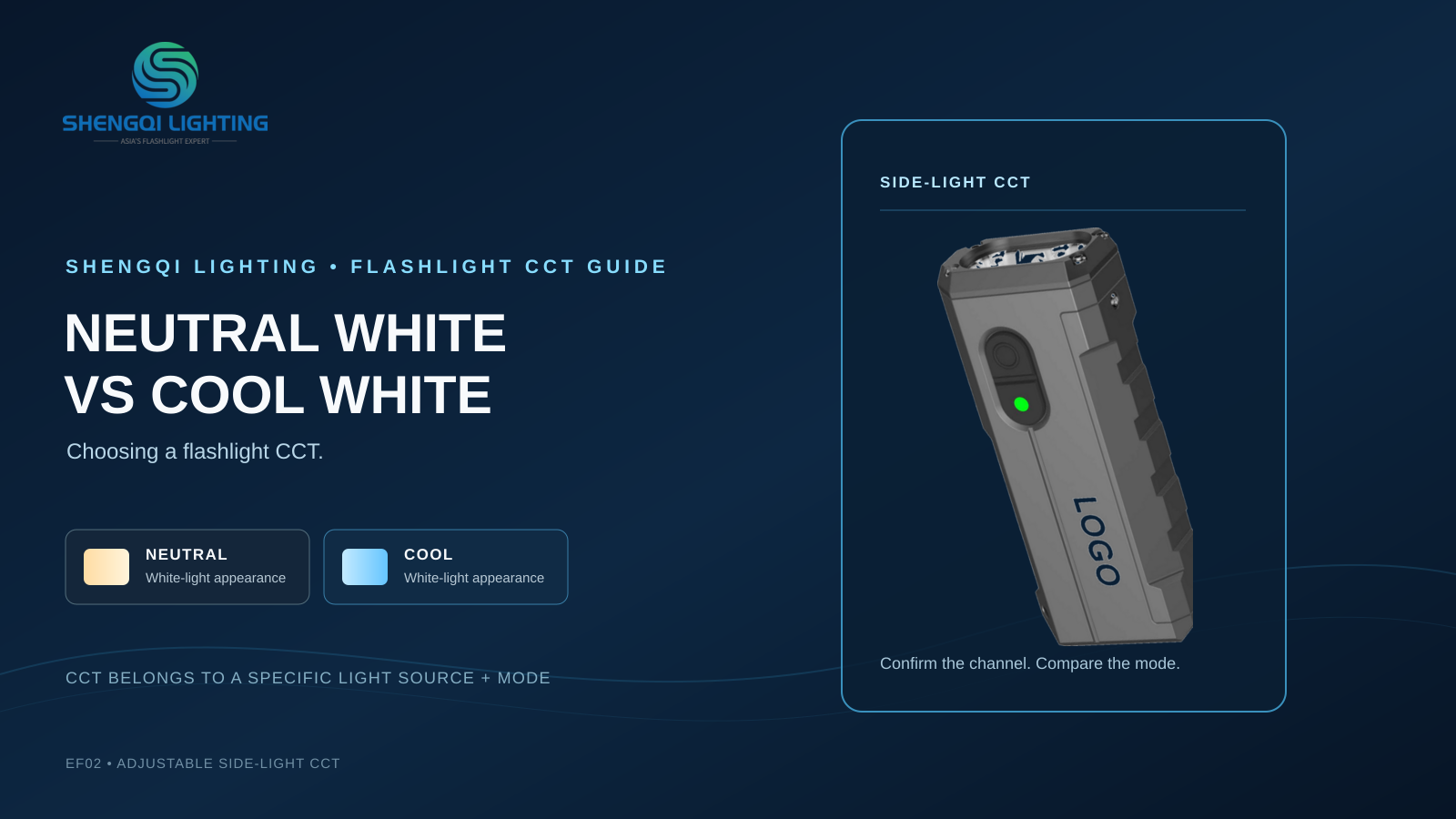
Neutral white and cool white describe different visual tendencies in white light. Correlated color temperature, or CCT, expresses that tendency in kelvin, but it is not a brightness rating, a color-rendering score, or a product-quality grade. When comparing flashlight white light, first confirm which light source and which mode the stated CCT describes. A main beam, side light, and adjustable white-light channel can each require separate product information.
The practical answer: neutral white versus cool white is only useful when the comparison names the actual lighting channel, selected mode, task, and evidence behind the label. One whole-product description cannot automatically explain every emitter on a multi-source flashlight.
In this article
What Are Neutral White and Cool White Comparing?
CCT describes the apparent color of white light. In general, lower CCT values appear warmer, while higher values appear cooler or more bluish. For example, 4000 K and 6500 K can help illustrate the direction of the difference. They are not universal dividing lines between neutral and cool white, measured values for Shengqi Lighting products, or a recommended setting for every person and task.
Terms such as neutral white and cool white are useful shorthand, but manufacturers do not always use identical numeric boundaries for them. CCT also does not refer to the physical temperature of a flashlight. A higher kelvin number does not establish that the body runs hotter, that the light uses more power, or that it has stronger overall performance.
The U.S. Department of Energy’s LED color characteristics fact sheet explains that the apparent color of light, color consistency, and the way objects appear under a source are separate aspects of color quality. That is why CCT should not be used as a shortcut for color rendering or for the overall quality of a flashlight.
First Confirm Which Light Source the CCT Belongs To
A single-output flashlight may have one fixed white-light specification. A multi-source flashlight can be different. Its main beam and side light can serve separate tasks, use different white-light configurations, or be described through different modes. Therefore, a product-level phrase such as “cool white” does not automatically mean every white-light channel has the same appearance.
The same principle applies to adjustable white light. An adjustable CCT feature may apply to a named channel only. It does not prove that the main beam is adjustable, that every white source changes together, or that all modes use the same CCT. Brightness adjustment and CCT adjustment are different functions: one changes output level, while the other changes the apparent color of the white light.
Before comparing a CCT claim, confirm these details:
- Does the information apply to the main beam, side light, or one named mode?
- Is the channel fixed, or does the documentation describe an adjustable white-light setting?
- If adjustment is available, which source does it control?
- Does the relevant mode have its own output, runtime, color, or operating information?
When a specification is absent, do not assume the product has or lacks a feature. The appropriate conclusion is simply that the specific channel or mode needs confirmation from the applicable product page, operating information, or sample evaluation.
Compare the Right White-Light Evidence
A meaningful neutral white versus cool white comparison keeps the object of the comparison clear. This table separates what a visible observation can support from what still requires product data or measurement.
| Light or mode being compared | What to confirm | What to observe | What the observation cannot prove |
|---|---|---|---|
| Main beam versus main beam | The stated main-beam mode and equivalent comparison conditions | Relative white-light appearance on the same target | Exact CCT, CRI, spectrum, or absolute output without supporting data |
| Side light versus side light | The active side-light setting and whether it is fixed or adjustable | How the selected setting appears for a nearby task | That the main beam has the same CCT or adjusts in the same way |
| Different white-light settings on one product | The controlled channel and the exact settings being compared | Whether a chosen appearance supports the intended task and user preference | That every white source changes together or shares the same settings |
| Two product photographs from different sources | White balance, exposure, target, display, and surrounding light | Possible differences that need further investigation | A controlled product-to-product CCT or performance comparison |
How to Compare Flashlight White Light More Fairly
A useful white-light comparison does not need to become a laboratory procedure. First identify the actual source and mode being compared. Then use the same target, distance, light position, and ambient-light condition as far as practical. A white or gray surface can make an apparent color difference easier to notice, while a task-relevant target can help show whether that difference is useful for the intended application.
Observe white-light appearance separately from brightness. A brighter sample can look different even if CCT is not the only cause. If the conditions are not aligned, record that limitation rather than assigning every visible difference to neutral white or cool white. This approach supports a better product decision without presenting informal observation as instrument measurement.
Photographs can be helpful records, but they can also mislead. Sony’s explanation of white balance describes how cameras compensate for the color of light in a scene and how automatic white balance can change the appearance of a photograph. Keep exposure and white balance consistent when documenting a comparison. Even under consistent settings, a photo or display does not establish exact CCT, CRI, or spectral data.
CCT Is Not the Same as Color Rendering
A neutral-looking white light is not automatically high CRI, and a cool-looking white light is not automatically poor at showing color. CCT describes the apparent color of the source. Color rendering describes how object colors appear under that source. When a task involves identifying wires, labels, finishes, markings, or material condition, use the relevant color-rendering information rather than trying to infer the result from CCT alone.
Readers who need to evaluate color accuracy for inspection can continue with high-CRI flashlight guidance for inspection tasks. It addresses a related but distinct selection question, so this article does not repeat its full CRI or R9 discussion.
A Design Example: Adjustable Side-Light CCT
The official page for the EF02 flat EDC flashlight identifies adjustable side-light color temperature. This is useful product information because it names the controlled source: the side light. A reader can therefore consider that adjustment in relation to a close-range task without assuming that the main beam has the same CCT behavior or the same adjustment capability.
The design value comes from clear source assignment. It connects a lighting channel, the object of control, and a potential task rather than treating “adjustable CCT” as a whole-product claim. Details such as CCT range, adjustment method, output behavior, color rendering, and other channel-specific information should be confirmed through the applicable product documentation.
How to Choose Between Neutral White and Cool White
Start with the actual task and the light source that will perform it. Someone comparing two main beams can have a different decision from someone selecting a side-light setting for short-range use. When samples are available, compare the relevant modes in conditions that resemble the intended task, then include personal preference as one valid part of the final decision.
If accurate color recognition matters, review color-rendering information separately. If the goal is to change the appearance of white light, confirm which channel is adjustable and how the documentation defines that function. Neutral white and cool white are useful descriptions, but neither is a complete quality score or a reliable prediction of brightness, beam distance, or professional suitability.
Frequently Asked Questions
Does a higher kelvin number mean a hotter flashlight?
No. A kelvin value in a flashlight CCT description refers to the apparent color of white light. It does not describe the physical temperature of the body, LED, battery, or electronic components. Thermal behavior requires separate product-specific information.
Does adjustable CCT apply to every light source on a product?
Not automatically. Adjustable CCT can apply to one named channel, such as a side light, rather than the main beam or every emitter. Check the applicable product documentation to identify the controlled source and its available settings.
Should the main beam and side light have the same CCT?
Not necessarily. A product can assign different lighting roles to a main beam and side light. The important point is that each channel is described clearly and that its white-light appearance supports the intended task. The preferred relationship between channels depends on the product concept and the user’s needs.
Define the White-Light Requirement Before Development
For a brand or product-development project, a stronger brief than “neutral white preferred” identifies the primary task, the specific light source that needs a certain white-light appearance, and whether another channel should be adjustable. That gives the development discussion a clearer starting point for lighting layout, controls, product structure, and sample evaluation.
Shengqi Lighting’s design and development services provide a path for projects that need to define those choices more precisely. To begin a relevant discussion, share the main task, the light source you want to compare or adjust, and the intended white-light appearance at sales@shengqilight.com.