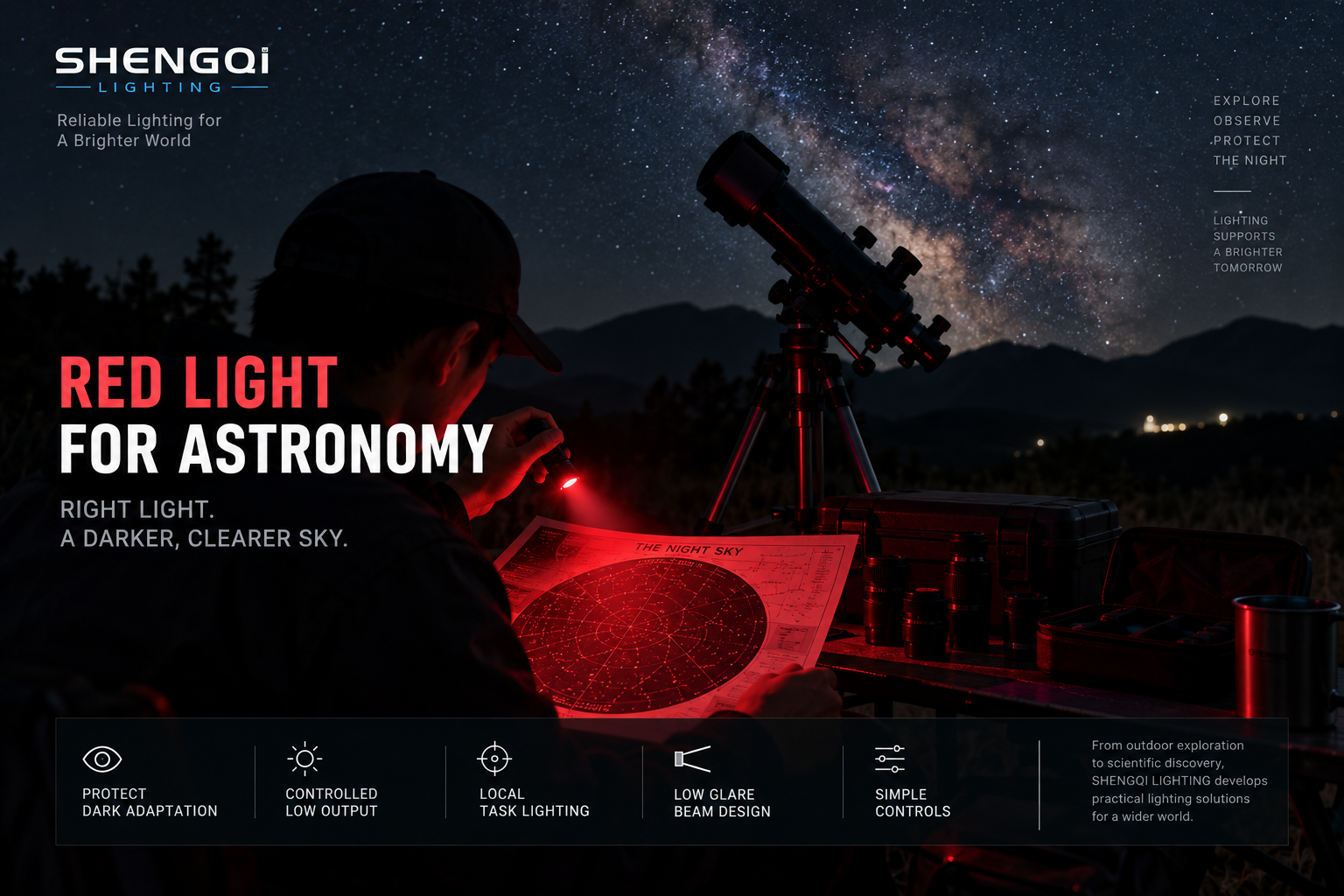

Why Astronomers Use Red Light at Dark Observing Sites
Typical astronomy-light tasks are small and local: reading a star chart, checking telescope controls, finding an accessory, adjusting tripod hardware, organizing eyepieces or checking notes. The goal is rarely to illuminate the entire observing field.
Astronomy auxiliary lighting is usually a local task-lighting problem, not an area-lighting problem. Buyers evaluating portable flashlight platforms should therefore define what must be seen before defining output.
Dark Adaptation Changes What “Enough Light” Means
Human vision becomes progressively more sensitive after time in a dark environment. Bright illumination can temporarily reduce that low-light sensitivity, which is why astronomy organizations commonly encourage restrained lighting at observing sites. NASA's stargazing guidance recommends minimizing bright devices and flashlights, while the National Park Service discussion of dark adaptation specifically warns that bright red light can still be disruptive.
The optimum output is task-dependent, not maximum-output dependent. In astronomy, “enough to read this label” can be more useful than “as bright as possible.”
Brightness Control Can Matter as Much as Red Color
Two flashlights can both use red LEDs and still behave very differently. One may begin at a strong red output that reflects harshly from paper. Another may provide a stable low level that is sufficient for reading a chart without producing unnecessary surface brightness.
Define the Minimum Useful Output Before the Maximum Output
Instead of beginning with “Red LED: 100LM,” an OEM brief should ask: What is the lowest stable output that still lets the user complete the intended task? Chart reading, equipment labels, control markings and accessory handling may require different usable levels. There is no universal astronomy lumen target.
Stepped Modes vs Continuous Dimming
Stepped modes can make output more repeatable and easier to document. Continuous or stepless dimming can let the user search more precisely for the brightness required in a particular environment, but it can add interaction complexity. The brightness-control architecture should match how precisely the target user needs to adjust the light.
An Astronomy Task Light Should Control Where the Light Goes
For a chart, eyepiece case, tripod control or telescope label, beam design is not primarily a distance question. Buyers should review hotspot, spill, beam width, edge transition, aiming and glare. Uncontrolled spill can illuminate more of the observing area than the user intends.
Spot vs Flood for Astronomy Is a Task Question
A narrower beam may help limit the illuminated area and isolate one control or accessory. If it becomes too narrow or produces a hard hotspot, it can be awkward for a larger chart or equipment case. A wider beam can make close work easier, but excessive width may illuminate nearby people or hardware unnecessarily. Neither architecture wins automatically.
| Astronomy Task | Lighting Need | Beam Consideration | Brightness Priority | Control Priority |
|---|---|---|---|---|
| Star Chart Reading | Readable local surface | Enough width for the chart without excessive spill | Low and adjustable | Predictable red access |
| Telescope Setup | Controls and mounting points | Controlled near-field coverage | Task dependent | Simple one-hand control |
| Eyepiece Handling | Small accessories | Localized illumination | Low | Fast low-output access |
| Tripod Adjustment | Hardware and markings | Aimed beam with usable context | Task dependent | Eyes-off operation |
| Equipment Case Search | Broader close area | Moderate width with spill control | Low to moderate | Easy level adjustment |
| Note Taking | Paper and pen area | Soft local field | Low | Stable repeatable level |
Glare Can Defeat a Good Red-Light Specification
White paper, glossy labels, metal surfaces and screens can produce uncomfortable local reflections even when the source itself is red. Output, working distance, beam distribution and any diffuser or optic should therefore be evaluated together. Digital screens may also be part of the dark-site workflow, but this is a lighting-design issue rather than a smartphone-settings guide.
A Red LED Needs a Defined Role in the Product Architecture
Different red LEDs can have different spectral characteristics, but wavelength alone does not determine whether a flashlight suits astronomy. Output, beam, task and controls still matter, so this article does not assign one universal “best” red wavelength.
Can support a very clear purpose and simpler source-selection logic.
Can offer broader utility, but source selection and startup require more deliberate design.
A very low white mode may still be useful where natural color rendering or broader non-astronomy utility matters. Neither approach is universally superior. Buyers reviewing the wider portable lighting product range should match the architecture to the intended workflow.
Startup Behavior Matters More at a Dark Site
If a user wants low red light but must accidentally pass through bright white to reach it, the optical specification and UI are fighting each other. Possible architectures include always starting in a low red state, remembering a previous red level, using a dedicated red control, or selecting the source before brightness. These are design options rather than astronomy rules.
The required behavior should come from the use case. A buyer should explicitly ask whether red needs direct access from OFF and whether the user can reach it without cycling through white.
Mode Memory Can Help Astronomy Use—or Create a Surprise
Memory can be convenient if the product returns to a useful low red level. It can be inconvenient if it remembers a high white or another unexpected state. “Memory” is therefore not automatically a premium feature.
Astronomy-Oriented Memory Strategy: Should the product remember the red source, red brightness, white source or nothing? Source memory, brightness memory and reset behavior should be defined separately.
Physical Design Matters When the User Is Operating in Darkness
The observer should not need to study the flashlight visually every time a control is used. Tactile switch recognition, body orientation, grip, switch separation, clip orientation where applicable and accidental activation should all be reviewed.
Eyes-Off Identification: Can the user identify the red-light control by touch? A separate red switch is not mandatory, but tactile differentiation can become valuable when white and red sources share a compact body. Small compact EDC flashlight platforms make this control-space trade-off especially visible.
Low-Light Performance Still Depends on the Power Architecture
Astronomy auxiliary lighting does not automatically require the largest possible battery. Battery capacity, product size, carry, storage, charging access and required operating time should be considered together. Low output should remain stable enough for the intended task, and low-battery behavior should remain understandable.
A battery-warning flash that is unnecessarily bright can also be inappropriate at a dark site. Battery indication behavior should therefore be reviewed under low-light conditions, not only on a brightly lit engineering bench.
Astronomy Red-Light Product Definition Matrix
| Design Area | Buyer Question | Engineering Variable | Prototype Evidence | Risk if Unclear |
|---|---|---|---|---|
| 1. Target User | Who operates the light? | UI / handling | Task evaluation | Wrong interface |
| 2. Primary Astronomy Task | What needs illumination? | Task distance / field | Representative-use review | Wrong lighting role |
| 3. Red-Light Role | Why is red included? | Source hierarchy | Functional test | Marketing-only feature |
| 4. Minimum Output | What is the lowest useful level? | Driver / mode | Dark-task test | Still too bright |
| 5. Maximum Red Output | Is a higher red state needed? | Output range | Task comparison | Unused intensity |
| 6. Dimming Architecture | Steps or continuous adjustment? | Firmware / control | Usability review | Control complexity |
| 7. Beam Width | How large is the task area? | Optic / diffuser | Beam review | Poor coverage |
| 8. Spill Control | How much surrounding light is acceptable? | Optical distribution | Dark-site review | Unnecessary illumination |
| 9. Glare | Which surfaces reflect strongly? | Output / distribution | Surface test | Local glare |
| 10. White-Light Role | Is white required? | Source architecture | Source-selection test | Unwanted activation |
| 11. Startup Behavior | What happens from OFF? | UI logic | Startup test | Unexpected source |
| 12. Mode Memory | What should be remembered? | Source / brightness memory | Reset test | Surprise startup |
| 13. Controls / Tactile Use | Can red be identified by touch? | Switch architecture | Eyes-off test | Wrong control |
| 14. Battery / Charging | How is power managed during observing? | Battery / feedback | Low-light power review | Unpredictable availability |
Five Ways a Red Astronomy Flashlight Can Miss the Real Use Case
01. The Red LED Is Still Too Bright for Close Tasks
Red does not remove the need for intensity control. Paper and labels can reflect a strong red hotspot. The user then receives more light than the task requires. Minimum usable output should therefore be verified in darkness.
02. The Beam Illuminates More of the Dark Site Than Necessary
A very broad beam may make one close task easy while lighting nearby equipment and observers. The issue is not flood lighting itself. It is uncontrolled coverage. Beam width should match the actual local task.
03. The User Must Cycle Through White Light to Reach Red
A multi-source light can be useful, but mode order matters. Requiring white activation before red can conflict with the intended dark-site workflow. Direct red access is one possible solution. The correct method depends on the architecture.
04. Mode Memory Creates an Unexpected Startup
Memory can save steps when it recalls low red. It can also recall an unwanted bright state. Buyers should specify source memory and brightness memory separately. Reset behavior should be tested rather than assumed.
05. The Product Is Designed Around “Red LED” Marketing Instead of Astronomy Tasks
A red emitter is only one component. If task distance, output, beam, UI and power behavior remain undefined, the product brief is incomplete. Start with the observing task. Then define the red-light architecture around it.
Twelve Tests Buyers Should Run on an Astronomy Red-Light Prototype
01. Minimum-Output Usability Test — Verify that the lowest stable red level still supports the intended local task.
02. Star-Chart Reading Test — Review readability, reflected brightness and illuminated area.
03. Telescope-Control Reading Test — Check labels and controls at representative working positions.
04. Close-Range Glare Test — Evaluate paper, glossy labels and reflective surfaces.
05. Beam-Spill Review — Observe how much unintended surrounding area receives light.
06. Red-Light Direct-Access Test — Verify the intended route from OFF to red.
07. Accidental White-Light Activation Test — Check whether normal operation can unintentionally trigger white.
08. Mode-Memory Test — Verify source, brightness and reset behavior.
09. Eyes-Off Control Test — Ask the user to identify and operate the relevant control without looking directly at the light.
10. Low-Battery Indicator Review — Evaluate warning behavior under low-light conditions.
11. Repeated-Use Learning Test — Check whether the core controls remain understandable after time away from the product.
12. Production-Representative Sample Comparison — Compare later units with the approved optical and UI behavior.
Acceptance criteria are project-specific. Bench measurement and real-use evaluation answer different questions. Integrating-sphere, illuminance or spectral measurements can support defined claims, but a controlled dark room or representative observing environment is still useful for task evaluation. Relevant portable-light testing capabilities should therefore be connected to the actual product brief.
Twelve Questions Before Developing a Red Light Flashlight for Astronomy
1. Who is the target astronomy user? Define whether the user is an occasional observer, club member, equipment operator or another group. Control complexity should follow that user.
2. What task requires the red light? Specify the job rather than simply requesting a red LED. The answer drives output and beam decisions.
3. Is the product intended for chart reading, telescope setup, accessory handling or mixed tasks? Different tasks create different illuminated-area requirements. A mixed-task product may need broader adjustment.
4. What is the lowest useful red-light output? Define it through prototype task completion. Do not assume a universal lumen value.
5. Does the product need several red levels or adjustable dimming? More control can improve flexibility. It can also add UI complexity.
6. What beam width is appropriate for the intended task? Review the actual illuminated area. Do not select spot or flood from terminology alone.
7. How much spill is acceptable? Decide how much surrounding illumination supports the task without unnecessarily lighting nearby equipment or observers.
8. Does the product also need white light? White can broaden utility. If included, its control relationship with red must be defined.
9. If white light is included, how should the user access red without an unwanted white-light activation? Direct red, dedicated controls or another project-specific sequence can be evaluated.
10. Should the product remember the red-light source or brightness level? Memory scope should be explicit. Convenience should not create unpredictable startup.
11. What battery and charging architecture fits the observing workflow? Consider size, carry, storage, operating time and charging access together.
12. How will prototype red-light behavior be approved before production? Freeze the relevant optical, control and power behavior. Connect approval to production revision control.
“Need astronomy flashlight, red LED, rechargeable.”
Better Astronomy Lighting Brief:Target User · Astronomy Task · Red-Light Role · Minimum Useful Output · Dimming Requirement · Beam Requirement · White-Light Requirement · Startup Requirement · Control Requirement · Battery Direction · Estimated Quantity · Target Market
How an OEM/ODM Project Should Define an Astronomy Red-Light Flashlight
A controlled development sequence should move through: 1. Target User → 2. Astronomy Task → 3. Red-Light Role → 4. Minimum Output → 5. Dimming → 6. Beam Pattern → 7. Glare → 8. White-Light Role → 9. Source Selection → 10. Startup → 11. Memory → 12. Switch Architecture → 13. Battery → 14. Prototype → 15. Verification → 16. Production Revision Control.
Do not approve the product simply because the LED is red. Optical Engineering, Electronic Design and PCB Layout must work together when low-output regulation, source selection, dimming, startup and tactile controls form part of the product requirement.
SHENGQI can support this type of coordinated custom flashlight development, with production engineering then connecting the approved architecture to controlled flashlight manufacturing capabilities. This technical framework can also support a later private-label astronomy flashlight brief without turning this page into a private-label sourcing page.
Frequently Asked Questions About Red Light Flashlights for Astronomy
1. Why do astronomers use red flashlights?
Dim red illumination can be less disruptive to dark-adapted observing than a brighter white light while still supporting local tasks such as reading charts and handling equipment. The advantage depends on keeping the illumination appropriately low. Red color does not remove the need for brightness and glare control.
2. Can a red flashlight be too bright for astronomy?
Yes. A strong red source can create glare from paper, labels or nearby equipment and can still disturb a low-light observing environment. Buyers should evaluate minimum usable output, beam distribution and working distance rather than assuming every red mode is automatically suitable.
3. Does any red LED flashlight work for stargazing?
No. A usable astronomy light also needs appropriate output, beam control, startup behavior and controls. A general multifunction light may contain a red LED but still start too bright, produce excessive spill or require the user to pass through an unwanted white-light state.
4. What beam pattern works best for an astronomy red flashlight?
There is no universal spot-or-flood answer. A chart may benefit from broader controlled coverage, while a small telescope control may need more localized illumination. The correct beam depends on task size, working distance, spill tolerance and glare from nearby surfaces.
5. Is red light always better for preserving dark adaptation?
Not in an absolute sense. Low-intensity red illumination is commonly used because it can be less disruptive than brighter white light in suitable tasks, but intensity still matters. An unnecessarily bright red source can remain visually disruptive, and wavelength alone does not determine product suitability.
6. Should an astronomy flashlight start directly in red mode?
It depends on the intended role. Direct red access can be valuable where avoiding accidental white activation is important, while a broader multi-use flashlight may justify another startup structure. Buyers should define the desired OFF-to-red path before sample approval.
7. What should buyers test on a red-light astronomy flashlight prototype?
Test minimum output, chart readability, telescope controls, glare, beam spill, direct red access, accidental white activation, mode memory, eyes-off operation, low-battery feedback and repeated-use learning. Production-representative samples should later be compared with the approved behavior.
8. Can red-light output, beam and controls be customized in an OEM/ODM flashlight project?
Yes. A project can define red-output levels, dimming, optical distribution, source selection, startup, memory, tactile controls and battery architecture around the intended task. The final requirements should be validated on prototypes and tied to controlled production revisions rather than treated as generic astronomy specifications.
Design the Light Around the Task, Not the Color Label
For astronomy use, a red LED is only the starting point. A useful red light flashlight for astronomy emerges when minimum output, beam distribution, glare, controls and startup behavior allow the observer to complete a local task without producing more light than necessary. The strongest specification therefore begins with task-controlled lighting rather than maximum lumens or a generic “red LED” requirement.
SHENGQI is also developing new portable-lighting platforms that include auxiliary red-light functionality. Product positioning is still being finalized, and specifications have not yet been released. Any future application claims will follow the final architecture and verified product information rather than preliminary development concepts.
Developing a Red-Light Product for Astronomy or Low-Light Tasks?
For the first technical review, prepare your Target User, Target Market, Astronomy / Low-Light Task, Red-Light Requirement, Minimum-Output Requirement, Beam Requirement, White-Light Requirement, Control Preference, Battery Direction, Estimated Quantity and Target Timeline.
Review SHENGQI LIGHTING's OEM/ODM portable lighting development capabilities.
Contact SHENGQI LIGHTING for an OEM/ODM technical evaluation at sales@shengqilight.com.
Contact SHENGQI LIGHTING