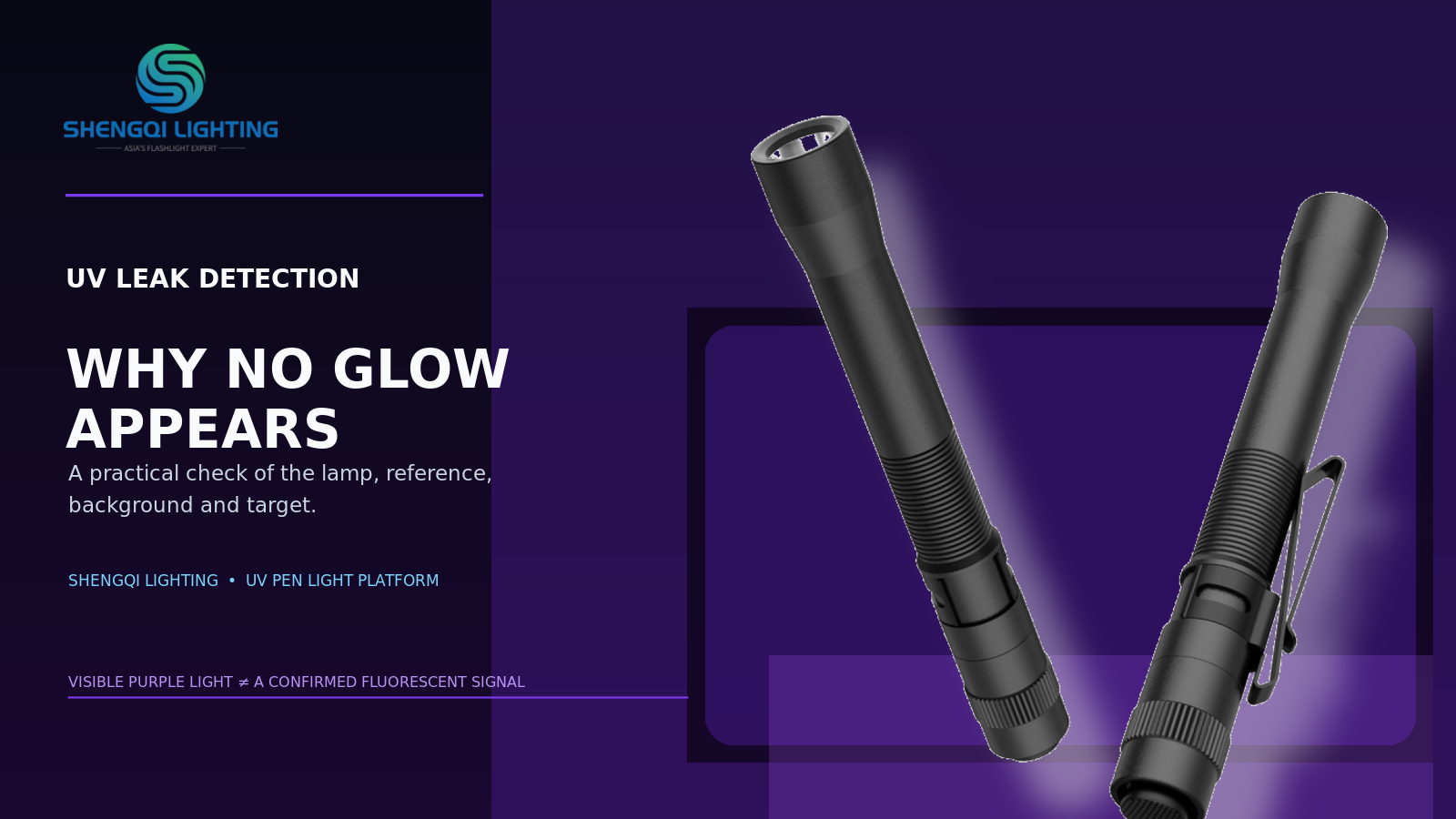
Imagine a dye-assisted inspection where the flashlight produces visible purple light, but the expected fluorescent signal does not appear on the surface being checked. This is a judgment example, not a SHENGQI LIGHTING customer case or a completed field test.
A missing glow can involve dye-and-lamp compatibility, whether the tracer has reached an observable location, and the surrounding viewing conditions. By itself, it does not prove that there is no leak, that the flashlight has failed, or that another wavelength is automatically required. Before interpreting the target area, first confirm that the current observation setup can reveal an appropriate known fluorescent reference under comparable conditions.
The key distinction: seeing purple light confirms that visible light is reaching the eye. It does not confirm that a specific fluorescent leak detection dye is being excited effectively, that enough signal is reaching the surface, or that the result is meaningful for the system being inspected.
Purple Light Is Not the Same as a Verified Fluorescent Signal
In dye-assisted leak detection, a UV flashlight helps an observer see the response of a compatible fluorescent tracer. It does not directly reveal bare refrigerant gas. The fluorescent effect depends on a chain of conditions: the tracer must be appropriate for the system, the lamp must be suitable for that tracer’s documented excitation requirements, the signal must be present where it can be observed, and the inspection conditions must allow the observer to distinguish it from the background.
That is why a flashlight that looks “more purple” to the eye is not automatically more useful for a leak-detection task. Visible purple appearance is not a measurement of effective UV output at the target, and it is not a comparison of two lamps’ suitability for one dye. The dye supplier’s stated lamp requirements and the system manufacturer’s instructions remain the starting point.
Optical matching and chemical matching are also separate questions. A dye may produce a visible response under a particular light source while still being unsuitable for a given system, oil, seal material, or service procedure. A visible response never authorizes adding a chemical tracer to an unapproved system.
First Question: Can This Setup Show an Appropriate Reference?
Before drawing a conclusion from the target area, verify the observation chain with an appropriate fluorescent reference that is recognized by the relevant dye supplier or test method. The purpose is modest but important: to establish whether this lamp, reference, and viewing condition can produce a visible response together. It is not a calibration, a quantitative UV measurement, or proof that the same lamp will work for every dye and task.
Confirm the dye requirement
Check the dye documentation for its stated light-source compatibility. Do not assume that a nominal wavelength, product color, or label alone settles the question.
Check the lamp as used
Confirm the selected mode, power source condition, and that the optical window is clean and unobstructed. These checks do not diagnose every fault, but they prevent an avoidable unknown from entering the comparison.
Check the viewing conditions
Working distance, lamp angle, surface condition, and ambient light can affect whether a visible signal can be distinguished. Do not invent a universal distance or angle; use the applicable product guidance and the actual task.
If filters, glasses, or other accessories are part of the documented observation method, follow the supplier’s instructions for that specific system. Ordinary eyewear or a colored lens should not be assumed to provide UV protection or the intended viewing performance.
Second Question: Is an Observable Tracer Signal Expected at the Target?
A UV leak detection light cannot create the expected dye signal where no compatible fluorescent material is available to observe. In an HVAC or AC example, whether an approved tracer has been introduced, circulated as required, and reached an externally observable location must be evaluated under the applicable system and dye instructions by appropriately qualified personnel.
The physical target also matters. A suspected area may be difficult to reach, visually blocked, recessed, covered, or positioned where the light and the observer cannot obtain a clear path. Surface texture, dirt, oil, reflections, and surrounding materials can complicate the view. These are observation limits, not evidence that a system condition has been ruled out.
Do not try to solve uncertain visibility by adding more dye, mixing dyes, or introducing chemicals into a system without documented approval. The correct next step is to identify which condition remains unknown: tracer permission, tracer location, lamp suitability, target access, or viewing environment.
Third Question: What Does the Observation Actually Allow You to Conclude?
A missing fluorescent signal is a limited observation, not a complete diagnosis. A visible signal is also limited: old tracer residue, an earlier spill, or a naturally responsive background material can create a bright area that still needs explanation. The practical goal is to avoid turning either result into a conclusion that the observation cannot support.
| Observation combination | Reasonable interpretation | Next question to resolve | Conclusion not supported |
|---|---|---|---|
| Known appropriate reference shows no visible response; target also shows no visible response. | The current observation setup has not yet been shown to reveal the expected signal. | Review lamp-to-dye compatibility, reference method, power condition, mode, and viewing conditions. | The lamp is certainly defective, or the system certainly has no leak. |
| Appropriate reference responds; target has no visible fluorescence. | The lamp, reference, and current viewing conditions can produce a visible response together. The target still has unresolved conditions. | Responsible personnel should review tracer history, system requirements, signal path, accessibility, and target conditions. | The system has been proven free of leaks. |
| Comparable background surface also fluoresces. | A background response may interfere with identification of the target signal. | Separate material response, historical residue, possible spill, and the signal associated with the location under review. | Every bright point comes from a current dye leak. |
| Target shows visible fluorescence. | There is a fluorescent indication that requires further explanation in context. | Review its location, background condition, service history, and the prescribed verification method. | A current leak is confirmed, or a repair has been confirmed complete, from one observation alone. |
If no credible, compatible reference is available, say so clearly. The verification chain is incomplete. An arbitrary object that happens to glow under a light source should not be treated as a universal substitute for a reference associated with the dye and inspection method in use.
Compare Samples by the Observation Chain, Not by Purple Appearance
Consider two lamps that appear different to the eye: one may seem to emit more visible purple light, while the other appears less purple. That visual impression alone does not establish which one gives the more useful response for the documented tracer and the intended work conditions. Compare both with the same appropriate reference, at comparable positions, with the same background and ambient-light conditions.
For a technical buyer, the useful record is practical rather than inflated: lamp model and selected mode, reference identity, approximate observation distance, environment, target type, and what remains unknown. This is a repeatable sample-evaluation record, not a laboratory certificate or a performance guarantee.
- Planned fluorescent dye and its publicly documented lamp-compatibility requirement.
- Inspection object, accessibility of the expected signal location, and important surface conditions.
- Expected working distance, ambient light, and any likely background fluorescence.
- Carry, grip, runtime, and power constraints that affect actual use of the light.
- The compliant reference method and the observation record planned for the sample review.
- Open questions that cannot yet be answered from a specification sheet or a photograph.
Discuss the Lighting Platform Only After the Task Is Defined
A UV flashlight for leak detection should be selected around the dye documentation and the intended observation task, not simply because a product is labeled UV or looks technical. SHENGQI LIGHTING’s 2AAA-UV pen light platform is publicly listed with a 365 nm UV LED and a 2 × AAA power configuration. It can be discussed as a compact UV-lighting platform, but that listing does not establish compatibility with a particular dye, an inspection range, UV irradiance, diagnostic accuracy, or suitability for every AC or HVAC system.
For a product-development discussion, meaningful technology is the relationship between light-source choice, electronics, power structure, beam behavior, housing design, and the user’s documented observation task. SHENGQI LIGHTING’s design and development services describe industrial design, optical engineering, electronic design, and prototyping. A final platform decision should still be made against the actual reference, task conditions, and product-specific evaluation scope.
This approach prevents an unsupported shortcut such as “365 nm is always right” or “a brighter purple appearance proves better leak detection.” The right platform is the one whose documented characteristics and sample behavior fit the approved tracer and real observation conditions.
Frequently Asked Questions
Can a UV flashlight show refrigerant gas directly?
No. In dye-assisted inspection, the light is used to help reveal an appropriate fluorescent tracer signal. It should not be described as directly showing exposed refrigerant gas.
Does no visible dye mean there is no leak?
No. A missing visible signal can reflect an unverified observation setup, tracer conditions, access limitations, background conditions, or other unresolved factors. It is not enough by itself to rule out a leak.
Does a glowing reference prove that the light works for every dye?
No. It supports only the narrower conclusion that the lamp, that reference, and those observation conditions produced a visible response together. Other dyes, distances, surfaces, and tasks require their own documented assessment.
Is 365 nm always the right choice for leak detection?
No universal wavelength conclusion should replace the dye supplier’s and system manufacturer’s documentation. The appropriate lamp specification depends on the compatible tracer and the intended observation task.
Can old dye residue look like a current leak?
It can create a fluorescent indication that needs context. Location, background response, prior service history, and the specified verification method should be considered before assigning the signal to a current leak.
Discuss a UV Lighting Platform for Your Documented Task
To discuss a suitable platform or sample-evaluation approach, share the target dye’s public compatibility information, expected working distance, ambient-light conditions, and intended use. This creates a more meaningful starting point than asking whether a UV flashlight “works for leaks” in general.