
Why IFA 2026 Matters to Portable-Lighting Product Teams
IFA Berlin 2026 is taking place September 4–8, 2026 at Messe Berlin. It is not a flashlight trade show. Its relevance comes from the broader consumer expectations visible across smart-home ecosystems, interoperability, energy management, connectivity, intelligent product experiences and human-centered interaction.
Those expectations influence how users judge whether an EDC flashlight platform, headlamp or portable work light feels modern. Portable-lighting brands can learn from consumer-tech design principles without copying consumer electronics feature-by-feature.
Do Not Copy the Trend — Translate It
AI
Bad Translation: Put “AI Flashlight” on the packaging.
Better Question: Is there a sensing, adaptive-control or automation problem that can genuinely be improved?
Connectivity
Bad Translation: Add Bluetooth because connected products look modern.
Better Question: Does the user need remote configuration, asset management, fleet maintenance or another connected workflow?
Energy Management
Bad Translation: Add a large battery and call the product intelligent.
Better Question: Can the user understand remaining power, charging state and the effect of high-output operation more clearly?
Multifunctionality
Bad Translation: Add another emitter because the housing has space.
Better Question: Which recurring task does that function solve, and what space, UI, power and validation cost does it add?
Portable Lighting Is Shifting From Component Specs to System Design
LED model, lumens, battery, ingress protection and range still matter. But mature products also need interaction, carry, charging, feedback, beam roles, secondary functions, thermal behavior and product-line fit. A strong component list does not automatically create a coherent product.
This matters across headlamp product platforms, handheld lights and work lights because different architectures turn similar components into very different user experiences.
Specification Sheet vs User Experience
| Specification | Better Product Question |
|---|---|
| 5 Modes | Can the user reach the right mode quickly? |
| 2000mAh | Does charging and runtime behavior fit the task? |
| Three LEDs | Does each emitter have a defined role? |
| USB-C | Is the connector integrated well into the product? |
| Display | Does it show information the user actually needs? |
The Next Product Advantage May Be Better Interaction, Not Another Feature
Two lights can have similar electrical specifications while one is easier to operate because it uses fewer unnecessary steps, clearer feedback, better tactile recognition, task-first controls and predictable startup. Interaction quality is a product differentiator even when two models have similar electrical specifications.
Multi-Function Products Need Functional Hierarchy
A portable light may combine a main light, side light, red light, UV, sensor, magnet, clip, power indication or another project-specific function. These can be useful, but every added function consumes space, power, UI, PCB capacity, thermal budget, manufacturing complexity and validation time.
PRIMARY FUNCTION defines the product's main job. SECONDARY FUNCTION supports another recurring use case. AUXILIARY FUNCTION handles a narrower supporting task. If every feature is marketed as the main feature, the product usually lacks a clear job.
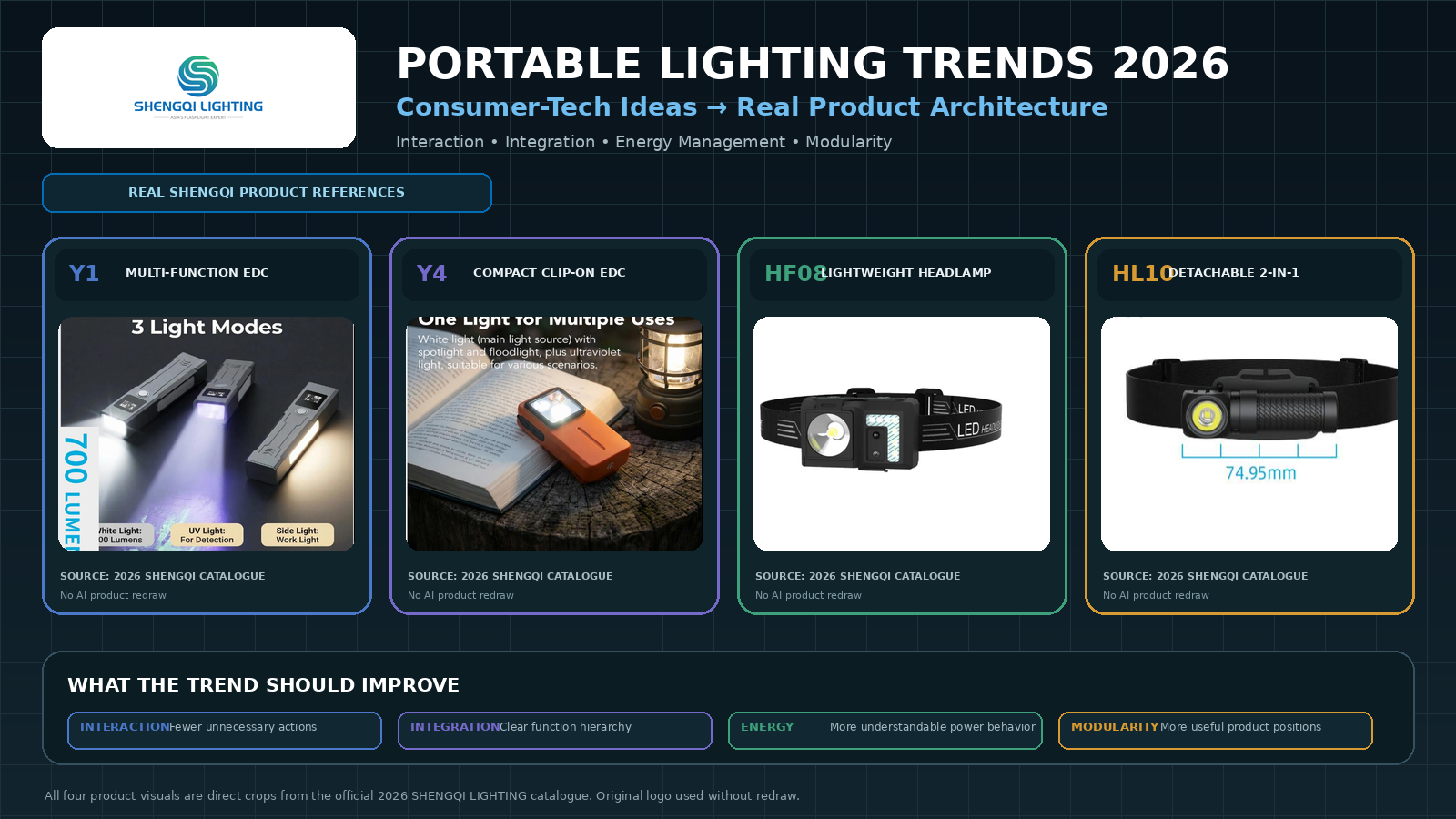
Y1 is one verified multi-function reference combining main white light, UV and side light in a flat rectangular architecture with a built-in 1000mAh battery and magnetic tail. Y4 combines spot, flood and UV in a compact rectangular format. These examples demonstrate architecture density, not a rule that more sources are better.
Different applications can also lead to different task-lighting product architectures where mounting and work positioning matter as much as emitter count.
Feature Density Has a Point of Diminishing Return
Feature density is the number of meaningful functions packed into the available physical and UI architecture. High feature density can create value, but it can also produce tiny controls, confusing interaction, thermal pressure, reduced battery space, less structural material and difficult assembly. The question is not “How many features fit?” but “How many features remain usable?”
| Feature | User Value | Space Cost | UI Cost | Power Cost | Validation Cost |
|---|---|---|---|---|---|
| Secondary White Light | Another beam role | Emitter / optic | Source selection | Additional load | Beam + control |
| Red Light | Auxiliary task | Emitter / window | Extra state | Mode-specific | Task validation |
| UV | Specialized inspection | Emitter / optics | Source hierarchy | Additional load | Functional check |
| Display | Information | Panel / window | Information hierarchy | Standby / active | Accuracy + readability |
| Sensor | Hands-free automation | Sensor / PCB | Override logic | Standby demand | Behavior testing |
| Magnet | Positioning | Mechanical volume | Low | None | Holding-use review |
| Connectivity | Remote / fleet workflow | Radio / antenna | App / pairing | Standby demand | System + security |
| Power-Bank Function | External power use | Power electronics | Status feedback | Shared battery | Charging / output |
Cost in this matrix means architecture complexity, not product price.
Smaller Products Force Better Prioritization
Consumer technology continuously pushes compact integration, and portable lighting experiences the same size pressure. Smaller products have less battery space, thermal mass, control area, optic volume and mechanical packaging freedom. Compactness is not free. Miniaturization moves trade-offs closer together.
Energy Management Is Becoming Part of the User Experience
IFA's broader energy-management discussion provides a useful analogy for portable lighting. Here, useful energy management can mean sensible mode spacing, battery indication, charging feedback, low-voltage behavior, regulated output, appropriate battery selection and controlled standby behavior. Energy management is useful when it makes remaining power more predictable.
A precise percentage display is not automatically better than a simple indicator. The user may only need to know sufficient, low, charging or complete. The correct information level depends on the decision the user must make.
Compact Electronics Still Have to Reject Heat
More functions, higher electrical load and a smaller body can increase thermal-design pressure. Consumer-tech-style integration does not bypass physics. Software can manage heat, but it cannot eliminate the need for a physical thermal path.
Smart Feedback Does Not Require a Screen
A portable light can communicate through an indicator LED, switch illumination, color, blink pattern, simple display or sensor feedback. The simplest feedback method that communicates the required state may be the better product decision.
Information hierarchy starts with one question: What does the user need to know immediately? Possible priorities include light state, battery state, charging state, lockout state and secondary-source state. More information can create less clarity.
Modular Use Can Be More Valuable Than Digital Connectivity
A portable-light ecosystem does not have to begin with an app. It can come from detachable formats, magnetic mounting, clips, shared battery architecture, common accessories or product-family controls.
HL10 provides a real mechanical-modularity reference through its detachable headlamp/flashlight architecture and magnetic tail, paired with a 16340 650mAh battery and 1250 / 500 / 350LM steady main modes. It demonstrates physical adaptability without implying connectivity.
Physical Ecosystem vs Digital Ecosystem
Shared batteries, accessories, mounts, clips, detachable parts and common mechanical interfaces.
Connected configuration, asset management, software interaction or other networked workflows.
A portable-light ecosystem should match the ownership and maintenance model.
A Product Line Should Share Logic, Not Just Styling
Product families can share charging architecture, battery families, control language, CMF, accessory logic or packaging hierarchy while keeping a clear role for each SKU. Consistency should reduce learning and supply complexity without turning every SKU into the same product.
| Product Class | Primary Role | Shared Architecture | Differentiator |
|---|---|---|---|
| Compact EDC | Frequent carry | Family controls / charging | Size and carry priority |
| General EDC | Broad handheld use | Battery / UI family | Function balance |
| Headlamp | Hands-free work | Charging / brand logic | Wearing architecture |
| Work Light | Positioned task lighting | Battery / accessories | Mounting and area light |
| Long-Range Handheld | Directional distance task | Brand / battery family | Optical role |
Five Consumer-Tech Trends Portable-Lighting Brands Should Not Copy Blindly
01. Adding an App Because Apps Look Modern
An app creates another product surface to design, support and maintain. If the user only needs light on, light off and predictable power status, an app may add friction instead of value. Connected functions are more defensible when they solve fleet, configuration or asset-management needs. Connectivity should follow workflow.
02. Adding a Display Without a Clear Information Need
A display consumes area, power and validation effort. If one indicator LED can communicate the required state, a screen may offer little practical benefit. More data is not the same as better feedback. Information hierarchy should decide the interface.
03. Adding More Emitters Without Defining Their Roles
Every emitter needs optics, PCB resources, control logic and validation. Additional light sources are useful only when each solves a repeatable task. Otherwise, the product gains feature density without functional clarity. Multi-function design requires hierarchy.
04. Adding AI Language Without a Real Automated Function
A sensor is not automatically AI, and automation is not automatically AI. If the product does not perform a data-driven or adaptive function that deserves the term, AI language creates a marketing claim without product substance. Automation, sensing and AI are different concepts and should not be used interchangeably in product marketing.
05. Chasing the Smallest Body While Keeping Every Existing Feature
Miniaturization reduces internal space while battery, optics, PCB, controls, structure and thermal paths still compete for volume. Something must change. A smaller body is useful only if the primary task remains comfortable and reliable. Compactness should clarify priorities rather than compress every old feature into less space.
Does a Flashlight Need Connectivity?
Usually not by default. Connectivity becomes reasonable when it supports configuration, fleet maintenance, status, asset management or another professional workflow. For ordinary handheld use, it can add battery load, electronics, app dependency, support work and privacy or cybersecurity considerations. Connected flashlights are not an inevitable endpoint.
Durability and serviceability deserve the same discipline. Longer product life, appropriate replaceability, battery strategy, durable housings, packaging and repair or service approaches may create meaningful value where the business model supports them. These choices should be evidenced rather than turned into unsupported environmental claims.
Brands can compare wider SHENGQI portable lighting products by role rather than assuming every platform should converge on one feature set.
IFA-Inspired Portable Lighting Trend Matrix
This is an IFA-inspired product-strategy matrix, not an official IFA flashlight trend report.
| Consumer-Tech Trend | Portable-Lighting Opportunity | Engineering Cost | Buyer Question | Validation Evidence |
|---|---|---|---|---|
| 1. Better Interaction | Fewer unnecessary steps | UI / firmware | Is the primary task faster? | Task test |
| 2. Energy Management | Predictable power behavior | Driver / sensing | What does the user need to know? | Power-state review |
| 3. Compact Integration | More portable architecture | Volume / thermal | Which subsystem loses space? | Carry + thermal review |
| 4. Multi-Function Design | Multiple real tasks | PCB / UI / space | Does every function have a role? | Task-by-task test |
| 5. Smart Feedback | Clear status | Indicator / display | What must be understood now? | Interpretation test |
| 6. Sensors / Automation | Reduced manual interaction | Sensor / control | Does automation save effort? | Behavior test |
| 7. Connectivity | Fleet / configuration workflow | Radio / software | Why must the product connect? | End-to-end workflow |
| 8. Modular Hardware | More use positions | Mechanical interfaces | Does modularity replace another tool? | Use-position test |
| 9. Shared Product Ecosystem | Common batteries / accessories | Platform constraints | Does sharing reduce complexity? | Family workflow |
| 10. Product-Line Consistency | Lower relearning | Architecture discipline | Which logic should stay shared? | Cross-SKU review |
| 11. Durability / Serviceability | Longer useful ownership | Structure / access | What must survive or be replaceable? | Lifecycle review |
| 12. Data / Information Clarity | Better decisions | Sensing / feedback | Which data changes user action? | Comprehension test |
1. Does it solve a real user task?
2. Can the user understand it?
3. Does it justify the space and power it consumes?
4. Can it be manufactured consistently?
5. Can the benefit be verified on a prototype?
If most answers are “No,” the function should not enter the product simply because it is a trend.
Fourteen Questions Before Turning a Consumer-Tech Trend Into a Flashlight Feature
1. Who is the user? A trend cannot be evaluated without a specific user. Different ownership and task models produce different priorities.
2. What existing user problem does the feature solve? Write the problem before naming the technology. If no recurring problem exists, novelty may be the only justification.
3. Does the feature affect the primary lighting task? Determine whether it improves illumination or only adds a secondary experience.
4. Does it require a new emitter? A new source creates optical, PCB, control and verification consequences.
5. Does it require additional control logic? Every new state adds interaction cost. Decide where it belongs in the hierarchy.
6. Does it require more PCB space? Added electronics compete with battery, structural and thermal volume.
7. Does it increase battery demand? Evaluate active and standby behavior rather than assuming the existing battery is sufficient.
8. Does it increase thermal load? Additional electrical power may require changes to physical heat transfer.
9. Does it change product size or weight? The feature may alter carry, grip or head-worn comfort even if it works electrically.
10. Does it create another failure point? More connectors, sensors, moving parts or software states create more items to validate.
11. Does it require new instructions or training? A valuable feature can still fail if occasional users cannot rediscover it.
12. Can the function be tested objectively? Define evidence before approval so “innovative” does not become the acceptance criterion.
13. Does it fit the brand's existing product family? A new feature should strengthen positioning rather than create an isolated architecture without reason.
14. Will the user still value the feature after the novelty disappears? Repeated utility matters more than launch-day curiosity.
Prototype the User Benefit, Not Just the Technology
A sensor turning on, display illuminating or wireless link connecting proves technical function. It does not prove user value. Technical function and user value are separate validation questions.
Twelve Tests for a Trend-Driven Portable Lighting Prototype
01. Primary-Task Completion Test — Can the product complete its main job more effectively?
02. First-Time User Test — Can a new user identify the primary action?
03. Feature-Discovery Test — Can users find the added function when needed?
04. Control-Clarity Test — Does the function add confusing states?
05. Battery / Charging Feedback Test — Does the information help the user make a decision?
06. Multi-Function Source-Selection Test — if applicable — Can users distinguish primary and secondary sources?
07. Sensor Behavior Test — if applicable — Does automation reduce actual interaction?
08. Connectivity Workflow Test — if applicable — Does the connected function improve the complete workflow?
09. Compact-Grip / Carry Test — Does integration reduce physical usability?
10. Output / Thermal Behavior Review — Does added functionality change useful operating behavior?
11. Repeated-Use Learning Test — Does the benefit remain understandable after time away?
12. Production-Representative Sample Comparison — Does later production reproduce the approved behavior?
Acceptance criteria are project-specific. Relevant portable-light testing capabilities can support verification, but the buyer still needs to define what success means for the project.
How OEM/ODM Buyers Should Translate Trends Into a Portable-Lighting Brief
Do not ask the factory for “a more innovative flashlight.” Define what innovation should improve.
A structured brief should cover: 1. Target User, 2. Primary Task, 3. Product Role, 4. Relevant Trend, 5. User Benefit, 6. Hardware Requirement, 7. UI Requirement, 8. Battery Impact, 9. Thermal Impact, 10. Size / Weight Impact, 11. Manufacturing Impact, 12. Validation Requirement, 13. Commercial Positioning, 14. Product-Line Relationship, 15. Prototype Plan and 16. Production Control.
“We need a smart multifunction EDC flashlight for 2026.”
Define target user, primary task, required functions, why each function exists, control requirement, battery direction, size direction, product-line position, estimated quantity and target market.
HF08 provides one lightweight sensor-enabled architecture reference through 240LM maximum output, a 1200mAh polymer battery, 32g weight including battery, 180° adjustment, Type-C charging and inductive operation. Inductive operation is automation-oriented interaction; it should not be mislabeled as AI.
For brands translating product trends into a real portable-light architecture, SHENGQI can support the engineering path across industrial design, optics, electronics, PCB development, manufacturing and verification through custom flashlight development.
Resources including 75 CNC machines and a fully automated SMT line can support implementation and production, but manufacturing equipment does not prove that a trend is valuable. Buyers should still connect the approved architecture with real flashlight manufacturing capabilities and controlled production evidence.
Frequently Asked Questions About Portable Lighting Product Trends
1. Why is IFA 2026 relevant to portable-lighting brands?
IFA is not a flashlight trade show, but its broader consumer-tech themes show how expectations around interaction, energy management, ecosystems, connectivity and product integration are evolving. Portable-lighting brands can use those principles as a product-strategy lens. The goal is not to copy consumer electronics feature by feature, but to ask whether better controls, power feedback, modularity or system integration can improve a real lighting task.
2. Does a modern flashlight need Bluetooth or app connectivity?
No. Connectivity is justified when it solves a specific workflow such as configuration, fleet maintenance, asset management or status monitoring. For many EDC and portable-lighting applications, an app can add electronics, battery demand, support burden and privacy or cybersecurity considerations without improving the core task. Modern product design can instead come from clearer interaction, disciplined energy management, useful feedback and better physical architecture.
3. What makes a portable light “smart”?
A smart portable-lighting decision improves the task through useful feedback, appropriate automation or clearer interaction. It does not require AI, a screen or connectivity. A sensor may automate a control, but sensing is not automatically AI. Buyers should separate automation, sensing and AI terminology and verify the actual user benefit rather than using “smart” as a general marketing label.
4. Are multifunction flashlights always better?
No. Every additional emitter, display, sensor or secondary feature uses space, power, controls, PCB resources and validation time. Multifunction design is valuable when functions have clear primary, secondary or auxiliary roles and users can access them without confusion. A simpler architecture can be stronger when it performs the intended task more clearly and reliably.
5. Why does compact flashlight design create engineering trade-offs?
A smaller housing reduces available volume for the battery, thermal path, optics, controls, PCB and structural material at the same time. Increasing one subsystem's volume leaves less space for another. Compact design therefore requires stronger prioritization rather than simply scaling every existing feature downward. Grip and carry also need to remain usable after miniaturization.
6. How can better energy management improve portable-lighting products?
Energy management can make power behavior more predictable through sensible mode spacing, battery indication, charging feedback, low-voltage behavior and appropriate regulation. The objective is not necessarily to show a precise percentage. The user may only need to understand whether power is sufficient, low, charging or complete and how demanding modes affect remaining use.
7. What should B2B buyers test before approving a trend-driven flashlight concept?
Buyers should test the primary task, first-time use, feature discovery, control clarity, power feedback, applicable sensor or connectivity workflows, carry comfort, thermal behavior and repeated-use learning. Technical function alone is not enough. The prototype should show that the feature creates a useful benefit and that production-representative samples can reproduce the approved behavior.
8. Can portable-lighting trends be developed into custom OEM/ODM products?
Yes, but the trend should first be translated into a product requirement. Buyers should define the target user, task, intended benefit, hardware and UI implications, battery and thermal impact, size direction, product-family relationship and validation plan. OEM/ODM development is more effective when innovation is described as a measurable improvement rather than as a request for a generally “smarter” product.
Technology Trends Are Useful Only When They Improve Product Decisions
The next generation of portable lighting does not need to be the product with the most electronics. It needs to be the product where optics, controls, power, mechanics and secondary functions support a clear user task with less confusion and better product discipline. Consumer-tech trends can inspire interaction, energy management, modularity and ecosystem thinking, but innovation should ultimately be verified through user value, engineering feasibility and production consistency.
Coming Soon: Shengqi Lighting is preparing to introduce a new Tactical Flashlight with Composite LED. Full specifications and official product information will be released soon.
Translating a Portable-Lighting Trend Into a Real Product?
For the first technical discussion, prepare your Target User, Primary Task, Desired Product Role, Functions Being Considered, Why Each Function Is Needed, Battery Direction, Size / Weight Direction, Estimated Quantity, Target Market and Timeline.
Review SHENGQI LIGHTING's OEM/ODM portable-lighting development approach through our development services.
Contact SHENGQI LIGHTING for an OEM/ODM technical evaluation at sales@shengqilight.com.
Contact SHENGQI LIGHTING