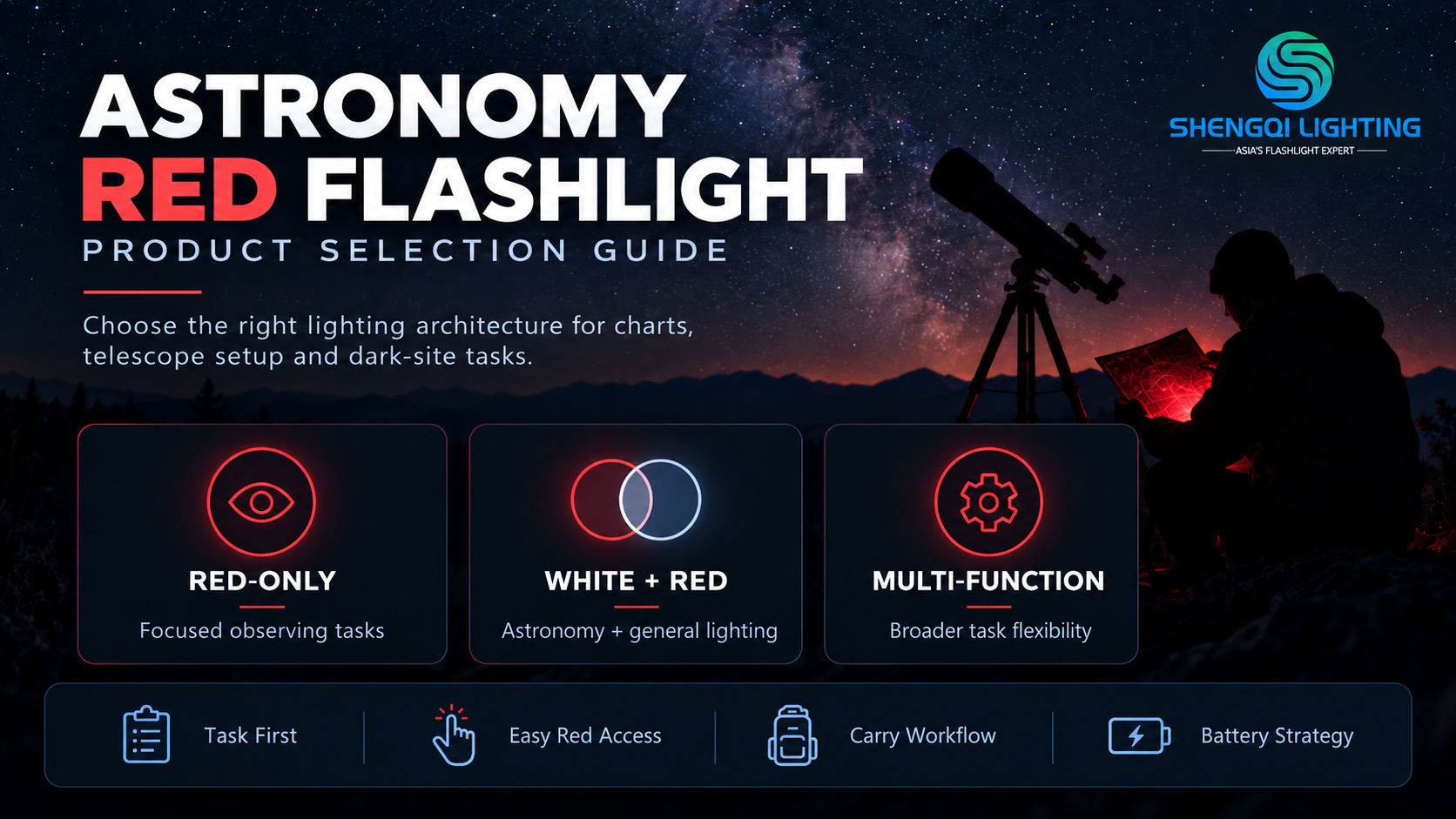

An Astronomy Red Flashlight Is a Product Architecture, Not Just a Red LED
Once a buyer has decided that red illumination belongs in the use case, the next decision is architectural: should red be the only light source, one of two major sources or an auxiliary function inside a broader portable-lighting product?
Low-output control remains important for astronomy use, but today's product-selection question is different: which architecture makes that required behavior easy to use? Buyers who need the deeper optical context can review SHENGQI's existing red-light design requirements for astronomy.
Choose an Astronomy Red Flashlight by Task, Not by Feature Count
Star Chart / Notes: usually centers on local task lighting and straightforward handling. Telescope Setup: may require broader equipment interaction and potentially a separate white-light role outside the observing state. Eyepiece / Accessory Handling: favors close identification and easy retrieval. Equipment Case Search: can require a somewhat larger local field. Mixed Outdoor Use: may make red only one requirement among several.
The same astronomy user may need different product architectures depending on whether astronomy is the only task or one of several tasks.
Build a Task Hierarchy First
Architecture should follow task hierarchy. A requirement that appears only occasionally should not automatically dominate the controls, battery or physical form.
When Does a Dedicated Red-Only Flashlight Make Sense?
A red-only architecture can make sense when the use case is narrow and the user does not need the same product for general white illumination. Fewer source states can support simpler operation, reduce the possibility of accidental white-light activation and make the product role easier to communicate.
The trade-off is narrower utility. A user may need a second white-light tool for setup, walking or other general work. That may be completely acceptable for a specialist astronomy customer, but less attractive for a retail channel expecting one product to serve camping, repair and broader outdoor use.
Dedicated architecture is strongest when the use case is narrow and well defined. It is not automatically the best architecture for astronomy.
When Does a White-and-Red Flashlight Make More Sense?
White + red can combine astronomy local-task lighting with general illumination in one product. That may fit telescope setup, mixed outdoor use or customers who do not want to carry a second light.
Adding white light expands utility but also changes the control problem. The design must decide how sources are selected, whether red and white share one switch, whether separate controls make more sense or whether a source-selection command is required. It also needs to consider whether a user can accidentally enter an unwanted white state.
When Does a Multi-Function Portable Light Become Useful for Astronomy?
A multi-function architecture may combine white, red, UV, side light, magnet, clip, secondary beam or another project-specific function. It becomes useful when several of those functions solve recurring tasks for the same customer rather than simply increasing the specification list.
An astronomy feature does not automatically justify a multifunction product, and a multifunction product does not automatically make a better astronomy light.
The Function Tax
Every added function can consume internal space, button logic, PCB resources, battery capacity, training, validation time and user attention. In this article, Function Tax means architecture complexity—not a financial tax or fee.
If the user must remember how to access five unrelated functions just to reach red light, the product may be solving too many problems at once.
Form Factor Changes How an Astronomy Red Flashlight Fits the Observing Workflow
Compact Handheld
A compact handheld can fit pockets and equipment bags easily and reduce carry burden. The trade-off is less internal space for battery, controls, optics and thermal structure. Small size is useful only when the controls remain easy enough to find and operate.
Pen-Style
Pen-style architecture can suit charts, notes, close equipment work and shirt- or pocket-oriented carry. It does not mean every pen-light product platform is appropriate for astronomy; the required red-light configuration and controls still need to be defined.
Tubular Handheld
A tubular handheld offers a familiar grip, a front-facing beam and can support different replaceable or rechargeable power architectures depending on the design. It may require more carry volume, and cylindrical bodies may need design features that reduce rolling on equipment trays.
Flat / Rectangular Portable Light
Flat architecture can create anti-roll geometry and space for clips, side lights or multi-function layouts. That can be useful, but the architecture is normally more function-dense than a simple dedicated tube. Flat is not automatically more advanced or more suitable for astronomy.
Compact vs Pen-Style Astronomy Flashlight: Different Carry Priorities
| Decision Area | Compact Handheld | Pen-Style | Buyer Question |
|---|---|---|---|
| 1. Carry | Pocket / bag oriented | Pen / shirt / pocket oriented | Where is it stored? |
| 2. Pocket Space | Shorter body possible | Long narrow profile | Which shape fits the user's carry? |
| 3. Grip | Short-body grip | Pen-like grip | How is the product held? |
| 4. Chart Reading | Can support local task use | Can suit close pointing / reading | How is the chart handled? |
| 5. Equipment Adjustment | Depends on grip and beam | Useful for localized inspection | What equipment is adjusted? |
| 6. Switch Area | Limited by compact body | Limited by narrow diameter | Can controls be identified by touch? |
| 7. Battery Space | Architecture dependent | Often narrow-cell oriented | What power workflow is needed? |
| 8. Beam Format | Depends on optic volume | Narrow housing constrains optics | What task area must be lit? |
| 9. Branding Area | Depends on body surfaces | Long narrow marking zone | How much surface is usable? |
| 10. Best-Fit Product Role | Compact carry / mixed formats | Close task / pen-oriented carry | What is the primary role? |
A standard tubular handheld can also be the correct choice where grip, replaceable power or general-use capability matters more than minimum carry volume. The selection is not limited to compact versus pen-style.
Select the Beam for the Task, Not for the Longest Distance
Ask what the user is actually doing: reading a chart, looking inside a case, checking telescope controls or walking between equipment. Those tasks create different beam priorities.
LOCAL TASK BEAM: concentrated around a small working area. CONTROLLED WIDER TASK BEAM: covers a larger close area without turning the product into an area light. GENERAL-PURPOSE WHITE BEAM: belongs to broader non-red tasks where the architecture includes white illumination.
Maximum beam distance is usually not the first procurement criterion for the red-light task. If the same product also functions as a general outdoor flashlight, white-light distance may be a separate requirement. Do not make the red-light task inherit specifications that belong to the white-light task.
Buyers comparing handheld flashlight platforms should therefore separate source roles before comparing headline performance.
Red-Light Access Should Match the Product Architecture
A red-only product can keep control complexity relatively low. A white + red product requires a source-selection decision. A multi-function product usually needs a clearer functional hierarchy so the user does not cycle through unrelated states simply to reach red.
Direct red access can be an important selection factor where the user wants to reduce unintended white activation, but not every astronomy-related flashlight must use direct red access.
Control Complexity Ladder
Red Only
Red + White
Multi-Source
Complexity does not equal quality. A more complex architecture is justified only when the additional functions support real tasks.
Astronomy Flashlights Spend More Time Being Carried Than Being Shined
Consider the full carry environment: pocket, telescope case, accessory bag, lanyard, jacket, table and equipment tray. Selection factors can include accidental activation, clip position, lanyard use, grip, retrieval in darkness and whether the body rolls when placed beside equipment.
A cylindrical product may use a clip, flat section, head geometry or another design feature to reduce rolling, but no single anti-roll method is mandatory. Likewise, clips and lanyards are valuable only where they fit the workflow.
Battery Architecture Should Match How the Astronomy Light Is Stored and Used
Built-In Rechargeable: can support compact integration and direct charging. Replaceable Lithium: can allow battery swaps where that workflow is useful. AA / AAA: can offer standardized replacement availability. None is universally superior.
Battery capacity in mAh cannot identify the right astronomy flashlight by itself. The buyer must also consider output behavior, product size, charging access, storage, replaceability and carry.
If the product is used only occasionally, storage behavior and checking battery or charging state before an observing session may matter more than peak output. Avoid assuming that a high-capacity specification alone solves the power workflow.
Different compact EDC flashlight platforms illustrate how strongly battery architecture and body format can influence each other.
Astronomy Red Flashlight Product Selection Matrix
| Buyer Requirement | Red-Only | White + Red | Multi-Function | Key Validation Question |
|---|---|---|---|---|
| 1. Astronomy Is Primary Use | Strongly focused role | May fit | May add unnecessary functions | What non-red tasks recur? |
| 2. Mixed Outdoor Use | Narrower utility | Broader utility | Could support more tasks | Which extra tasks matter? |
| 3. Simple Operation | Potentially simpler | Source logic required | More states likely | How many actions reach red? |
| 4. Direct Red Access | Naturally focused | Must be defined | Must be prioritized | Can red be reached predictably? |
| 5. White-Light Utility | Requires another tool | Included | Usually possible | How often is white needed? |
| 6. Low-Light Task | Clear dedicated role | Can support it | Can support it if accessible | Is red behavior appropriate? |
| 7. Multiple Lighting Roles | Limited | Two main source roles | Broader possibilities | Does each function have a task? |
| 8. Compact Carry | Possible | Possible | Feature density may affect size | Are controls still usable? |
| 9. Pocket / Pen Carry | Possible | Architecture dependent | May require more body area | Which body shape fits carry? |
| 10. Equipment-Bag Carry | Suitable if dedicated | Suitable | Suitable if retrieval is clear | Can it be identified in darkness? |
| 11. Battery Replacement | Platform dependent | Platform dependent | Platform dependent | Is swapping part of workflow? |
| 12. Rechargeable Convenience | Possible | Possible | Possible | Is charging easy before use? |
| 13. Branding Area | Body dependent | Body dependent | May offer larger surfaces | Does branding affect grip? |
| 14. User Training | Potentially low | Moderate | Potentially higher | Can users rediscover controls? |
| 15. Product Complexity | Focused | Moderate | Higher | Does added complexity add value? |
Use-Case Recommendation Matrix
| Use Case | Likely Architecture Direction | Why | What to Verify |
|---|---|---|---|
| Star-Chart Reader | May favor red-only or simple white + red | Task is narrow and close-range | Red access and chart-task fit |
| Telescope Setup User | Could favor white + red | General setup may need another source | Source selection and beam role |
| Astrophotography Kit | May favor compact or specialized architecture | Bag space and equipment handling matter | Carry, retrieval and controls |
| Astronomy Club Shared Kit | May favor simpler control architecture | Multiple occasional users | Learning and repeatability |
| Multi-Use Outdoor Customer | Could favor white + red or multifunction | Astronomy is one of several tasks | Function hierarchy and complexity |
Five Mistakes Buyers Make When Choosing an Astronomy Red Flashlight
01. Choosing the Product With the Most Features
More features can look attractive on a comparison sheet but create more states, controls and learning requirements. If the primary task is simple chart reading, functions unrelated to that task may add little value. Buyers should separate primary, secondary and occasional requirements before selecting the platform. The better architecture is the one that solves the defined workflow without unnecessary Function Tax.
02. Treating Every Red-Light Product as an Astronomy Product
A red emitter alone does not confirm that the product fits astronomy. Red access, handling, beam role and product architecture still need to match the task. A general-purpose product may contain red illumination for a completely different reason. Evaluate the whole product rather than the LED list.
03. Ignoring How Red Mode Is Accessed
A product can have useful red output but an inconvenient path to reach it. This becomes especially important in white + red or multi-source products. Buyers should test the complete OFF-to-red workflow and note whether unrelated source states create friction. Direct red access may matter, but it should be judged in context.
04. Choosing the Smallest Body Without Testing the Controls
Compactness reduces carry volume, but it also reduces control area and internal packaging space. A button that works well in a product rendering may be difficult to locate by touch. The user should test grip, retrieval and control identification under representative conditions. Small is useful only when it remains usable.
05. Comparing Battery Capacity Without Considering the Product Workflow
A larger mAh figure does not automatically make the product more suitable. Battery type affects size, storage, charging and replacement behavior as well as nominal capacity. The right architecture depends on how often the user observes and how the product is prepared before use. Power should be evaluated as a workflow rather than a single number.
Compare Product Architectures Side by Side Before Choosing the Platform
B2B buyers should avoid reviewing a red-only sample one week, a white + red sample a month later and a multi-function sample in a completely different environment. Put candidate architectures into the same use-case review so differences in control, carry, beam and complexity become easier to see.
| Evaluation Area | Sample A | Sample B | Sample C | Buyer Observation |
|---|---|---|---|---|
| Red Access | Review | Review | Review | Steps, predictability, accidental states |
| Lighting Role | Review | Review | Review | Does each source have a task? |
| Beam | Review | Review | Review | Does the field match the task? |
| Controls | Review | Review | Review | Can users operate by touch? |
| Carry | Review | Review | Review | Pocket, bag, case or lanyard fit |
| Battery | Review | Review | Review | Charging and replacement workflow |
| Size | Review | Review | Review | Does size improve or reduce usability? |
| Weight Feel | Review | Review | Review | Carry and handling impression |
| Product Complexity | Review | Review | Review | Do added functions earn their complexity? |
| Astronomy Task Fit | Review | Review | Review | Which task does it support best? |
Twelve Tests for Comparing Astronomy Red Flashlight Architectures
01. Red-Light Access Test — Compare how clearly each architecture reaches the required red source.
02. Star-Chart Task Test — Use each sample for the same chart-reading task.
03. Telescope-Control Task Test — Compare handling and local illumination around equipment controls.
04. Equipment-Case Search Test — Check whether the useful field matches bag or case work.
05. Eyes-Off Control Test — Determine whether controls can be identified without visual inspection.
06. Carry / Retrieval Test — Compare pocket, case, bag or lanyard workflows.
07. Accidental White-Activation Test — if applicable — Review unwanted source changes on multi-source platforms.
08. Beam-Spill Review — Compare how much illumination reaches outside the intended task area.
09. Battery / Charging Workflow Review — Compare preparation, charging and replacement requirements.
10. Product-Complexity Review — Ask which added functions solve recurring tasks.
11. Repeated-Use Learning Test — Check whether users can rediscover the important controls after time away.
12. Production-Representative Sample Review for B2B Projects — Confirm that the selected production architecture matches the approved product definition.
Relevant portable-light testing capabilities can support defined verification requirements, but architecture selection should begin with representative tasks rather than laboratory numbers alone.
How Brands Should Select an Astronomy Red Flashlight Platform Before Customization
A disciplined platform-selection process can follow: 1. Target Market → 2. Target User → 3. Primary Astronomy Task → 4. Secondary Tasks → 5. Red-Only / White + Red / Multi-Function → 6. Form Factor → 7. Control Requirement → 8. Battery Direction → 9. Carry Requirement → 10. Sample Comparison → 11. Platform Selection → 12. Then Customization.
Choose the platform before choosing the Pantone color. Cosmetic branding cannot correct an architecture that is wrong for the user's task.
What to Send When Asking a Supplier for Astronomy Red Flashlight Platform Options
1. Target Market — Where the product will be sold or used.
2. Target User — Astronomy user, club, equipment buyer or another defined group.
3. Primary Astronomy Task — The main activity the light must support.
4. Secondary Use Cases — Other recurring tasks that may justify additional functions.
5. Red-Only or Multi-Source Preference — Initial architecture direction if already known.
6. White-Light Requirement — Whether general white illumination belongs in the same product.
7. Form-Factor Preference — Compact, pen-style, tubular, flat or open to supplier options.
8. Control Requirement — Any priority around red access or simple source selection.
9. Battery Direction — Rechargeable, replaceable or open to evaluation.
10. Carry Requirement — Pocket, case, bag, lanyard or other expected workflow.
11. Estimated Quantity — Used to evaluate suitable platform and commercial path.
12. Target Timeline — Needed to assess development and sourcing feasibility.
The supplier response should not be only a catalog. Where available, it should identify relevant architecture options, key differences, configuration assumptions, technical questions, sample availability and the customization boundary.
Existing SHENGQI platforms such as Y1, Y4 and G8 illustrate different flat, compact rectangular and compact EDC mechanical architectures; they should not be treated as astronomy-specific red-light products unless a separately defined red-light configuration is technically established and verified. Buyers can review the broader portable lighting product range as architecture reference rather than as an astronomy recommendation list.
After the correct architecture has been selected, SHENGQI can support deeper custom flashlight development across Industrial Design, Optical Engineering, Electronic Design, PCB Layout, Manufacturing, Testing and OEM/ODM product development.
Frequently Asked Questions About Astronomy Red Flashlights
1. What is an astronomy red flashlight?
An astronomy red flashlight is a portable task light that provides red illumination for observing-related work such as charts, telescope accessories or equipment checks. It may use a red-only, white + red or multifunction architecture. The right format depends on task, controls, carry and power requirements rather than the red LED alone.
2. Should an astronomy flashlight be red-only or include white light?
There is no universal winner. Red-only can support a focused, simple product role, while white + red can combine astronomy use with general illumination. Buyers should decide whether white light is a recurring requirement and whether adding it makes red-light access or control logic unnecessarily complex.
3. Is a multifunction flashlight better for astronomy?
No. It depends on actual user tasks. A multifunction product makes sense when several functions solve recurring needs for the same user. If additional emitters, magnets or secondary lights do not support real tasks, they can add control, battery and learning complexity without improving astronomy use.
4. What form factor works best for an astronomy red flashlight?
There is no universal best form factor. Compact handhelds, pen-style lights, tubular handhelds and flat portable products serve different carry and handling priorities. The buyer should consider storage, grip, control size, beam role and whether the product is dedicated or multifunctional.
5. Is a pen-style red flashlight useful for astronomy?
It can be, particularly for close tasks, notes or pocket-oriented carry, but the pen-style body alone does not make the product astronomy suitable. Red-light configuration, access, beam role and control usability still need to match the intended task.
6. How important is direct access to red light?
Direct red access can be important for users who want to reduce unwanted white-light activation or minimize control steps. It is a product-selection factor rather than a universal requirement. Dedicated red-only products, dual-source lights and multifunction products may solve red access in different ways.
7. What should buyers test when comparing astronomy red flashlight samples?
Compare red access, beam role, controls, carry, battery workflow, task fit, size and product complexity under the same representative use cases. For multi-source products, also check accidental white activation where relevant. Side-by-side evaluation makes architecture trade-offs easier to see.
8. Can an existing flashlight platform be adapted for an astronomy product?
Possibly. It depends on the platform, engineering feasibility and required red-light behavior. An existing body may already fit the desired carry and battery workflow, while optics, controls or electronics may still need modification. Buyers should evaluate the platform first and define customization only after technical feasibility is confirmed.
Select the Architecture That Fits the Observing Task
An astronomy red flashlight should not be selected simply because the specification includes a red LED. The better architecture is the one that gives the target user the required red-light role, form factor, control access, carry method and power system without unnecessary complexity. Product architecture should be resolved before cosmetic branding turns the platform into a finished commercial SKU.
SHENGQI is also developing additional portable-lighting platforms that include auxiliary red-light functionality, expanding the range of architectures available for future application-specific development. Final product positioning and specifications will be released after the relevant development information is confirmed.
Selecting a Red-Light Platform for an Astronomy Product?
For the first technical discussion, prepare your Target Market, Target User, Primary Astronomy Task, Secondary Use Cases, Red-Only / White + Red Preference, Form-Factor Direction, Control Requirement, Battery Direction, Carry Requirement, Estimated Quantity and Target Timeline.
Review SHENGQI LIGHTING's OEM/ODM portable lighting development capabilities.
Contact SHENGQI LIGHTING for an OEM/ODM technical evaluation at sales@shengqilight.com.
Contact SHENGQI LIGHTING