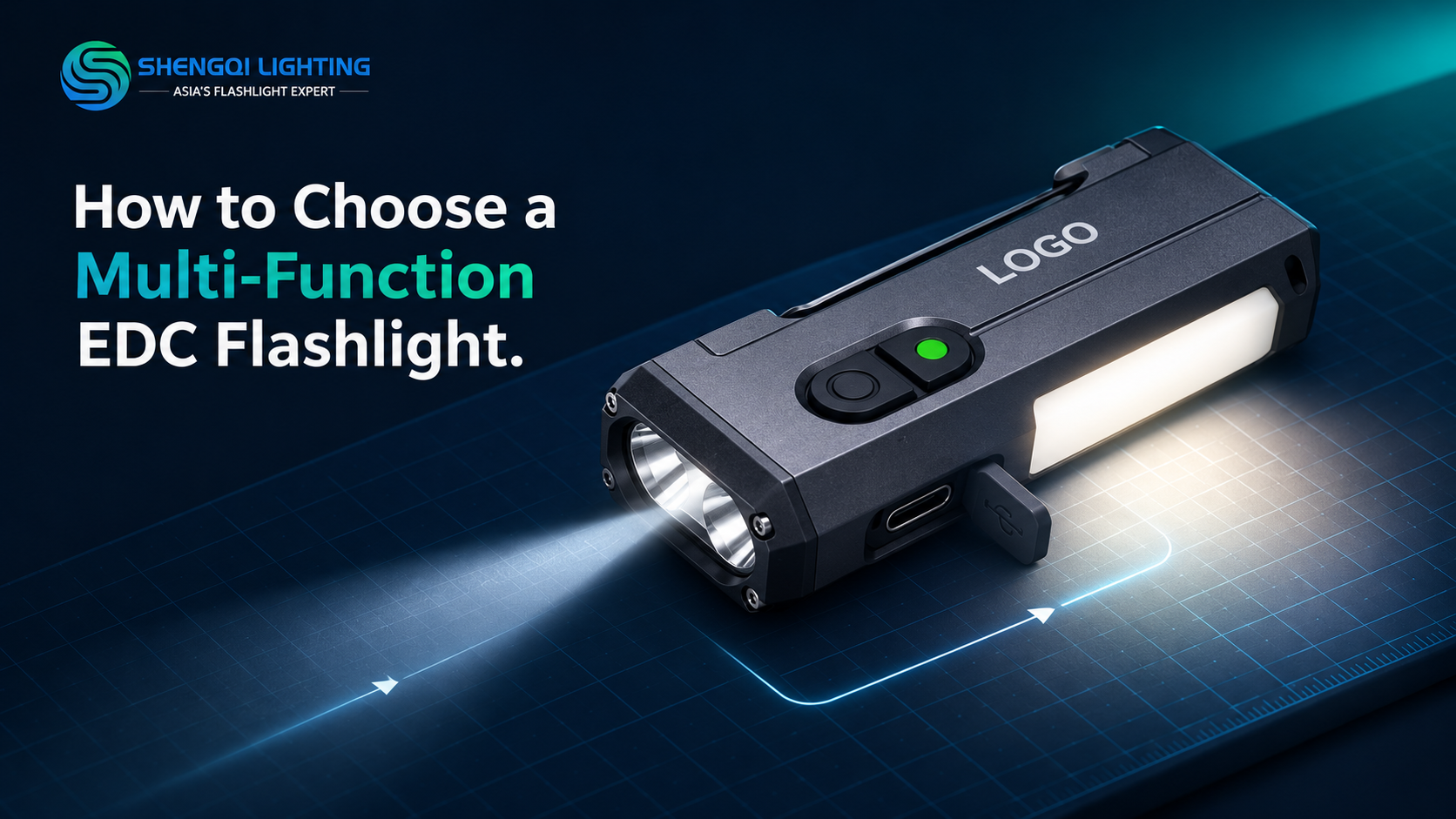
A multi-function EDC flashlight is most useful when its light sources, adjustable structure, carry method and essential controls support one continuous task. Imagine locating an object in hand, moving closer to inspect it, then needing both hands for the next step. The right product should reduce unnecessary re-gripping, re-aiming and re-positioning between those moments. To choose a multi-function EDC flashlight, begin with two or three real tasks in sequence, then keep only the features that have a clear role in that sequence and can be verified on a sample.
Start With the Task Sequence, Not the Feature List
The word “multi-function” can describe a long feature list, but a list does not explain whether the product feels coherent in use. An EDC light earns its place in everyday carry when a user can move from one common task to the next without creating new friction. A useful selection process therefore starts with a sequence, not a catalog of modes.
For example, a person may use a handheld beam to locate an item, bring the light close to inspect a label or small surface, and then need both hands to continue the task. Another user may switch between walking through a dim space, checking nearby objects and attaching the light to a garment or piece of gear. These are illustrative task paths, not customer cases. Their value is that they reveal where a light must change direction, where a different beam character may help and when a carry feature becomes part of actual use.
Write the sequence in plain language before comparing products. Ask where the light begins, what needs to be seen next, whether the user must move the beam, and whether the user must release one or both hands. A feature should remain in the concept only if it has a clear answer to one of those questions. This keeps an EDC flashlight feature selection focused on observable utility rather than novelty alone.
Decide Which Functions Actually Work Together
A useful feature combination has four connected layers: the light itself, the structure that directs it, the way the product is carried or supported, and the small amount of interaction needed to move between tasks. Looking at those layers together prevents a common mistake: assuming that a feature exists in theory because it appears on a product specification.
Light source role
Ask what each source is supposed to help the user see. A directed beam and a wider task light may have different jobs, but the product concept should explain when each one is needed.
Direction and structure
A movable head or body can change where light is aimed. The feature matters only when it helps place illumination where the task happens without forcing repeated repositioning.
Carry and support
A clip, attachment point or support option affects where the light can be used. It does not automatically prove that the chosen attachment position is practical for every user or task.
This distinction is especially important for products with multiple light sources. Two or more sources in one body do not establish that they can be operated simultaneously, that their controls are equally convenient or that the light remains aimed at the same place after a source change. Those are separate sample questions. A well-designed multi-light EDC flashlight makes the division of work clear rather than asking users to discover it through trial and error.
Controls still matter, but they should support the sequence rather than become the entire selection criterion. If your team needs a detailed evaluation of switches, mode memory or lockout behavior, use the separate flashlight controls and modes guide. Here, the key question is simpler: does the necessary interaction help the user transition between the intended tasks with reasonable clarity?
Feature Combination Selection Table
| Task Sequence | Useful Feature Combination | What to Check on a Sample | What the Feature List Does Not Prove |
|---|---|---|---|
| Locate an object, then inspect it at close range | A directed source plus a wider nearby work-light option where the task genuinely needs both. | Move from the first viewing distance to the second and observe whether the product needs awkward re-aiming. | That both sources operate together, or that their outputs have the same intended role. |
| Handheld observation, then a two-hand task | A light source, adjustable aiming structure and an actual carry or support method. | Test whether the product can be placed or attached in a useful orientation for the task. | That a clip or movable part is suitable for every material, location or body position. |
| Carry the light, then use it immediately | Pocket-compatible form, retention feature and a control layout that can be evaluated in the intended carry position. | Use the planned carry method, retrieve the sample and record extra adjustments before the first useful beam appears. | That the same carry arrangement will suit every garment, pocket or user preference. |
| Move between general navigation and a specific nearby task | Clearly separated light functions and only the controls required to move between them. | Follow the sequence without consulting a feature chart and note where the function assignment becomes unclear. | That more listed modes create a more understandable user experience. |
| Brand demonstration of a technology-forward EDC concept | Visible functional separation, purposeful movement and a carry concept tied to a user scenario. | Ask whether each visible feature has a demonstrable task and whether the transition looks natural. | That a visually complex product automatically provides a better everyday-carry experience. |
What Useful High-Tech EDC Design Looks Like
A technology-forward EDC flashlight does not need to perform every possible job. Its value can be seen when a user can identify what each element does, how the structure changes the placement of light and why a carry feature belongs to the workflow. Clear functional division creates a more credible product story than decorative effects or an unexplained collection of modes.
The Y6 4-in-1 EDC flashlight provides one example of a visible feature combination. Its current product page identifies spotlight, floodlight, red light and UV light, together with a 90-degree pivoting head, a 360-degree rotating clip and a maximum output of 500 lumens. In selection terms, the important point is not the number “four.” It is whether the intended user has a defined reason for each light type and whether the movable head and clip help position the chosen light for the task.
Those stated features do not establish a particular switching sequence, simultaneous-lighting behavior, clip load limit, runtime or UV application result. They also do not prove that every angle or attachment point will be stable and useful. A sample walkthrough is still needed. The technology is meaningful when its structural movement and lighting choice reduce a real step in the user’s sequence.
The EF02 dual-light EDC flashlight illustrates a different direction: dedicated spotlight and floodlight modes with a stated maximum output of 1000 lumens. That combination can be evaluated around the relationship between a more directed observation task and a wider nearby task area. The listing should not be used to infer a specific color-temperature range, color-rendering result, adjustment behavior or performance level beyond the stated product facts.
Run a Complete Task Walkthrough Before Approving the Feature Mix
Testing every listed feature once is not enough. A multi-function product can appear impressive when each function is demonstrated separately but still interrupt the user when the tasks are connected. The more reliable approach is to recreate the intended sequence from beginning to end with a sample product.
- Write down two or three target tasks in their natural order.
- Identify the required lighting position at each step: in hand, near the object, facing a work area or supported in one place.
- Perform the complete sequence with the sample and record where an extra grip change, aim adjustment or relocation is needed.
- Sort each feature into Keep, Remove or Verify.
Keep means the feature clearly supports the intended user and task. Remove means the team cannot identify a credible use for the target customer. Verify means the feature exists but its aiming, access, mounting position or interaction still needs product-specific confirmation. This method does not require arbitrary time targets, cycle counts or performance thresholds. It simply reveals whether the product remains coherent once its features must work together.
The hidden cost of an unfocused feature set
When an auxiliary function has no role for the target user, the product story becomes harder to explain. When the structure cannot place the selected light where it is needed, the user repeatedly repositions the product. When a demonstration shows each function separately but not the transition between them, the concept can look more convincing than the everyday experience. These are product-definition issues, not evidence of a specific product defect or market outcome.
Define the Feature Combination Before Development
For brands and product teams, a concise experience statement is more useful than a long list of isolated functions. It gives industrial design, optics, electronics and sample evaluation a shared point of reference without becoming a generic development-process document.
Example product-experience statement
“The user carries one compact light to locate an object, inspect it at close range and direct illumination toward a stationary task. The selected light sources must have distinct roles. The structure and carry method must support the required lighting position. The sample review will follow that full task sequence and record any unnecessary repositioning.”
This is not an RFQ template or a substitute for detailed engineering requirements. It is a practical starting point for deciding what the product should feel like before the team adds features. Relevant EDC platforms can be reviewed through the SHENGQI LIGHTING EDC flashlight category.
Frequently Asked Questions
How many functions should an EDC flashlight have?
There is no useful universal number. Keep the functions that serve the target user’s real task sequence. Remove functions with no clear purpose, and verify features whose practical placement or operation remains uncertain.
Do multiple light sources make a flashlight more useful?
They can, when each source has a defined task and the user can transition between tasks naturally. Multiple sources alone do not prove simultaneous operation, equivalent output or unchanged beam placement after switching.
Why does an adjustable head matter on an EDC flashlight?
It can matter when a user must change the position of light without constantly changing their hand position. Its value depends on the intended task and the actual support or carry position used with the product.
Does a pocket clip automatically create hands-free lighting?
No. A clip provides a possible carry or attachment method. The sample must still show whether the selected position is secure, practical and able to aim light at the relevant task.
How should a brand evaluate a multi-function EDC flashlight sample?
Run the complete intended task sequence. Observe light placement, carry or support position and the actions needed to move between tasks. Judge the combination rather than approving features one by one in isolation.
Build an EDC Lighting Experience Around the Actual Task
SHENGQI LIGHTING supports product-design and OEM/ODM discussions around lighting roles, physical form, carry concepts and sample evaluation. The strongest starting point is a clear description of the target tasks and the functions that must work together.
To discuss an EDC lighting concept, review product development services, use the contact page, or email sales@shengqilight.com with the intended task sequence and desired feature combination.