365nm vs 395nm UV Flashlights for Field Inspection
Direct answer: both 365nm and 395nm sources are in the UVA region. A 365nm flashlight often produces less visible violet spill and can make some fluorescent responses easier to distinguish, especially when paired with a suitable filter. A 395nm source is closer to visible violet, so the beam itself is easier to see and may be cost-effective for some tasks. Suitability depends on the target material, irradiance, working distance, ambient light, filter, measurement method and safety assessment—not wavelength alone.
1. Wavelength changes what the operator sees
UV fluorescence occurs when a material absorbs shorter-wavelength energy and emits longer-wavelength light. Different dyes, minerals, residues, security features and biological materials respond differently. Therefore, a wavelength that performs well on one target may be weak on another. The correct purchasing method is to test representative samples under realistic lighting and at the intended distance.
The CDC defines UVA as 315–400nm. Both nominal 365nm and 395nm sources fall within that band, although a real LED has a spectral distribution rather than a single infinitely narrow line. A supplier should provide the LED part, spectral data or peak-wavelength tolerance and the final product's measured output conditions.
2. 365nm and 395nm: practical comparison
| Factor | 365nm tendency | 395nm tendency | Verification |
|---|---|---|---|
| Visible beam | Usually less visibly violet | Usually more visibly violet | Controlled photos plus spectrum |
| Fluorescence contrast | Often preferred when visible spill masks weak fluorescence | Can work well on strong, broad-response targets | Test the actual target and ambient light |
| Filtering | A matched filter may improve contrast further | Filtering must account for the source spectrum | Filter transmission curve and assembled output |
| Safety | Requires exposure assessment | Requires exposure assessment | Irradiance, distance, duration and controls |
3. Filters, optics and the complete optical stack
A UV-pass/visible-blocking filter can reduce unwanted visible emission, but it also introduces transmission loss and thermal/mechanical requirements. Its spectrum must match the LED and target. A generic dark-looking window is not proof of the required transmission. Ask for the filter material, transmission curve, thickness, supplier/revision and final assembled measurement.
Reflector or lens geometry determines irradiance distribution. A narrow beam can increase irradiance in a smaller area; a flood beam covers more area but may reduce signal at the same distance. Protective windows, coatings and contamination can also change transmission. The AR glass, diffuser and filter guide explains these stack-level trade-offs.
4. Safety controls belong in the product brief
UV exposure can affect eyes and skin. The risk depends on wavelength, irradiance, distance, exposure duration and geometry. Controls may include limiting power or duty cycle, shielding, interlocks for fixtures, warnings, restricted use, appropriate protective equipment and training. Do not use the fact that a beam looks dim as evidence that exposure is low.
UVA inspection lights are not the same as UVC disinfection products. Buyers should not infer germicidal performance from the word “UV.” The FDA warns that direct UVC exposure can injure skin and eyes and that product performance varies. This guide addresses 365nm and 395nm inspection lights, not pathogen inactivation.
5. OEM verification checklist
- Define the target: real samples, working distance, inspection area and ambient light.
- Lock the source: LED supplier/part, peak wavelength and tolerance, drive current and approved alternatives.
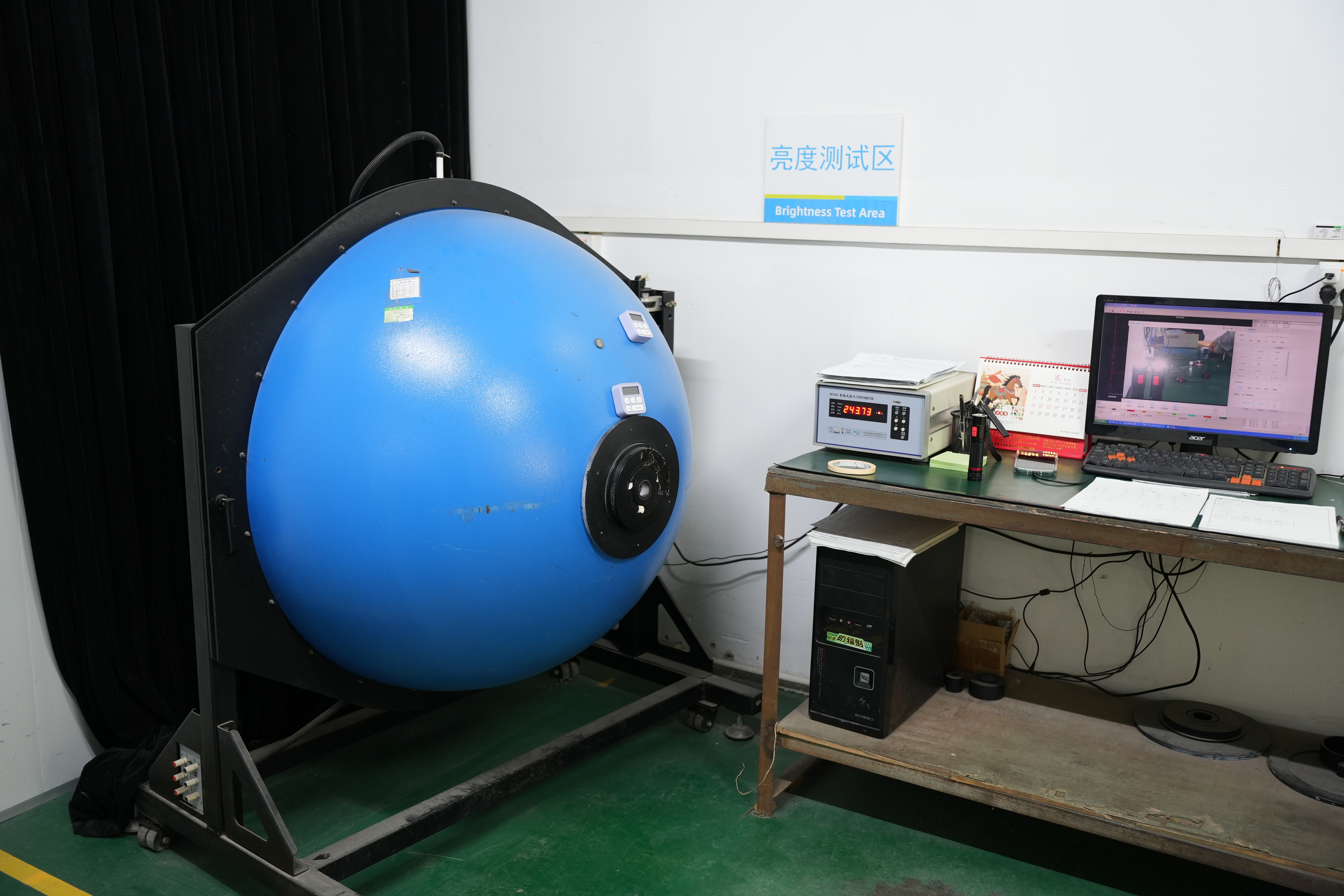
- Measure the assembled product: spectrum and irradiance at stated distances, modes and thermal states.
- Validate the filter: transmission curve, material, thickness and retention design.
- Assess safety: foreseeable exposure, labels, instructions and controls for the intended market.
- Control substitutions: re-evaluate when LED, filter, driver, optic or window changes.
If the product combines UV with a white-light channel, evaluate each mode and accidental activation paths. Battery regulation also matters because declining voltage or thermal step-down can change irradiance during an inspection; see the battery and driver guide.
Frequently asked questions
Is 365nm always better than 395nm?
No. 365nm often improves contrast for some fluorescent targets, but 395nm can be suitable for strong responses, visible aiming or cost-sensitive applications. Test representative targets.
Why does a 395nm beam look brighter?
395nm is closer to visible violet and many LEDs also emit visible spill. Apparent brightness does not directly indicate UV irradiance or safety.
Does a black filter make any UV flashlight professional?
No. Performance depends on the filter's measured transmission, the source spectrum and the complete optical stack. Color alone is not a specification.
Can these lights disinfect surfaces?
Do not assume so. 365nm and 395nm UVA inspection lights are not equivalent to validated germicidal systems, and no disinfection claim should be made without specific evidence and regulatory review.
Review the optical metrics guide and contact SHENGQI LIGHTING with the intended material, distance, inspection area and market. Model-level UV performance and safety controls require project confirmation.
Safety reference basis: CDC ultraviolet radiation facts and FDA UV radiation information.