
What Is Headlamp Beam Architecture?
Beam architecture describes the relationship between emitter role, optical element, beam pattern, emitter position, mechanical aim, control relationship and electrical load. A headlamp with three visible LEDs does not automatically have a more complete architecture than one with a single well-designed source.
The architecture should describe what each light source does, not merely how many emitters are visible on the front housing.
The practical sequence is: User Task → Working Distance → Field of View → Beam Role → Optical Architecture → LED → Optic → Control Logic → Battery → Thermal Behavior → Prototype Verification → Production Consistency.
Bad Specification vs Better Specification
“We need a 1,000-lumen headlamp with spot, flood and red light.”
Define the primary task, near-field requirement, distance-lighting requirement, useful illuminated area, lowest useful mode, auxiliary red-light role, whether beams must operate independently or together, and the relative battery and runtime priorities.
A lumen target without a visual task is incomplete.
Define the Visual Task Before Choosing Spot or Flood
Close Equipment Work: the user may value a broad field, less head movement and reduced hotspot glare on reflective surfaces. Walking or Movement: foreground visibility, path definition and peripheral awareness can matter together. Distance Inspection: stronger central concentration and clearer target isolation may become more important. Mixed Work: genuinely different working distances may justify separate beam roles.
These are design considerations rather than mandatory prescriptions. Working distance should be expressed as a task requirement before optics are selected. Buyers can compare existing headlamp product platforms to understand different physical architectures without treating any existing model as the universal answer.
Working-Distance Ladder
What must the user see close to the body, hands or equipment?
What surrounding area or route must remain understandable while the user moves?
What specific object or feature needs clearer directional illumination?
Distance categories are application-defined. Fixed universal meter ranges can hide the real visual task.
What Is a Spot Beam Supposed to Do?
A spot-oriented beam concentrates more of the available light toward a defined central area. This can create a stronger hotspot, clearer target isolation and less broad illumination than a flood-oriented architecture.
Actual performance still depends on the LED, reflector or TIR geometry, optical diameter, focus, drive condition and alignment. Spot does not automatically mean long range. A poorly matched emitter and optic can still produce an inefficient or irregular directional beam.
A spot can also become too narrow for the task. It may require more head movement, reduce peripheral context, feel uncomfortable in close work, create glare on reflective objects or become difficult to aim at short distance. More concentrated is not universally better.
What Is a Flood Beam Supposed to Do?
A flood-oriented beam spreads useful light across a broader area, especially where the user needs to see hands, equipment, surfaces, steps or surrounding objects without repeatedly moving the head to chase a narrow hotspot.
Flood design should consider beam width, uniformity, central brightness, edge transition, glare and reflection. Flood does not automatically mean low brightness; it describes distribution rather than a fixed output level.
If the beam becomes very wide, the same total output can be distributed across a larger area and feel less concentrated farther away. A bright near-field flood can also produce uncomfortable reflection from light-colored or metallic surfaces. Beam width and output must be designed together.
Spot vs Flood Is a Workflow Decision, Not a Winner-Takes-All Comparison
| Design Question | Spot-Oriented Beam | Flood-Oriented Beam | Buyer Decision |
|---|---|---|---|
| Working Distance | More directional task | Broader near-field task | What must be seen? |
| Field of View | Narrower emphasis | Wider coverage | How much context matters? |
| Head Movement | May require more aiming | May reduce scanning | How active is the user? |
| Target Isolation | Stronger emphasis | Less isolated | Is one object the priority? |
| Peripheral Context | Potentially reduced | Potentially stronger | Does surrounding context matter? |
| Reflective Surface Glare | Hotspot can reflect strongly | Wide bright beam can also glare | What surfaces are common? |
| Optical Packaging | Needs directional optic | Needs broad distribution | What front-module space exists? |
| Battery / Power Use | Mode-specific | Mode-specific | What duty cycle is expected? |
| User Interface | Needs clear access | Needs clear access | How will sources be selected? |
| Intended Role | Directional lighting | Wide-area lighting | Which role is primary? |
The better beam is the one that matches the task.
Does Every Headlamp Need Both Spot and Flood?
No. If the application is tightly focused around one visual task, a single optimized beam can simplify optics, controls, part count and UI. Dual-beam architecture becomes more defensible when users genuinely move between two different working-distance or field-of-view requirements. Dual-beam architecture should be justified by user workflow, not feature marketing.
Red Light Needs a Defined Task Too
A dim red-light mode may reduce perceived disturbance in some low-light tasks compared with a brighter white beam. Possible roles include map or note reference, low-output local tasks, avoiding a bright white burst or group environments where lower visible disturbance is preferred.
The effect depends on output level, wavelength or spectrum, adaptation state, individual vision and the task. A very bright red beam can still affect the user's low-light experience. Low output may matter as much as color.
Where deeper red-light product decisions are relevant, buyers can review additional red-light design considerations separately from this headlamp architecture guide.
Dedicated Red Light or Very Low White?
Dedicated Red: can provide a distinct spectral experience and clear auxiliary identity. Very Low White: can simplify emitter architecture while retaining more natural color rendering. Neither is the universal winner. The requirement should come from the visual task.
Hotspot and Spill Shape How a Headlamp Feels in Motion
The hotspot is the central higher-intensity area of the beam. Spill is the lower-intensity surrounding illumination. Their size, width and relative brightness strongly influence how a headlamp feels while the user's head is moving.
That explains why the same lumens can create a different beam experience. One 500-lumen design can concentrate more output centrally, while another distributes more of the same total light across the surrounding field.
The transition between hotspot and spill matters too. A sudden transition can create a strong visual boundary; an extremely soft transition may reduce target definition. There is no universal ideal. The application determines whether the user needs clearer separation or smoother field continuity.
Beam Distance Is Only One Part of Headlamp Usefulness
Headlamp distance requirements should be interpreted together with beam width, target size, field of view, head movement and task duration. A maximum listed distance can be useful product information, but it does not by itself establish how comfortable or useful the beam will feel during a hands-free task.
A narrow directional beam may place more emphasis farther ahead while providing less surrounding context. A broader architecture may illuminate more of the immediate work area while appearing less concentrated at distance.
For headlamp beam design, the buyer should therefore describe the task before turning distance into a headline requirement.
LED Choice Does Not Define the Beam by Itself
The finished beam may depend on the LED, reflector, TIR, lens, diffuser and mechanical position working together. A reflector can shape a conventional hotspot-and-spill relationship. A TIR can control emitted light through a different optical geometry. A diffusing optic can broaden or soften distribution. A lens or project-specific optic may serve another optical target.
Reflectors do not always throw farther, and TIR optics do not always create a better beam. Actual performance depends on the emitter, optic geometry, spacing, alignment and available product size.
Optical Alignment Is Also a Production Issue
LED centering, optic placement, PCB position, gasket thickness, lens position, housing geometry and assembly tolerance can influence hotspot location and beam symmetry. Two units built to the same marketing specification can therefore show different beam behavior if alignment drifts. Optical alignment is a production issue as well as a design issue. Sample-to-production controls should connect optical approval with real headlamp manufacturing capabilities.
More Emitters Create More Beam Options—and More Integration Work
A headlamp may use one main LED, spot + flood, white + red, spot + flood + red or another project-specific configuration. Every additional emitter can add PCB channels, optics, heat, control states, sealing interfaces, assembly work and validation requirements.
Every emitter should earn its place through a defined user task.
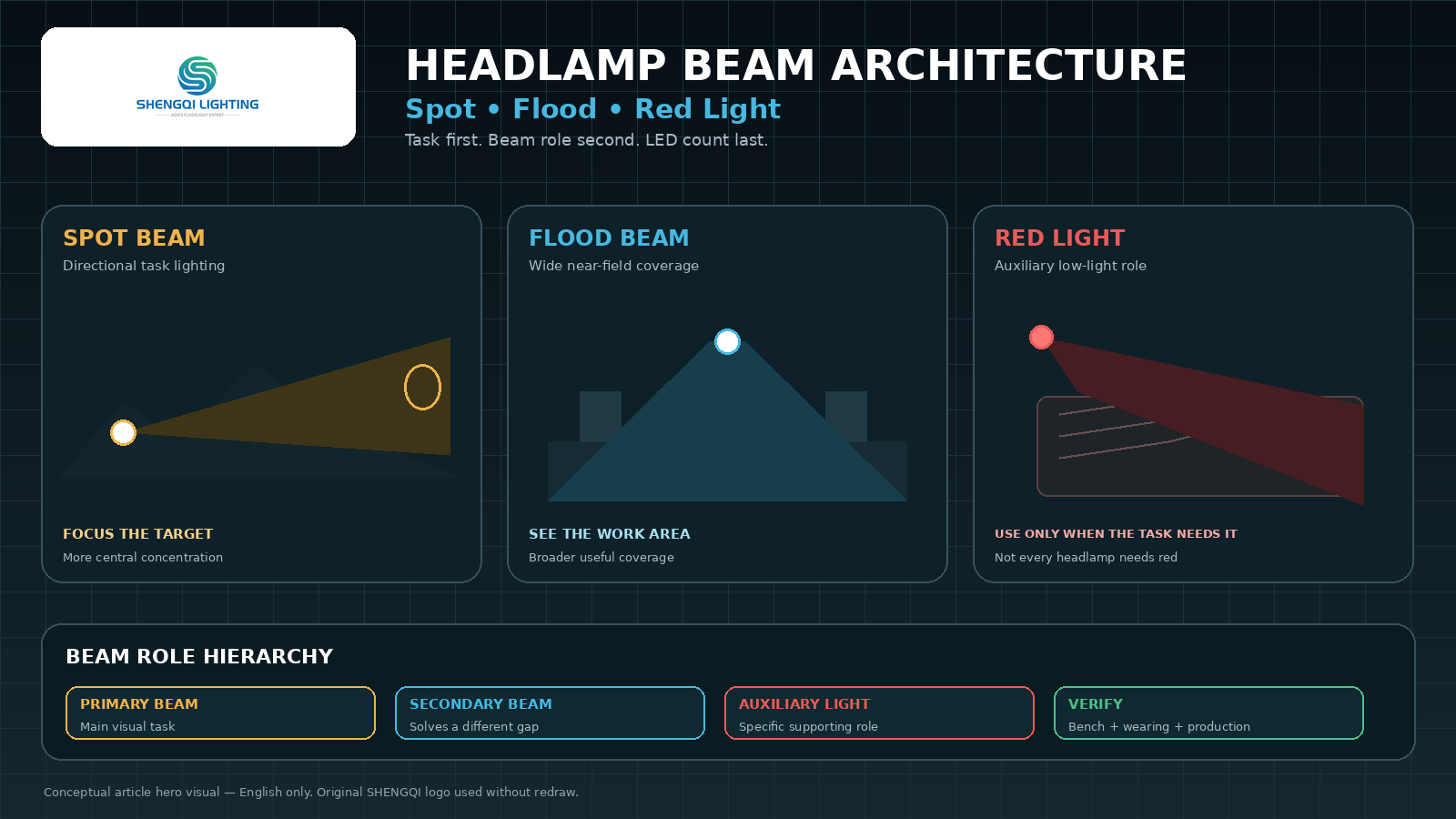
Headlamp Beam Hierarchy
Carries the main visual task.
Solves another clearly different viewing requirement.
Performs a narrower supporting task.
Primary Beam First: first decide what the primary beam must do. Then ask what it fails to do. If near-field coverage is insufficient, a flood source may solve that gap. If low-disturbance local lighting is missing, a red or another low auxiliary source may be considered. Secondary emitters should solve gaps in the primary lighting task.
When Does a Three-Source Headlamp Become Over-Designed?
Spot + flood + red can sound complete, but the combination can increase emitter count, PCB complexity, button logic, heat, battery load, optical windows, sealing interfaces, cost and training burden. The buyer should ask whether every source has a clear job. Feature completeness is not the same as product clarity.
If spot and flood are physically separated, their beams may originate from slightly different positions. Near-field users can notice overlap, shadows or asymmetry more easily than distant users. Multi-emitter layouts should therefore be evaluated at real working distances.
Beam Architecture Fails if the User Interface Is Confusing
Spot, flood and red sources create control questions: separate switches or one selector, mode cycling or direct access, long press or short press, memory or no memory, lockout, sensor behavior and whether a particular source needs protected access. These decisions are project-specific.
Some architectures may offer Spot only, Flood only and Spot + Flood together. Combined operation can increase total output, battery load and heat while creating a mixed beam. Simultaneous operation is useful only when the user actually needs the combined beam.
Eyes-Off Operation
A headlamp is unusual because the user often cannot see the controls while wearing it. Buyers should ask: Can the switches be identified by touch? Can spot and flood be changed without removing the headlamp? Do multiple buttons feel distinguishable? If the brief requires red-only access, can the user reach it without unintentionally activating white light?
Possible white-light-prevention approaches include a dedicated red switch, a deliberate red startup sequence or memory. These are options, not universal rules. A red-light headlamp does not automatically need red-first operation.
Beam Architecture Changes Battery Load and Thermal Behavior
Spot, flood and auxiliary emitters can use different currents, efficiencies and duty cycles. Running spot and flood simultaneously can change electrical load and heat compared with using either source independently. The final battery strategy therefore depends on which modes are important and how long users are expected to operate them.
Headlamps also have a different human-factor boundary from handheld lights because the light module sits near the forehead, skin and headband system. Surface-temperature behavior should be verified against intended modes and product requirements without assuming a universal temperature threshold.
More LEDs, larger optics and larger batteries can increase front-module weight, affecting head movement, strap tension, bounce and long-use comfort. Optical ambition has a mechanical cost.
Three SHENGQI Platforms Show Different Architecture Priorities
HF08 is a lightweight adjustable platform using a 5W LED, 240LM maximum output, 1200mAh polymer battery, 32g weight including battery, 180° angle adjustment, Type-C charging and inductive operation. Its confirmed features are useful for discussing mechanical aiming and low front weight without assuming an unverified beam pattern.
HL8 uses a 5W LED with 300LM High, 140LM Medium and 55LM Low steady levels, a listed maximum distance of 69m, 18650 1800mAh battery, 6063 aluminum body, IPX5, 1m impact specification and wave sensing. It illustrates how control architecture and hands-free sensing can become part of headlamp usability. It should not be described as having red light.
HL10 uses 1250LM, 500LM and 350LM steady main modes, a detachable headlamp/flashlight architecture, 16340 650mAh Li-ion battery and magnetic tail. Detachability changes how the same light module can be positioned relative to the user and the task. These models are architecture references, not substitutes for a category-level beam specification.
Buyers evaluating different form factors can also review the broader portable lighting product range.
Headlamp Beam Architecture Design Matrix
| Design Area | Buyer Question | Engineering Variable | Prototype Evidence | Risk if Unclear |
|---|---|---|---|---|
| 1. Target User | Who wears it? | Fit / controls | Wearing review | Wrong human factors |
| 2. Primary Task | What must be seen? | Primary beam | Task evaluation | Feature-led design |
| 3. Working Distance | Where is the target? | Beam distribution | Real-distance review | Wrong optic |
| 4. Spot Beam Role | Why directional? | Hotspot / concentration | Spot review | Unnecessary narrow beam |
| 5. Flood Beam Role | Why wide area? | Width / uniformity | Near-field review | Poor task coverage |
| 6. Red-Light Role | What does red solve? | Spectrum / output / UI | Low-light review | Unused complexity |
| 7. Hotspot | How large? | Central intensity area | Beam review | Poor aiming comfort |
| 8. Spill | How much context? | Peripheral light | Motion review | Lost context |
| 9. Optical Architecture | Which optic fits? | Reflector / TIR / lens | Optical comparison | Component-led choice |
| 10. Multi-Emitter Layout | Why each source? | Position / overlap | Real-distance test | Shadow / asymmetry |
| 11. Controls | How are beams selected? | Switch / firmware | Eyes-off test | UI confusion |
| 12. Battery | Which modes dominate? | Power architecture | Mode behavior test | Poor duty-cycle fit |
| 13. Thermal / Weight | Can it be worn comfortably? | Heat / front mass | Wearing evaluation | Poor comfort |
| 14. Production Alignment | Can the beam repeat? | Assembly tolerance | Production comparison | Sample-to-batch drift |
Four Ways a Headlamp Beam Architecture Can Miss the Real Task
01. High Lumens, Wrong Beam Width
The product may measure strong total output while concentrating too much or too little light for the actual job. Users then move their heads constantly or experience excessive foreground brightness. The issue is not necessarily insufficient output. The beam distribution is mismatched to the task. Approval should therefore include field-of-view behavior.
02. Spot and Flood Exist, but Switching Between Them Is Awkward
Two useful beams can become frustrating when users must cycle through several unwanted states. This is especially important because users cannot normally look at a headlamp while operating it. Controls should be tested while worn. Beam architecture and UI architecture need to be approved together.
03. Red Light Exists Only Because the Competitor Has It
A separate red emitter adds hardware and control complexity even when the actual user task does not require it. The product team should identify what the red source is expected to accomplish and whether a low white mode could meet the same requirement. Adding a function without defining its role creates feature inventory rather than product clarity.
04. The Prototype Beam Looks Good, but Production Alignment Is Inconsistent
A carefully assembled sample can have a centered hotspot while later units shift because of LED, PCB, optic, gasket or housing variation. The parts may still appear identical from outside. Optical production controls must protect the approved relationship. Beam consistency therefore needs production-representative verification, not only prototype approval.
Twelve Questions Before Developing a New Headlamp Beam Architecture
1. Who will wear the headlamp? Define the user, wearing duration and interaction context. Beam and controls should follow that workflow.
2. What is the primary hands-free task? Identify the job the primary beam must solve before adding secondary sources.
3. What does the user need to see close to the body? Define the near-field area rather than assuming flood is necessary.
4. Is distance inspection required? Specify the distant task and target rather than asking only for more lumens.
5. Does the application need spot, flood or both? Dual-beam architecture should correspond to two genuinely different visual requirements.
6. Is a dedicated red light actually required? Identify its task and compare that requirement with a very low white mode.
7. What should the lowest useful mode accomplish? Low output may reduce glare or disturbance and support close work.
8. Can spot and flood operate independently or simultaneously? Combined mode should exist only if it produces useful beam behavior.
9. How should users switch between beam sources without looking at the headlamp? Eyes-off operation should be evaluated while worn.
10. What battery and runtime priorities affect the optical architecture? Different beam modes can create different load profiles.
11. What weight and front-module limits affect emitter and optic size? Optical hardware influences wearing balance and mechanical packaging.
12. How will beam consistency be verified from prototype to production? Define measurement, visual comparison and production-representative review before release.
OEM/ODM Beam Specification Card
- Target User
- Primary Task
- Working Distance
- Near-Field Requirement
- Distance Requirement
- Red-Light Role
- Control Preference
- Battery Direction
- Weight Direction
- Estimated Quantity
- Target Market
Fourteen Tests Buyers Should Run on a Headlamp Beam Prototype
01. Near-Field Beam Review — Evaluate the actual close work area and whether the beam requires excessive head movement.
02. Mid-Field Beam Review — Review movement, surrounding context and field continuity.
03. Distance-Task Review — Use the actual distant visual task rather than a generic wall.
04. Spot Hotspot Review — Check hotspot size, centering and target emphasis.
05. Flood Uniformity Review — Check wide-area distribution and uncomfortable bright zones.
06. Spill / Peripheral-Visibility Review — Determine whether surrounding light supports movement and awareness.
07. Reflective-Surface Glare Review — Evaluate representative metal, white or reflective work surfaces where relevant.
08. Spot-to-Flood Switching Test — Confirm that beam selection is understandable while the product is worn.
09. Combined-Beam Review — if applicable — Determine whether simultaneous operation improves the real task.
10. Red-Light Low-Output Review — if applicable — Evaluate the intended auxiliary task and disturbance level.
11. Eyes-Off Control Test — Operate switches without looking at the headlamp.
12. Output / Battery Behavior by Beam Mode — Compare intended source combinations under representative operation.
13. Thermal / Wearing Evaluation — Evaluate surface behavior, balance, strap interaction and front-module comfort.
14. Production-Representative Beam Comparison — Compare beam position, hotspot, spill and controls with the approved prototype.
Acceptance criteria are project-specific. A headlamp should be evaluated while worn, because head movement, eye position, strap fit and beam direction interact in ways a bench test cannot reproduce. Bench measurement and wearing evaluation answer different questions and should complement each other.
A white-wall beamshot can reveal artifacts, hotspot shape and symmetry, but it cannot fully reproduce walking, equipment work, dark surfaces, reflective surfaces or moving head position. Beamshot is evidence, not the entire validation plan. Relevant portable-light testing capabilities can support project-specific verification.
How an OEM/ODM Project Should Define a Headlamp Beam Architecture
A structured project should move through: 1. Target User, 2. Use Case, 3. Working Distance, 4. Beam Roles, 5. LED Architecture, 6. Reflector / TIR / Lens, 7. Spot / Flood Relationship, 8. Red-Light Role, 9. Control Logic, 10. Battery, 11. Thermal Behavior, 12. Mechanical Aim, 13. Weight Distribution, 14. Prototype, 15. Verification and 16. Production Alignment.
The beam specification should be defined before the housing, emitter count and marketing lumen target are frozen.
SHENGQI's optical and electronic development capabilities can support headlamp projects where beam roles, controls and product architecture need to be customized around a brand's application. Relevant work can include Industrial Design, Optical Engineering, Electronic Design, PCB Layout, Manufacturing, Testing and Quality Control through custom headlamp development.
An automated SMT line and eleven dust-free assembly lines can support repeatable electronics and assembly processes, but equipment itself does not prove beam consistency. The approved optical relationship still needs process control and verification.
For additional technical topics beyond this page, buyers can review more lighting engineering content.
Frequently Asked Questions About Headlamp Beam Design
1. What is headlamp beam architecture?
Headlamp beam architecture is the relationship between the user's visual task, light sources, optical elements, emitter positions and control logic. It defines which beam is primary, what any secondary or auxiliary light must do, whether sources operate independently or together, and how hotspot, spill, aiming, battery load and thermal behavior interact. The architecture should describe the behavior of the beam system rather than simply list LED count or total lumens.
2. What is the difference between a spot beam and a flood beam?
A spot-oriented beam concentrates more light toward a central area and can provide clearer directional emphasis or target isolation. A flood-oriented beam spreads illumination across a wider field and can reduce the amount of head movement required for close work. Neither description sets a fixed brightness or distance. The correct architecture depends on working distance, field of view, target size, glare and movement.
3. Does every headlamp need both spot and flood modes?
No. A product designed around one concentrated visual task may benefit from a single optimized beam, simpler optics and simpler controls. Spot and flood become more useful together when the same user genuinely moves between two different viewing requirements, such as broad near-field work and directional inspection. Dual-beam architecture should therefore be justified by workflow rather than by the desire to add another feature.
4. Does every headlamp need a red-light mode?
No. A red emitter should have a defined auxiliary purpose. Some projects may use it for low-output local work, map reference or reduced visible disturbance compared with a brighter white beam. Other applications may be served by a very low white mode with simpler hardware. The decision should be based on the user's visual task, controls and power architecture rather than competitive feature matching.
5. Is red light always better for preserving night vision?
No universal absolute answer applies to every user and task. The perceived effect depends on brightness, spectrum, adaptation state, individual vision and what the user is trying to see. A very bright red beam can still disturb low-light adaptation. For product development, output level can matter as much as color, which is why buyers should compare the actual red-light task with a suitably low white mode.
6. Why can two headlamps with similar lumen ratings produce very different beams?
Lumens describe total light output, while user experience also depends on how the optics distribute that light. LED geometry, reflector, TIR, lens, diffuser, hotspot size, spill width, beam transition and mechanical alignment can all change the result. Two products with similar total output may therefore provide very different field of view, directional emphasis, peripheral context and glare behavior.
7. What should B2B buyers test on a headlamp beam prototype?
Buyers should test near-field, movement and distance tasks; hotspot, flood uniformity, spill and reflective-surface glare; source switching; combined beams where applicable; red-light behavior where applicable; eyes-off operation; battery behavior; wearing comfort and thermal behavior. Bench measurement should be combined with wearing evaluation, and production-representative samples should later be compared with the approved prototype for optical consistency.
8. Can spot, flood and red-light architecture be customized for OEM/ODM headlamp projects?
Yes. An OEM/ODM project can define separate beam roles, emitter and optic architecture, source positioning, control logic, mechanical aiming, battery direction and verification criteria around the target user's task. The project should begin with working distance, field of view and beam-role requirements rather than fixing LED count or a marketing lumen target first. Prototype and production verification then confirm whether the intended beam behavior can be reproduced.
Beam Role Clarity Should Come Before Feature Count
A well-designed headlamp does not need the largest number of emitters. It needs a clear relationship between the user's task, the primary beam, any secondary beam, auxiliary light, controls and power system. Buyers should approve beam behavior—not simply LED count or the largest lumen number on the specification sheet. When every source has a defined role and the product can reproduce that behavior from prototype through production, the beam architecture becomes easier to explain, operate and manufacture consistently.
Coming Soon: Shengqi Lighting is preparing to introduce a new Long-Range Tactical Flashlight. Full specifications and official product information will be released soon.
Developing a Headlamp for a Specific Beam Task?
For the first technical review, prepare your Target User, Primary Task, Spot Requirement, Flood Requirement, Red-Light Requirement, Battery Direction, Weight Direction, Estimated Quantity, Target Market and Timeline.
Review SHENGQI LIGHTING's OEM/ODM portable lighting development capabilities for optical, electronic and mechanical product development.
Contact SHENGQI LIGHTING for an OEM/ODM technical evaluation at sales@shengqilight.com.
Contact SHENGQI LIGHTING