
What should buyers look for in a 365nm UV pen light for field inspection?
Buyers should evaluate a 365nm UV pen light by its actual UV source specification, fluorescence performance on the target material, beam coverage, approved battery format, mechanical carry, environmental limits and sample-to-production consistency. For the 2AAA-UV platform, the verified specification identifies a 3535 UV LED with a 360–365nm range, two 1.5V AAA alkaline batteries and an IPX5 rating. Testing should use the intended fluorescent target at a representative working distance and under realistic ambient light. Buyers should also request runtime or UV-output stability evidence when those values matter. The IPX5 boundary, UV exposure controls and production-sample consistency should be reviewed separately. A “365nm” marketing description alone is not sufficient evidence.
What a 365nm UV Pen Light Actually Does
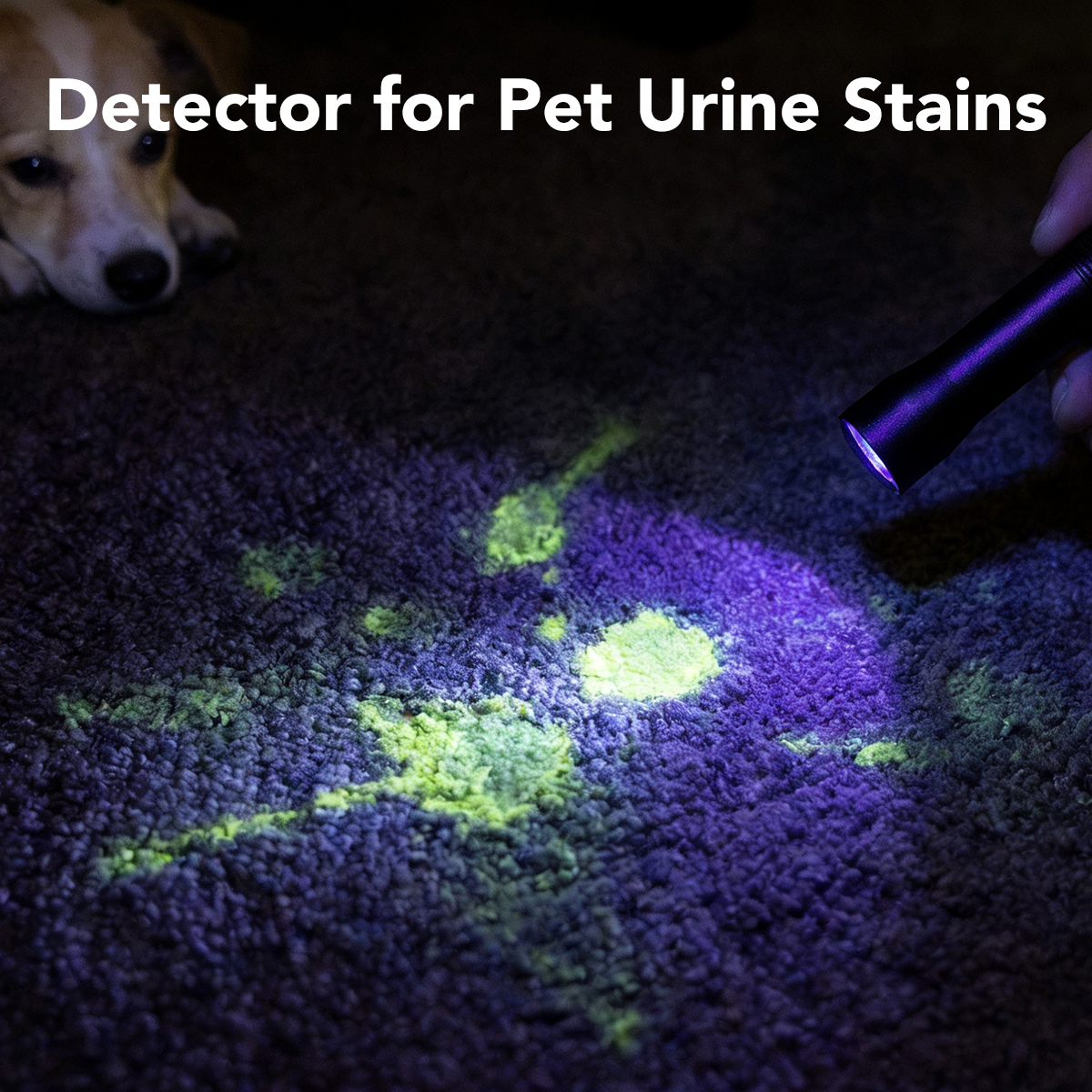
A compact UV inspection light can help reveal fluorescence when a compatible tracer, marking or material responds to the emitted UV range. That makes it useful for local field screening, equipment-marking checks and selected security-feature observation.
A UV pen light can help reveal fluorescence when the target material, tracer or security feature responds to the emitted UV range, but the observed fluorescence must be interpreted within the applicable inspection procedure.
Why the 365nm Label Is Only the Starting Point
A “365nm UV flashlight” description does not by itself establish wavelength consistency, beam coverage, useful fluorescence contrast, working distance, visible-light background or runtime. Buyers still need to review the LED specification, battery state, optics, mechanical alignment and production revision.
Different UV ranges can produce different fluorescence and visible-light behavior, but wavelength selection should be matched to the target material and inspection procedure. Buyers comparing wavelength categories can review the existing 365nm and 395nm UV wavelength comparison.
Five Field Inspection Tasks a Compact UV Pen Light Can Support
Useful for compatible tracer dyes and marked fluid paths. The tracer material must be designed to respond to the UV source used.
UV-reactive markings and selected printed features can be visually screened. UV fluorescence alone does not authenticate an item.
Fluorescent maintenance marks, tagged components and UV-reactive identifiers may support local inspection workflows.
Known materials may fluoresce under appropriate UV illumination, but the visual response should not be treated as definitive material identification.
A pen light can support rapid local checks before formal instrument testing. Pre-screening should not be confused with laboratory confirmation.
Visible Brightness Is Not the Same as Fluorescence Performance
The purple light visible to the eye does not directly prove UV radiant output, excitation efficiency or useful inspection contrast. Buyers should evaluate the actual fluorescent target, ambient-light control, working distance, beam coverage, visible-light background and repeatability.
The inspection result should be evaluated on the intended fluorescent target rather than by how bright the emitter appears to the eye.
Ambient Light Can Change What the Inspector Sees
Daylight, overhead lighting, glossy surfaces, reflections, viewing angle and source-to-target distance can all change visible contrast. A field UV light should be tested under the lighting conditions in which the customer actually expects to use it.
2AAA-UV Case Study: A Compact 360–365nm Field Inspection Platform
The 2AAA-UV field inspection pen light is marketed in the 365nm UV pen-light category, while the current internal specification identifies a 3535 UV LED with a specified 360–365nm range.
Its housing uses 6463 aluminum alloy with an anodized black finish. It measures 120.45mm long, with a 16.50mm lamp head and 15.80mm tail. Weight is 48g including two AAA alkaline batteries and the clip, or 27g without batteries while retaining the clip.
The platform also lists IPX5 and 1-meter impact resistance. The current specification does not establish UV radiant power, runtime or a universal detection distance, so actual fluorescence performance should be verified on the buyer's target material.
What the 2×AAA Battery Architecture Means in the Field
The 2AAA-UV uses two 1.5V AAA alkaline batteries. This supports a replaceable-battery workflow without requiring a charging circuit in the pen-light body. Packaging should clearly identify the approved battery type and polarity.
Only battery formats included in the approved product specification should be used. Battery availability is a logistics advantage only when the target market and buyer actually support that format.
Battery Count Does Not Prove UV Runtime
Runtime depends on LED load, battery condition, chemistry, driver behavior, ambient conditions, cutoff threshold and UV-output stability. Buyers needing formal runtime data should request a defined battery specification, test method, output-over-time record and endpoint.
Why a Pen-Shaped UV Tool Works for Field Inspection
The narrow format supports pocket carry, tool-bag organisation and local inspection positioning. The portable inspection pen lights category illustrates this compact architecture. Smaller diameter may not suit every glove or grip requirement, so switch accessibility and handling should be checked on samples.
A Pocket Clip Is a Workflow Feature, Not Just Styling
The clip can support shirt-pocket, workwear, pouch or inspection-bag carry. Buyers should evaluate retention, orientation, insertion, removal, deformation and possible interference with controls rather than assuming a universal retention force.
Test the UV Sample on the Actual Fluorescent Target
Do not approve a UV pen light by shining it onto a white wall and judging the purple appearance. Sample testing should use the actual tracer, security marking, fluorescent label or representative material specified by the project.
Record the target material, working distance, ambient lighting, fresh-battery condition, model, product revision and visual result. A comparison sample may also be useful where the project defines one.
UV Beam Uniformity Matters in Close Inspection
Buyers should review hotspot intensity, dark rings, uneven illumination, edge falloff, target coverage and visible-light background. A visually bright center spot does not automatically mean better field inspection.
Define a representative working distance first, then compare beam coverage at that distance. This avoids inventing one universal beam diameter or detection range for every application.
The Approved Sample Must Match the Production Batch
UV performance can change when the UV LED supplier, LED bin, wavelength tolerance, driver, optics, lens, battery specification, mechanical alignment or PCB revision changes. If a future custom version uses a filter, that component would also require revision control.
Production review should connect the approved sample to the BOM revision, LED specification, battery specification, dimensions, switch function, reference-target appearance and packaging revision. Broader UV inspection supplier sourcing guidance can be reviewed separately.
Ten Tests Buyers Should Perform on a 365nm UV Pen-Light Sample
Verify the stated 360–365nm internal specification and sample revision.
Use the real tracer, marking or representative material instead of a wall.
Review dark, low-light or normal indoor conditions that match the project.
Assess coverage and uniformity at the intended working distance.
Compare relative background light without inventing a suppression percentage.
Use the approved AAA alkaline specification and record battery condition.
If runtime matters, track output behavior and define the test endpoint.
Look for missed activation, intermittent operation and tactile inconsistency.
Check insertion, removal, orientation and retention on target workwear.
Compare multiple representative units to identify meaningful variation.
Acceptance criteria should be defined by the buyer and development team for the actual application.
Eight Questions to Ask Before Sourcing a 365nm UV Pen Light
B2B buyers should not approve a UV pen light from the “365nm” label, purple-light appearance or product photograph alone.
Ask for the source specification and the revision used in the approved sample.
Define the tracer, marking or material before evaluating the light.
Use representative conditions rather than a generic detection-distance claim.
UV projects may require wavelength-appropriate measurement equipment and methods.
For 2AAA-UV, the confirmed format is two 1.5V AAA alkaline batteries.
Request conditions, battery details, output behavior and a defined endpoint.
Review IPX5, impact, switch and clip evidence at model level where available.
Control the BOM, LED, battery, dimensions, function and packaging revision.
Compact UV Pen Light vs Larger UV Inspection Platforms
| Product Architecture | Main Strength | Main Limitation | Battery Workflow | Typical Inspection Role | Buyer Verification Focus |
|---|---|---|---|---|---|
| Compact 2AAA UV Pen Light | Slim portable architecture | Limited body volume | Replaceable AAA alkaline cells | Field pre-screening and local inspection | Wavelength, beam and runtime verification |
| Larger Multi-LED UV Flashlight | Potentially wider coverage | Larger physical format | Varies by design | Broader-area screening | Array consistency and output verification |
| Rechargeable Multi-Function UV Light | Integrated functions | More complex interface | Rechargeable workflow | Multi-function inspection | Mode logic, charging and UV verification |
This comparison describes product architectures, not verified performance for every model.
How SHENGQI LIGHTING Supports UV Pen-Light Development
For a UV inspection-light project, OEM/ODM development should connect the required fluorescent target, UV source specification, optics, battery architecture, mechanical carry, enclosure design, sample validation and production revision control.
Relevant capabilities include Optical Engineering Design, Electronic Design, Manufacturing, Battery Testing, Discharge-Time Testing, Waterproof Testing and Quality Control. Buyers can review SHENGQI's flashlight testing and quality-control capabilities, custom UV pen-light development and pen-light production capabilities.
SHENGQI LIGHTING operates under an ISO9001 quality management system. That system supports process control but is not a product certification for 2AAA-UV. Market-specific compliance requirements should be reviewed for the final configuration and destination market.
UV Inspection Requires Exposure Controls
Ultraviolet radiation should not be directed into the eyes, and unnecessary skin exposure should be avoided. Workplace procedures and applicable UV safety requirements take priority.
The appropriate protective measures depend on wavelength, irradiance, distance, exposure duration and the work procedure. A UV pen light should be used only for its defined inspection task, and users should not stare into the emitter to confirm operation.
The wavelength label alone does not establish a safe exposure duration.
Can a 365nm UV pen light confirm a leak, counterfeit or material defect?
No. A UV pen light can reveal fluorescence from compatible tracers, markings or materials, but fluorescence alone does not establish a final diagnosis, authentication result or certified inspection conclusion. The visual response must be interpreted within the applicable inspection procedure and supported by documentation or a professional instrument where required. A compact UV light may be useful for pre-screening, but it cannot guarantee detection of every leak, counterfeit feature or material defect. The target must contain or use compatible fluorescent material, and the final decision should follow the customer's approved inspection method.
Frequently Asked Questions
1. What is a 365nm UV pen light used for?
It can support fluorescence screening, compatible tracer observation, UV-reactive marking checks and portable field pre-screening. The result depends on whether the target responds to the emitted UV range, the ambient-light condition and the inspection method. It should be treated as an auxiliary visual inspection tool rather than a device that guarantees detection or confirms a final diagnosis.
2. Is the 2AAA-UV exactly 365nm?
The current internal product specification identifies a 3535 UV LED with a 360–365nm range. “365nm UV pen light” is the market and category description. The available specification does not establish an exact 365.0nm peak wavelength, spectral bandwidth or production-batch wavelength tolerance, so projects requiring tighter optical criteria should define an appropriate verification method.
3. Is 365nm always better than 395nm for field inspection?
Not universally. The correct UV range depends on the fluorescent target, ambient conditions and inspection procedure. Buyers should avoid choosing a wavelength only from a general statement that one category is always superior. For a dedicated comparison of wavelength categories, review the linked UV wavelength selection guide earlier in this article.
4. Can a UV pen light confirm leaks or counterfeit documents?
No. Fluorescence can support inspection, but it does not by itself prove the cause of a leak or authenticate an item. The tracer, security feature or material must be compatible with the UV source, and the observation should be interpreted according to the applicable inspection procedure, documentation and professional verification method where required.
5. What batteries does the 2AAA-UV use?
The verified specification identifies two 1.5V AAA alkaline batteries. Other chemistries should not be assumed compatible unless they are added to an approved product specification. Buyers should also confirm polarity marking, packaging information and the battery workflow expected in the destination market rather than treating the AAA form factor alone as proof of compatibility.
6. Is IPX5 suitable for immersion?
No. IPX5 describes resistance to water jets under applicable test conditions and is not an immersion rating. The “X” also does not state a solid-particle protection level. IPX5 does not establish resistance to oils, solvents, inspection chemicals or every wet-work environment. Final assembly condition and project-specific exposure should be reviewed.
7. What should B2B buyers test before approving a UV pen-light sample?
Verify the UV LED range, actual fluorescent target, beam coverage, ambient-light performance and approved battery. Where relevant, request runtime or UV-output stability testing. Buyers should also check switch repeatability, clip function, IP evidence, impact boundaries and sample-to-batch consistency. Approval should connect the tested sample to the final LED, BOM, battery and production revision.
Define the Fluorescent Target Before Freezing the Product
Industrial inspection brands, maintenance-product companies, security-product distributors, tool wholesalers and private-label buyers can discuss UV LED specification, optical development, battery-platform definition, pen-shaped housing, clip structure, sample validation and batch consistency.
Contact SHENGQI LIGHTING for an OEM/ODM technical evaluation at sales@shengqilight.com.
UV fluorescence should be interpreted within the applicable inspection procedure, and wavelength, output, safety and compliance requirements should be verified for the final product and target application.