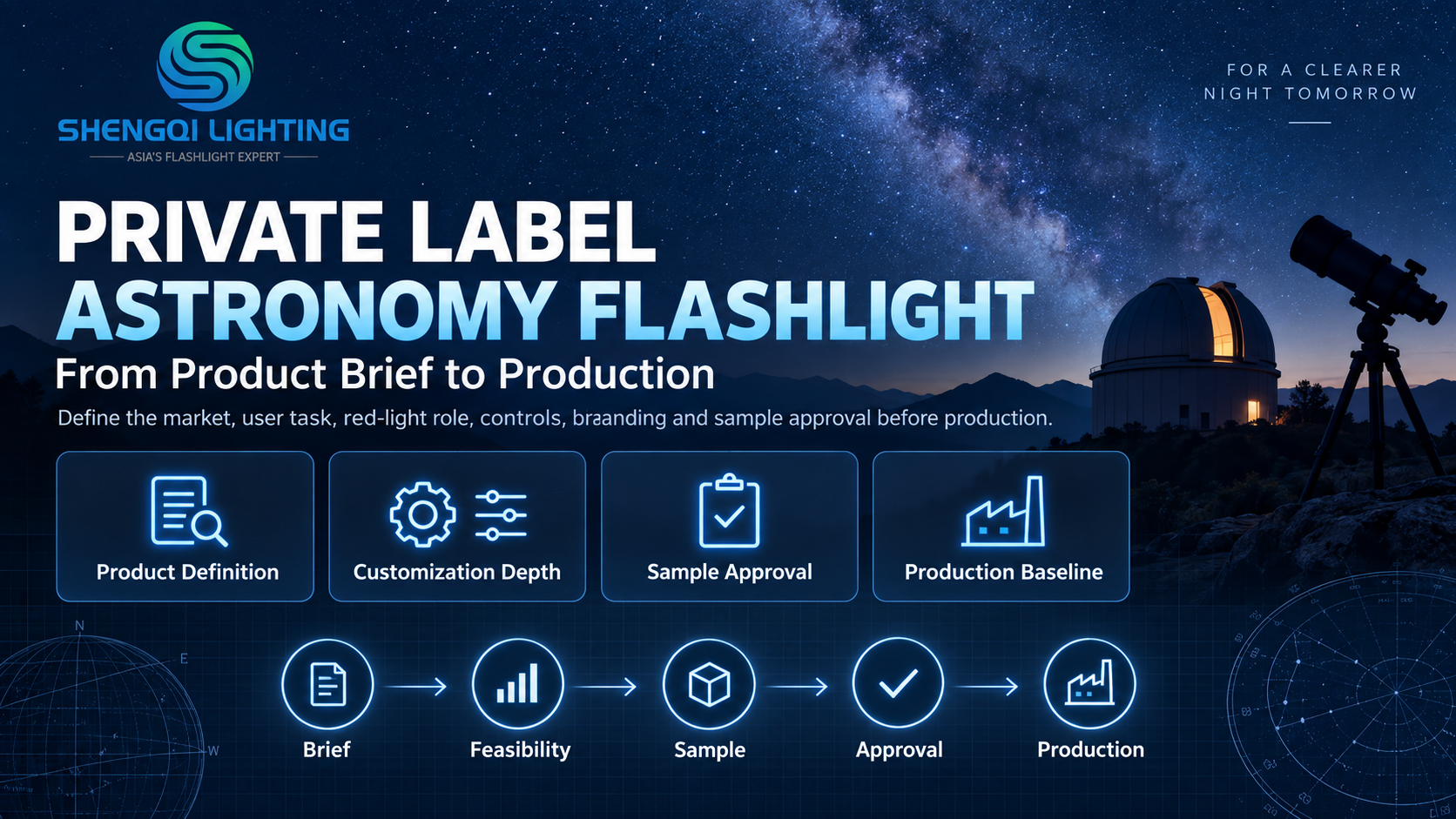

Private Label Astronomy Flashlight Means More Than Adding a Logo
Buyer A already has a mature astronomy retail channel and needs an established flashlight platform with approved brand identity, packaging and accessory contents. Buyer B needs a specific red-light startup behavior, a different control architecture and a new body format. Both can be called private-label projects, but the development depth is completely different.
Private label describes the commercial ownership of the branded product; it does not define how much engineering work the project requires.
| Model | Typical Meaning | Development Depth |
|---|---|---|
| White Label | A largely standardized existing product sold by different brands with limited branding changes. | Usually limited. |
| Private Label | An existing or modified platform sold under the buyer's brand with selected configuration, CMF or packaging changes. | Project dependent. |
| OEM | The buyer provides defined product requirements, design or specifications; the supplier manufactures and provides agreed engineering support. | Defined by buyer scope. |
| ODM | The supplier may contribute concept, industrial design, optics, electronics, PCB, mechanical engineering and prototypes. | Potentially deep. |
The commercial labels matter less than agreeing on exactly who owns each design and engineering decision.
Define the Market Before Customizing the Flashlight
Target country, channel and price positioning influence packaging, documentation, feature depth, compliance review and quantity planning. An astronomy specialty retailer does not evaluate the same product architecture as a distributor or institutional buyer. Existing flashlight platforms can be reviewed only after the commercial context is clear.
| Channel | Buyer Expectation | Customization Priority | Packaging Priority | Commercial Risk |
|---|---|---|---|---|
| Astronomy Specialty Retail | Clear astronomy role | Controls / product positioning | Feature explanation | Generic product fit |
| Telescope Bundle | Accessory compatibility | Size / included items | Bundle integration | Over-specification |
| Online DTC Brand | Differentiated proposition | CMF / controls / branding | Strong product communication | Feature overload |
| Distributor | Broad channel fit | Configuration balance | Multi-market clarity | Too-narrow positioning |
| Institutional / Observatory Supply | Defined use requirement | Function / documentation | Operational information | Requirement mismatch |
Private Label Development Starts With the Astronomy Task
Possible tasks include chart reading, telescope setup, accessory handling, note taking, equipment identification and mixed outdoor use. The critical question is whether astronomy is the primary use case or only one of several use cases.
Astronomy-Focused Product: may prioritize a simple low-light workflow and fewer unrelated functions. Multi-Use Outdoor Product: may justify white light, red light and broader utility. Neither is automatically better. Product positioning should decide the architecture before marketing language does.
Choose the Right Customization Depth Before Asking for a Quote
Logo · Packaging · Label
Color · Finish · Strap / Clip · Pack Contents
Battery · Existing Emitters · Supported Modes · Accessories
PCB · UI · Optics · Structure
ID · Optics · Electronics · PCB · Mechanical Design · Prototype
Conceptual Sourcing Framework — not an industry-standard classification.
Full ODM can create stronger differentiation and deeper product control, but it also increases engineering work, revision cycles, validation and commercial commitment. An existing platform can be the more rational option for market testing or when the customer proposition does not require structural change.
Customization has value when it changes the customer proposition—not simply when it makes the BOM different.
Existing Platform or New ODM: Which Path Fits the Brand?
| Decision Area | Existing Platform | Modified Platform | New ODM Development |
|---|---|---|---|
| Product Differentiation | Lower | Moderate | Potentially high |
| Engineering Scope | Limited | Targeted | Broad |
| Prototype Work | Configuration review | Modified samples | Development iterations |
| Control over UI | Platform dependent | Possible if supported | Can be designed around brief |
| Optical Customization | Limited | Selective | Deep if justified |
| Mechanical Customization | Minimal | Targeted | New architecture possible |
| Packaging | Customizable | Customizable | Customizable |
| Validation | Configuration-focused | Changed areas | Broader development validation |
| Commercial Risk | Lower development exposure | Moderate | Higher project commitment |
| Best-Fit Scenario | Platform already fits market | Specific differentiation needed | Brand proposition needs new architecture |
Define the Red-Light Requirement Without Rewriting the Entire Astronomy Guide
The private-label brief should record whether red light is required, whether the product is red-only or white + red, whether low-output behavior is a priority, whether direct red access is required, whether several red levels are needed and what task the beam serves. For the deeper technical context, review the existing red-light design requirements for astronomy.
“Add one red LED.”
Define what task the red source supports, how the user reaches it, the required brightness behavior and how it interacts with any white-light source.
Private Label UI Should Be Specified Before the Sample Is Approved
“3 Modes” or “5 Modes” is not a complete private-label specification. Buyers should define first activation, red access, white access, mode order, source switching, memory if required, lockout if required and indicator behavior.
Conceptual Product Behavior Sheet
| User Action | Product State | Expected Response |
|---|---|---|
| OFF + Short Click | OFF | Project-defined first state |
| Source Command | Light ON | Project-defined red / white change |
| Lockout Command | OFF | Project-defined carry protection |
Conceptual behavior sheet only; not a real SHENGQI product UI.
Form Factor and Battery Architecture Define the Private-Label Product More Than the Logo
Possible formats include compact handheld, flat EDC architecture, tubular flashlight, clip-based product or another application-specific form. Buyers can compare the broader compact EDC flashlight range without assuming one body style fits every astronomy channel.
Battery direction should answer: rechargeable or replaceable, storage needs, portability, expected duty cycle, charging workflow and target market. Built-in lithium, replaceable lithium and AA/AAA-compatible architectures each create different product and service implications. The brief should define the workflow rather than prescribe a universal best battery.
Branding Should Work With CMF and Product Geometry
Private label may involve logo, color, finish, marking, graphics and product labels. CMF means Color, Material and Finish; it affects appearance, tactile feel, wear, production process and cosmetic consistency.
Logo position should consider grip, clip position, moving parts, switches, curvature, expected wear and packaging visibility. Laser marking, printing or other graphic methods may all be appropriate depending on material and finish. No method is universally superior. Special CMF should be approved on the physical sample rather than only from a digital color reference.
Packaging Is Part of the Private-Label Product Definition
The project may include a retail box, instruction card, barcode, product label, charging cable where applicable, lanyard, battery where applicable, pouch or another accessory bundle. These are project-specific and should not be assumed.
Useful packaging normally explains intended lighting roles, controls, charging or battery handling, included accessories, maintenance and applicable market information instead of relying on generic claims such as “POWERFUL RED LIGHT.”
A Private-Label Sample Should Prove More Than Logo Placement
The buyer should review the product function, red-light role, controls and battery workflow; the cosmetic color, finish, logo and markings; packaging artwork, labels, accessories and instructions; and whether the physical sample matches the exact commercial configuration quoted.
Use revision identities rather than “latest sample.” Examples such as Sample Rev B, Packaging Rev A and Firmware Rev X are conceptual labels that show the control principle.
Private-Label Sample Approval Sheet
| Approval Area | What Buyer Checks | Evidence | Status |
|---|---|---|---|
| Product Function | Required operation | Sample test | Buyer-defined |
| Red-Light Role | Required task behavior | Task review | Buyer-defined |
| UI | State logic | Behavior sheet | Buyer-defined |
| Housing | Fit / form | Physical review | Buyer-defined |
| CMF | Color / material / finish | Approved sample | Buyer-defined |
| Logo | Position / appearance | Artwork + sample | Buyer-defined |
| Accessories | Correct contents | Pack-out list | Buyer-defined |
| Packaging | Artwork / structure | Approved pack | Buyer-defined |
| Documentation | Instructions / labels | Approved files | Buyer-defined |
Define What the Private-Label Product Must Prove Before Production
“Sample looks good” is not a production acceptance method. The approval chain should be Requirement → Verification → Acceptance Criteria → Evidence → Approval. Depending on the project, verification may cover optical behavior, UI, charging, battery, mechanical fit, cosmetics and packaging.
Astronomy-specific checks can include red-light role, low-light usability, accidental white activation where relevant, beam spill and control access—but these checks belong inside the private-label approval plan rather than replacing it.
For projects requiring formal verification support, SHENGQI can connect approval requirements with relevant portable-light testing and quality-control capabilities.
Golden Sample, BOM and Artwork Must Describe the Same Product
The golden sample should connect to the product drawing, BOM, firmware where applicable, light source, battery, CMF, logo artwork, packaging artwork and approved accessories. A physical sample without controlled documentation is a weak production reference.
Brand assets also need revision control: logo file, product label, box artwork, manual and barcode. An ARTWORK FREEZE means the approved revision is clearly identified before production. It does not mean artwork can never change; later changes simply require renewed confirmation.
If an LED, battery, switch, PCB component or optic is substituted, even an externally identical product may behave differently. Approved alternatives should therefore remain controlled. Production execution should connect the approved baseline with documented flashlight manufacturing capabilities.
Compare Private-Label Quotations Only After the Product Definition Matches
Two prices cannot be compared fairly until both suppliers are quoting the same product revision, material, battery, lighting configuration, packaging, accessories, branding method, verification scope and quantity assumption.
| Quote Area | Supplier A Assumption | Supplier B Assumption | Buyer Must Confirm |
|---|---|---|---|
| Product Revision | Check | Check | Same revision? |
| Battery | Check | Check | Same battery specification? |
| Lighting Configuration | Check | Check | Same sources / modes? |
| Housing / Finish | Check | Check | Same material / finish? |
| Branding | Check | Check | Same method? |
| Accessories | Check | Check | Same pack-out? |
| Packaging | Check | Check | Same package scope? |
| Verification | Check | Check | Same test scope? |
| Quantity | Check | Check | Same assumption? |
MOQ depends on customization depth, material, component sourcing, process, packaging and supplier constraints. Development timing similarly depends on whether the project uses an existing platform, engineering modification, tooling, validation and packaging work. Ask for a milestone plan rather than relying on a single generic lead-time number.
Private Label Astronomy Flashlight Development Matrix
| Development Area | Buyer Decision | Typical Customization Level | Evidence to Approve | Risk if Unclear |
|---|---|---|---|---|
| 1. Target Market | Region | Commercial | Market brief | Wrong positioning |
| 2. Sales Channel | Retail / bundle / distribution | Commercial | Channel plan | Wrong package / feature depth |
| 3. Target User | User group | Product | User brief | Poor workflow fit |
| 4. Astronomy Task | Primary job | Product | Task review | Generic product |
| 5. Product Platform | Existing / modified / ODM | Architecture | Approved scope | Wrong development depth |
| 6. Red-Light Role | Required behavior | Configuration / engineering | Task evidence | Incomplete astronomy brief |
| 7. White-Light Role | Needed or not | Configuration | Source approval | Wrong use-case scope |
| 8. Controls | Startup / source logic | Platform / engineering | Behavior sheet | UI mismatch |
| 9. Form Factor | Body direction | Platform / ODM | Physical sample | Poor carry fit |
| 10. Battery | Workflow direction | Configuration | Approved specification | Service mismatch |
| 11. CMF | Color / material / finish | Cosmetic | Approved sample | Cosmetic inconsistency |
| 12. Branding | Logo / marking | Branding | Artwork + sample | Wrong brand execution |
| 13. Packaging | Pack-out / information | Branding / commercial | Approved artwork | Launch errors |
| 14. Verification | What must pass | Project-specific | Test evidence | Subjective approval |
| 15. Golden Sample / Production Baseline | Approved revision | Production control | Sample + documents | Sample-to-batch drift |
Five Mistakes Brands Make When Private-Labeling an Astronomy Flashlight
01. Starting With the Logo Before Defining the Product
Branding cannot fix an unclear product role. The buyer should first define user, task, architecture and controls. Otherwise, a polished logo may be applied to a product that does not fit the channel. Product definition should lead branding.
02. Asking for Full ODM When an Existing Platform Would Meet the Market Need
ODM can create differentiation, but it also creates more engineering and validation. If an existing platform already matches the proposition, unnecessary redesign adds complexity without improving customer value. Development depth should follow the commercial need.
03. Treating “Red LED” as a Complete Astronomy Specification
A red source still needs a task, access logic and defined relationship with white light where applicable. The private-label brief should specify the role, not only the component. Technical details belong in the product requirement.
04. Approving the Product Sample but Not the Packaging and Documentation
The customer buys the complete branded SKU. Incorrect artwork, accessories, labels or instructions can compromise a launch even when the flashlight itself is correct. Product and packaging approval should converge before production.
05. Comparing Supplier Prices Before Aligning the Product Configuration
A lower quotation may simply contain a different battery, finish, accessory set or verification scope. Price becomes meaningful only after assumptions match. Compare like with like before making the sourcing decision.
Is Your Astronomy Flashlight Brief Ready for Supplier Review?
How to Build a Private Label Astronomy Flashlight Brief for an OEM/ODM Supplier
A complete brief should define: 1. Brand / Channel, 2. Target Market, 3. Target User, 4. Astronomy Task, 5. Product Positioning, 6. Existing Platform or ODM, 7. Red-Light Requirement, 8. White-Light Requirement, 9. Controls, 10. Form Factor, 11. Battery, 12. CMF, 13. Logo, 14. Packaging, 15. Accessories, 16. Estimated Quantity, 17. Target Timeline and 18. Verification Requirements.
What to Send in a Private Label Astronomy Flashlight RFQ
- Brand / Company
- Target Market
- Sales Channel
- Target User
- Primary Astronomy Task
- Product Positioning
- Existing Platform or Custom Development Preference
- Red-Light Requirement
- White-Light Requirement
- Control Requirement
- Form-Factor Direction
- Battery / Charging Direction
- Branding / CMF Requirement
- Estimated Quantity
- Target Timeline
Packaging requirements can be added as part of the commercial and artwork discussion.
“Need private label astronomy flashlight. Please send best price and MOQ.”
Define target market, user, task, red-light role, product architecture, branding direction, estimated quantity and target timeline.
The better the first brief, the fewer assumptions the supplier has to make.
What Should the OEM/ODM Supplier Return?
Platform options, feasibility questions, customization boundaries, engineering risks, product assumptions, sample plan, verification direction, packaging questions and commercial assumptions. A catalog and a price alone are not enough for a deeper private-label project.
Supplier capability should match customization depth. A logo-and-box project may not require deep ODM resources. For brands that need more than branding changes, SHENGQI can support deeper private label flashlight development across industrial design, optical engineering, electronic design, PCB layout, packaging design, manufacturing and verification. Buyers can also review the wider portable lighting product range when considering existing-platform options.
Frequently Asked Questions About Private Label Astronomy Flashlights
1. What is a private label astronomy flashlight?
It is a portable-lighting product sold under a buyer's brand and configured around that brand's market, astronomy use case, product positioning, controls, appearance, packaging and commercial requirements.
2. Is private labeling only adding a logo to an existing flashlight?
No. A project may include only branding, but it can also involve CMF, accessories, battery configuration, controls, optics, packaging or engineering changes depending on the required differentiation.
3. What is the difference between white label, private label, OEM and ODM flashlights?
White label usually means a standardized existing product with limited branding changes. Private label can include selected product and brand customization. OEM generally follows buyer-defined requirements, while ODM may involve deeper supplier-led design and engineering.
4. Should an astronomy brand use an existing flashlight platform or develop a new product?
There is no universal answer. Existing platforms can reduce development complexity when they already fit the market. New development becomes more reasonable when differentiation depends on new controls, optics, electronics or mechanical architecture.
5. What can usually be customized on a private label astronomy flashlight?
Possible areas include logo, CMF, packaging, accessories, configuration, controls, optics and selected engineering elements, but actual customization depends on the platform and engineering feasibility.
6. What should buyers approve on the product sample before mass production?
Approve function, red-light role, controls, battery workflow, housing, CMF, logo, accessories, packaging, documentation and the exact product revision being quoted for production.
7. How should brands compare quotations from two private label flashlight suppliers?
First align product revision, battery, lighting configuration, materials, finish, branding method, accessories, packaging, verification scope and quantity assumption. Price comparison should come after configuration alignment.
8. What should a buyer include in the first astronomy flashlight OEM/ODM RFQ?
Include market, channel, user, astronomy task, desired platform or development path, red- and white-light requirements, controls, form factor, battery direction, branding, quantity and target timeline.
Private-Label Product Ownership Starts Before the Logo
A private label astronomy flashlight becomes a real branded product when the buyer has defined what the product should do, how deeply it should differ from an existing platform, which revisions are approved and what evidence connects the sample to mass production. The logo is one part of that system—not the starting point for every engineering decision.
SHENGQI is developing additional portable-lighting platforms that incorporate auxiliary red-light functionality, creating more options for future application-specific product development. Final positioning and specifications will be released only after development information is confirmed, so unreleased concepts should not be treated as finished astronomy products.
Planning a Private Label Astronomy Flashlight Project?
Prepare your Brand / Company, Target Market, Sales Channel, Target User, Astronomy Application, Desired Customization Depth, Red-Light Requirement, White-Light Requirement, Form-Factor Direction, Battery Direction, Branding / Packaging Requirement, Estimated Quantity and Target Timeline.
Review SHENGQI LIGHTING's OEM/ODM portable lighting development capabilities.
Contact SHENGQI LIGHTING for an OEM/ODM technical evaluation at sales@shengqilight.com.
Contact SHENGQI LIGHTING