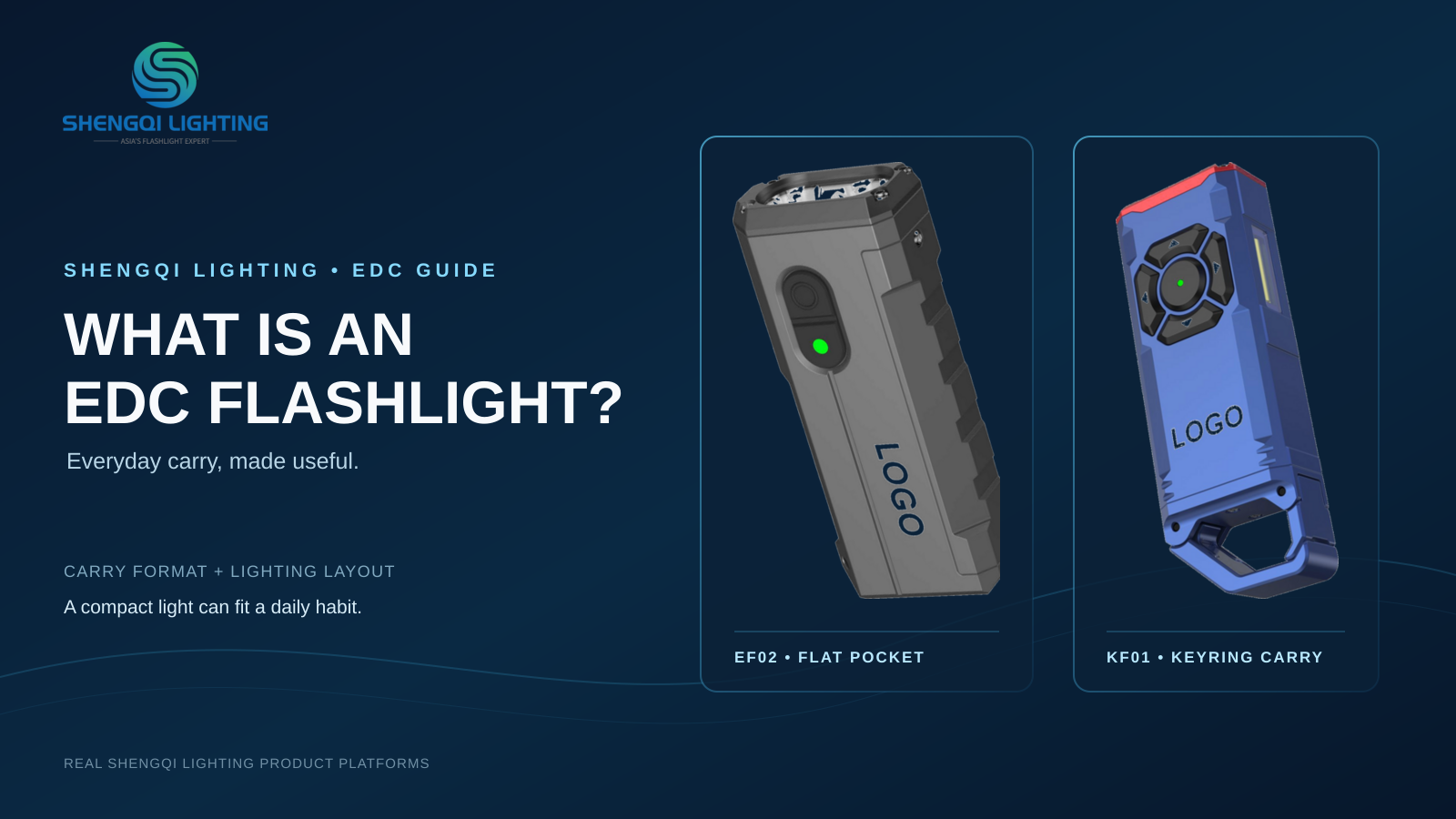
EDC stands for everyday carry: items a person chooses to keep close because they can be useful in ordinary routines. An EDC flashlight is a portable light designed to be carried regularly and used when a small amount of light is needed. “Everyday” does not mean everyone must carry the same equipment. It means the light should make sense for the user’s own habits, carry space and typical tasks.
A practical definition: an EDC flashlight is not a fixed size class, a performance certification or one required battery format. It is a lighting tool selected to be easy enough to carry often and useful enough to reach for when normal ambient light is not enough.
In this article
Why Carry a Flashlight Every Day?
A small flashlight can be useful in moments that do not require a large lighting system: finding a dropped item beneath furniture, checking inside a bag, looking into a narrow storage space, or briefly lighting the area directly in front of you indoors or outside. The value is not that every moment needs a dedicated flashlight. It is that a light can be available without having to search for one first.
For many people, everyday carry is about reducing friction. A product earns a place in a pocket, bag or keyring when it is reasonably easy to bring along and has a clear purpose when needed. A flashlight can meet that role because light direction matters: seeing into a corner, under an object or along a path is different from simply making a screen brighter.
A Phone Light and an EDC Flashlight Can Serve Different Roles
A phone light is convenient and can handle many temporary lighting needs. It is already with the user, requires no separate item and can be sufficient for a quick look nearby. An independent EDC flashlight becomes useful when the direction of light needs to be separated from the position of the phone.
For example, a person may want to keep a phone available for a call, map, message or photo while aiming light into another position. A separate light also uses its own power source rather than drawing from the phone battery. Depending on the product, its body shape, beam layout or carry feature may be more convenient for a particular short task. Those are possible advantages, not universal guarantees: the right choice still depends on the individual product and how it will be used.
Useful question: Do you need only a quick burst of light, or do you need light aimed somewhere while the phone remains free for another task? The answer helps clarify whether a separate everyday carry light is worth carrying.
EDC Flashlights Do Not Have One Required Shape
Everyday carry lighting appears in several formats. A keyring light can stay with keys. A pocket flashlight can travel in a clothing pocket or small bag compartment. Some products use a clip or another carry feature to help keep the light in a chosen location. These descriptions overlap rather than create strict categories: a clipped light may be flat or cylindrical, and a compact body does not automatically establish weight, output or suitability for every pocket.
The important question is how the carry format fits a daily routine. Someone who already keeps keys in hand may value a keyring platform. Someone who carries a phone, notebook or tools in a pocket may consider how a light sits beside those items. The most useful format is usually the one a person can carry comfortably and retrieve without turning a simple task into a search.
| Daily situation | Useful lighting role | What depends on the product |
|---|---|---|
| Looking beneath furniture or inside a narrow storage area | Aim light toward a nearby target without moving the phone into the same position | Body access, beam pattern, switch operation and the available lighting mode |
| Checking a bag, drawer or vehicle compartment | Provide short-range visibility where room lighting does not reach | Carry location, one-handed retrieval and how the light is directed |
| Walking briefly between indoor and outdoor spaces | Light the immediate route or identify a nearby object | Actual output control, beam distribution and the user’s preferred carry method |
What Useful Technology Looks Like in Everyday Carry Lighting
Technology in an EDC flashlight is most useful when it makes the product easier to carry, understand and operate. That can include the relationship between the light source and the control area, a body shape that fits its intended carry position, or clearly separated lighting functions for different short tasks. More features do not automatically create a better everyday carry experience. A feature should have a recognizable purpose and should not make normal operation unnecessarily confusing.
Shengqi Lighting’s KF01 illustrates a keyring-carry platform, where the intended carry location is part of the product concept. The EF02 illustrates a different direction: a pocket-flat body with a main beam and side light. These examples show how carry format, body form and lighting layout can be combined in different EDC product platforms without suggesting that one arrangement is best for every user.
For readers ready to browse broader product options, the EDC flashlight collection provides a starting point. A person considering several functions should first ask what those functions need to accomplish in the same daily routine, rather than treating a longer feature list as the goal.
Explore Shengqi Lighting’s EDC Program on Douday
Douday is Shengqi Lighting’s EDC private-label site. It focuses on keychain flashlight and flat pocket flashlight platforms for readers who want to look beyond the basic definition of everyday carry and examine how a product platform can support a brand project. Visitors can explore Shengqi Lighting’s EDC program on Douday to see the current keychain and flat EDC platform directions, and to understand possible development paths for equipment brands.
This is useful when a brand needs to connect a product’s carry format with its lighting layout and intended user. A keyring platform and a flat pocket platform can begin from different daily habits, even when both sit within the wider EDC category. The goal is not to force every user into one format, but to make the carry method and the product’s purpose clear.
When Should You Look More Closely at Features?
A simple EDC light may be all that a user needs. If a person has a recurring task that involves more than basic forward lighting, it can be useful to consider how the product’s functions work together. For example, a user may want a light that changes direction, provides another lighting channel or fits a very specific carry location. Those functions should be evaluated as part of a real routine, not in isolation.
For a deeper discussion of that selection process, read how to choose a multi-function EDC flashlight. The key question is still practical: does each function support an identified use, or does it add complexity without helping the way the product is carried and used?
Frequently Asked Questions
Does an EDC flashlight have to be rechargeable?
No. EDC describes a daily carry use, not a required battery system. A product may use rechargeable or non-rechargeable batteries, and a rechargeable battery may also be designed to be replaceable. Battery type, compatibility and charging method should always be confirmed in the instructions for the specific product rather than assumed from the EDC label.
Can a keychain light count as an EDC flashlight?
Yes. If a person chooses to keep a light with their keys for regular access, it can be part of everyday carry. Whether it is sufficient for a specific task depends on the product’s actual lighting behavior, carry arrangement and the conditions in which the person expects to use it.
Are more lighting modes always better for everyday carry?
Not necessarily. Additional modes can be useful when they support a clear purpose, but they can also make a simple task less direct if the user must work through unnecessary choices. A practical EDC design matches its controls and lighting options to the tasks the user is likely to perform.
Start With the Daily Carry Habit
An EDC flashlight makes the most sense when its carry format and lighting role match real daily behavior. Before choosing a product or planning a platform, define who will carry it, where it will be kept and which nearby lighting tasks it should make easier. That creates a clearer direction than starting with a long list of features.
For brand, channel or product-development discussions, Shengqi Lighting can consider the target user, preferred carry format and primary lighting task as part of a product conversation. Learn more about the available product development services, or share your EDC project direction at sales@shengqilight.com.
A useful everyday carry light is not defined by how many features it has. It is defined by whether its carry format, lighting layout and controls make sense for the moments when its owner reaches for it.