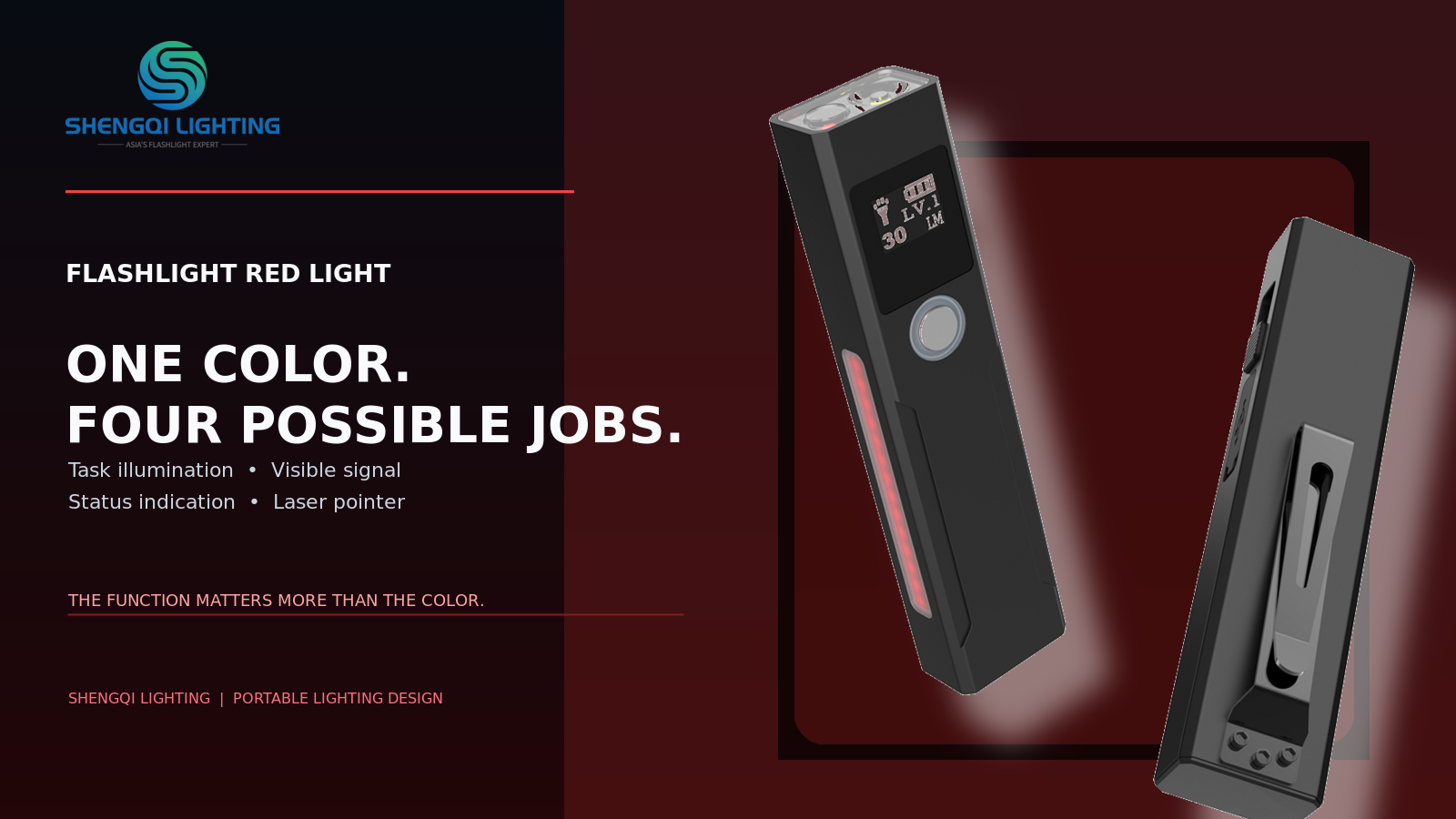
Why do flashlights have a red light? In many cases, red illumination is added for controlled close-range tasks in dark surroundings, where a broad white beam could be unnecessarily disruptive. But a red light on a flashlight may also be a visible marker, a device-status indicator, or a red laser pointer. These functions are not interchangeable. Before choosing a product, first confirm what the red source is designed to do, where it is visible, and how it should work with white light.
The key distinction: A red LED can illuminate a nearby task area. A red marker helps others notice the light source. A red status indicator communicates a product condition. A red laser points to a location. Seeing a red glow does not prove which of these jobs the product can perform.
Why Is Red Illumination Added to a Flashlight?
A red LED can provide a limited amount of light for a local task in a dark environment. Typical examples include finding an item inside a bag, checking the position of nearby equipment, reading a short note, or locating a control without lighting the entire surrounding area with a bright white beam. The purpose is not that red light is always better. The purpose is controlled illumination for a defined task.
Low output, a manageable illuminated area and sensible beam direction all matter. A red light aimed directly into another person’s field of view can still be distracting. A red channel that is much brighter than the task requires can also work against the reason it was added. The National Park Service notes that dim red light can be useful for dark-environment observation, while bright red light may still interfere with that observation. Read the National Park Service discussion of red light and dark adaptation.
Red illumination is therefore a task choice, not a universal night-use solution. When the red channel is unnecessary, turning it off is more useful than adding extra modes simply to enlarge a feature list. For detailed astronomy-specific selection, including beam control and low-output considerations, see our related guide to red-light flashlight design for astronomy.
Red Looks Similar, but the Functions Are Different
The same product may contain more than one red-emitting component. A buyer should separate the user’s intended result from the color that happens to be visible. The following comparison helps prevent a red source from being assigned a job it was not designed to perform.
| Red-light function | What the user needs | What to verify | What it does not establish |
|---|---|---|---|
| Red task illumination | See a local target or nearby work area. | Usable illuminated area, output control and task readability. | Complete preservation of dark adaptation or suitability for every color-identification task. |
| Visible marker or attention signal | Be noticed from an expected direction. | Source orientation, obstruction, viewing angle and the defined operating mode. | Road compliance, rescue qualification or a guaranteed detection distance. |
| Device status indicator | Understand the current device state. | The model-specific status definition, location and display behavior. | That red always means low battery, a fault or active charging. |
| Red laser pointer | Point to a specific location or direction. | Official specifications, product labeling, instructions and applicable restrictions. | Red area-lighting capability or an unverified safety classification. |
Lighting a Surface and Being Seen Are Different Jobs
Task illumination is judged at the target: can the user see the object, shape, label or nearby control that matters? A visible marker is judged from the observer’s direction: can another person see the source itself? A flashlight can perform one of these jobs well and the other poorly, depending on the location and direction of its red source.
For example, a front-facing red LED may be useful when the user points the flashlight toward a nearby object. The same source may be difficult for someone standing to the side to see. A side-facing indicator may remain visible when a light is clipped to a bag or tool, but may provide little useful light on a work surface. Hands, clothing, pocket clips and mounting positions can further block a source that looked clear during a product demonstration.
This is why a red flashing mode should never be treated as automatically equivalent to a regulated warning device. Without product-specific evidence, a flashlight’s red flash does not establish vehicle-light compliance, rescue-device qualification or a required safety function.
A Red Status Indicator Must Be Read by the Model Manual
A small red status LED can be separate from the flashlight’s red illumination channel. It may be associated with charging, battery level or another operating condition, but the meaning belongs to that specific model’s documentation. A steady red display, slow flash and rapid flash do not have one shared interpretation across all flashlights.
When a user sees a red indicator, the practical check is simple: identify which window or light source is active, note whether the product is connected to power, note whether the signal is steady or flashing, and compare the observation with the model’s official explanation. This prevents the user from treating a charging indicator as a work-light mode, or assuming that any red flash means low battery or fault.
A Red Laser Is Not a Red LED Work Light
A red LED can illuminate an area. A red laser is designed to indicate a point or direction. A visible red dot may help a user reference a location, but it cannot replace the broad usable light needed to find an item, inspect a nearby surface or read simple information.
Do not identify a light source from a red dot in a photograph, an exterior color or a product name alone. Check the formal specification and product labeling. The U.S. Food and Drug Administration explains that laser light is emitted in a concentrated beam and should be used according to the product’s instructions and safety labeling. Read the FDA’s general laser safety information.
A laser should not be directed toward eyes, people, vehicles or aircraft. This is a basic use limitation. It is not a claim about the classification, output, safety rating or regulatory status of any individual flashlight product.
When Red Light Makes the Task Harder
Seeing an object under red light does not mean a user can accurately identify its original color. A colored map, color-coded card, wiring label or different-colored items in a bag can lose useful contrast when the task is illuminated mainly by red light.
Increasing red output is not automatically the answer. The Federal Aviation Administration uses chart reading as an example of how red lighting can distort color recognition. This is a visual limitation from an aviation context, not a statement that a portable flashlight is aviation-approved or suitable for flight use. Read the FAA discussion of dim-light vision and color distortion.
If reliable color identification is part of the task, the product should retain a suitable white-light option and that option should be evaluated on the actual target. A buyer should not assume that every white mode has the same color-rendering quality, and should not assume that every red mode is appropriate for color-coded materials.
The Same Portable-Light Platform Can Use “Red” for Different Jobs
Published SHENGQI LIGHTING product configurations show why buyers should read each feature description carefully. The P100-R is listed with an independent red LED. The P100-RL is listed with a red laser. The OF03 lists red light alongside RGB status indication.
These published differences describe separate feature directions. They do not establish the output of a red channel, an exact control sequence, a red-channel flashing mode, laser class, runtime, application compliance or success in a specific use case. A published white-light maximum output also cannot be transferred to a red source unless that output is specifically stated for the red channel.
This is where practical technology becomes visible in product design: the source type, source placement, optical direction and electronic controls should communicate a clear job to the user instead of making several red functions appear interchangeable.
How to Turn “We Need Red Light” Into a Useful Requirement
Example requirement
“We need a red illumination channel for a local, close-range task while retaining a white-light option for color identification. Device-status indication must be clearly distinguished from the lighting function.”
This example gives a supplier a direction, but it does not yet define the complete product. The request still needs to identify the target object, operating environment, intended beam direction, normal viewing direction, acceptable control method and the result that must be confirmed on a sample.
A simple sample review can follow these steps:
- Confirm whether the source is a red LED, red status indicator or red laser according to the applicable documentation.
- Check the light on the actual target or from the actual viewing direction.
- Confirm whether task illumination, visible indication and device status are easy for the user to distinguish.
- Record unknowns that still need specifications, instructions or further evaluation.
This is a suggested evaluation method, not a completed SHENGQI LIGHTING test or a certification procedure. Clear use cases can help align industrial design, optical design and electronic design before an existing platform is selected or a new direction is discussed. Explore SHENGQI LIGHTING design and development services.
FAQ
Does every red light on a flashlight preserve night vision?
No. Red light can be useful for controlled low-light tasks, but brightness, beam direction and duration still matter. A red LED does not guarantee that a user’s dark-environment observation will be unaffected.
Does a blinking red indicator always mean low battery?
No. Indicator meanings are model-specific. Confirm the product documentation for the location, state and timing pattern of that exact indicator.
Is a red laser the same as a red LED?
No. A red LED can illuminate an area, while a red laser is intended to point to a location. Their sources, beam behavior and intended user actions are different.
Can red light make colors harder to identify?
Yes. Red illumination can change color contrast and make color-dependent information more difficult to judge. If accurate color identification matters, evaluate a suitable white-light option on the real target.
Discuss the Red-Light Function Your Product Actually Needs
Tell SHENGQI LIGHTING what needs to be illuminated or indicated, the operating environment, the direction from which the light must be seen, and how red light should work alongside white light. This creates a clearer starting point than simply requesting “a flashlight with red light.”
Email sales@shengqilight.com to discuss a suitable platform or product-development direction.